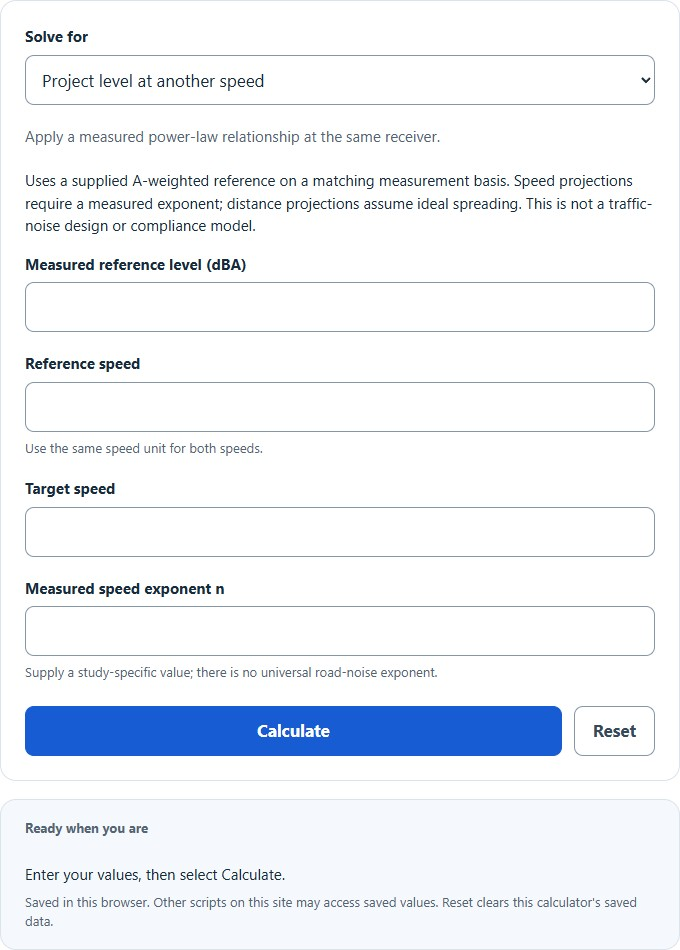
Project a measured reference sound level to another speed or distance, or combine independent simultaneous A-weighted sources. These conditional calculations are not an absolute road-noise emission model.
Related Calculators
- Tire Pressure Difference Calculator
- Balance Bead Calculator
- RPM Tire Size Calculator
- Hydroplaning Speed Calculator
- All Automotive Calculators
Road Noise Formula
The calculator uses a supplied measured reference, not a universal 75 dBA baseline. For speed, use a study-specific exponent n under unchanged vehicle mix, traffic volume, pavement and receiver conditions. For distance, choose ideal continuous-line or point-source spreading. Ratios must use matching units.
Speed: L2 = L1 + 10 n log10(v2/v1).
Distance: L2 = L1 − G log10(r2/r1).
Combined sources: Ltotal = 10 log10(Σ 10Li/10).
Variables and matching measurement basis:
- L1 and L2: reference and projected A-weighted sound levels, in dBA, with the same averaging basis.
- v1 and v2: positive speeds in the same unit; n is a supplied measured power-law exponent, not a universal constant.
- r1 and r2: positive distances in the same unit, measured from the same source reference.
- G = 10 for an ideal continuous line source; G = 20 for a compact point source.
- Li: independent simultaneous source levels with matching A-weighting and averaging intervals. Do not double-count a shared source or sum sequential time samples.
FHWA guidance describes ideal spreading losses of about 3 dB per distance doubling for a continuous line and 6 dB for a point source. Finite roads, ground, barriers, weather and background noise can change actual levels. The calculator does not apply unsupported fixed pavement, truck or ground corrections. It is not a substitute for an accepted site-specific traffic-noise assessment.
What is Road Noise?
Road noise is the sound generated by vehicles traveling on roadways. It is a type of environmental noise that can be disruptive to nearby residents and wildlife. Factors that contribute to road noise include vehicle speed, traffic volume, road surface, tire design, and the distance from the road. Understanding and calculating road noise levels can help in the design of noise barriers and other mitigation strategies.
How to Calculate Road Noise?
Use the following steps for a measured-reference projection or an energetic source sum.
- Choose speed, distance or combined-source mode and use a reference appropriate to that method.
- For speed, supply the measured reference level, both speeds in matching units and a measured exponent n.
- For distance, supply the reference level, both distances from the same source reference and the line or point geometry.
- For combined sources, enter independent simultaneous dBA levels on the same averaging basis, separated by commas.
- Calculate and inspect the formula details. Check model assumptions before using the result; these calculations do not establish indoor levels, safety or regulatory compliance.
Example Problem:
For a continuous line, a measured 68 dBA at 10 m projects to 61.98 dBA at 40 m under ideal spreading: 68 − 10 log10(40/10). A compact point source would instead give 55.96 dBA.
A separate empirical speed example uses 68 dBA at 60 km/h and a supplied n = 3. At 75 km/h the conditional projection is 70.91 dBA. The value n = 3 is illustrative, not a recommended road-noise default.
Two independent simultaneous 70 dBA sources combine to 73.01 dBA, not 140 dBA or their 70 dBA arithmetic mean. Sequential measurements require an appropriate time-weighted calculation.