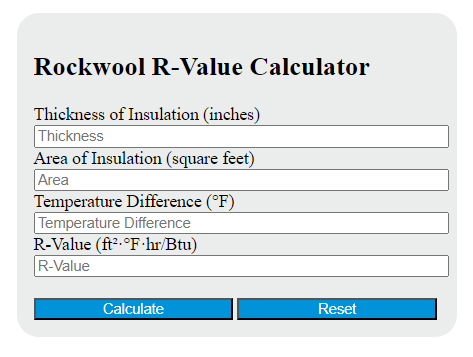
Calculate mineral-wool R-value from thickness, R per inch, or thermal conductivity, or solve target thickness with RSI, U-factor, heat flow, and rounding.
Related Calculators
- Thermal Resistance Calculator
- Heat Loss R-Value Calculator
- U-Value of Ground Floor Calculator
- Insulation Surface Temperature Calculator
- Heat Load Calculator
- House Area Calculator
- All Construction Calculators
Rockwool R-Value Formula
The following formula is commonly used to estimate the total R-value of a Rockwool/mineral wool layer when you know the product’s R-value per inch (from a datasheet or a typical value) and the installed thickness.
Variables:
- Rtotal is the total R-Value (thermal resistance) of the Rockwool layer (ft²·°F·hr/Btu, or m²·K/W)
- Rper in is the Rockwool R-value per inch (ft²·°F·hr/Btu per in), which varies by product and conditions
- t is the insulation thickness (inches)
Note: For a given material layer, the R-value depends primarily on thickness and the material’s thermal conductivity (and can vary somewhat with temperature and density). It does not depend on area or temperature difference. Area and temperature difference are used to estimate heat flow through an assembly, for example: Q = (A · ΔT) / R.
What is a Rockwool R-Value?
The R-value of Rockwool (mineral wool insulation) describes its resistance to heat flow. A higher R-value means better insulation performance (less heat flow for the same area and temperature difference). For Rockwool products, R-value is typically reported for a specific thickness, and it generally increases roughly in proportion to thickness.
How to Calculate Rockwool R-Value?
The following steps outline how to estimate the Rockwool total R-value, and (optionally) estimate heat flow using that R-value:
- Find the Rockwool/mineral wool product’s R-value per inch (Rper in) from the manufacturer’s datasheet, or use a typical value as an estimate.
- Measure the installed insulation thickness (t) in inches (convert units if needed).
- Calculate total R-value: Rtotal = Rper in · t.
- If you want to estimate heat flow, determine the insulated area (A) and the temperature difference across it (ΔT).
- Compute heat flow using Q = (A · ΔT) / Rtotal (units must be consistent).
Example Problem:
Use the following variables as an example problem to test your knowledge:
Rockwool thickness (t) = 2 inches
Rockwool R-value per inch (Rper in) = 4.2 (ft²·°F·hr/Btu per in) (example typical value)
Area (A) = 100 square feet
Temperature difference (ΔT) = 20 °F
Total R-value: Rtotal = 4.2 × 2 = 8.4 ft²·°F·hr/Btu.
Estimated heat flow: Q = (100 × 20) / 8.4 ≈ 238 Btu/hr (≈ 69.8 W).