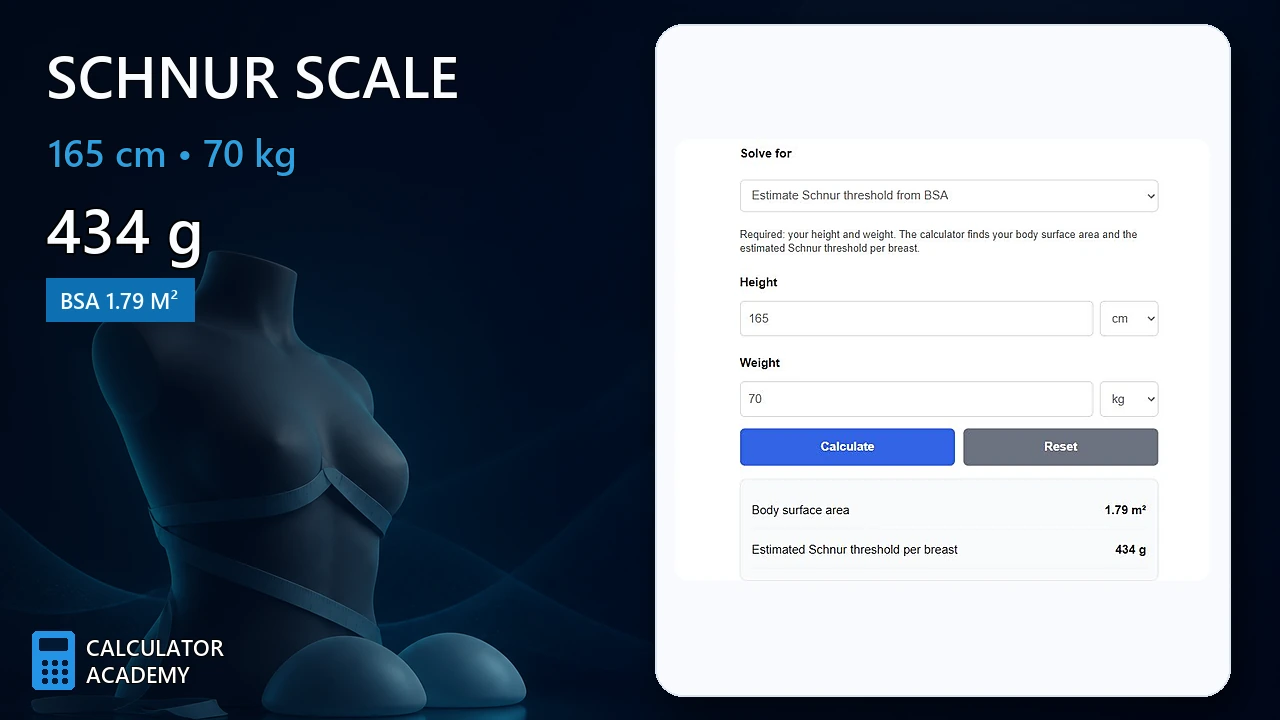
Calculate the Schnur scale minimum resection threshold per breast from body surface area or height and weight, in grams and ounces.
Schnur Scale Formula
The Schnur Sliding Scale is a guideline table, not a single fixed equation. The usual process is to calculate body surface area (BSA), find the corresponding 22nd-percentile resection weight from the Schnur table, and then compare that threshold to the planned tissue removal per breast.
If the entered BSA falls between two published Schnur table values, an estimate can be made by linear interpolation.
Variable Definitions
- BSA = body surface area, usually expressed in square meters (m²)
- Hcm = height in centimeters
- Wkg = body weight in kilograms
- Wplanned = planned resection weight in grams per breast
- Wmin = minimum Schnur threshold at the selected percentile, commonly the 22nd percentile
What the Schnur Scale Measures
The Schnur Scale is used in breast reduction planning to relate patient body size to an expected minimum tissue resection amount. Larger body surface area generally corresponds to a higher threshold, while smaller body surface area corresponds to a lower threshold. The result does not diagnose medical necessity by itself; it is simply a size-based benchmark often used during documentation and coverage review.
How to Use Each Mode
- Enter the patient’s height and weight so the calculator can estimate BSA.
- Use Estimate Schnur threshold from BSA to view the interpolated table threshold per breast.
- Use Compare planned removal with Schnur threshold to add a planned resection weight per breast and compare it with that threshold.
- Interpret both values on the same basis: per breast, not combined bilateral total.
How to Interpret the Result
| Comparison | Interpretation |
|---|---|
| Planned resection is below the threshold | The proposed tissue removal is below the 22nd-percentile Schnur guideline for that BSA. |
| Planned resection is equal to the threshold | The proposal is right at the guideline cutoff. |
| Planned resection is above the threshold | The proposal meets or exceeds the guideline amount for that BSA. |
In many real-world reviews, the Schnur result is considered alongside symptoms, physical findings, conservative treatment history, and surgeon documentation. A threshold match alone does not guarantee approval, and a value below the threshold does not automatically rule out clinical need.
Example
Suppose a patient is 165 cm tall and weighs 70 kg. First calculate BSA:
If the Schnur table values around that BSA are 404 g at 1.75 m² and 441 g at 1.80 m², the estimated threshold is:
If the planned resection is 500 g per breast, then:
That means the planned amount is above the estimated Schnur threshold.
Common Input Mistakes
- Using total bilateral resection weight instead of weight per breast
- Confusing BSA with BMI; they are different measurements and are not interchangeable
- Mixing units, such as entering pounds when grams were intended
- Rounding too early, which can matter when the planned weight is close to the threshold
- Assuming the scale is the only decision factor in clinical or coverage review
Practical Notes
- The standard comparison is usually made in grams per breast.
- BSA is most commonly recorded in m².
- If your calculator accepts other units, it should convert them before comparison.
- Results close to the cutoff should be interpreted carefully, especially when estimates or interpolated values are involved.
- This calculator is best used as a planning and documentation aid, not as a substitute for a surgeon’s evaluation or policy-specific criteria.
Quick FAQ
Is the Schnur result for one breast or both?
The threshold is typically interpreted per breast.
Do I need height and weight every time?
Yes in this interface. It calculates BSA from height and weight before estimating the Schnur threshold.
Why does the calculator use a table instead of a simple formula?
The Schnur Sliding Scale was published as a body-size-to-resection guideline table, so the threshold comes from the table values rather than from one standalone equation.