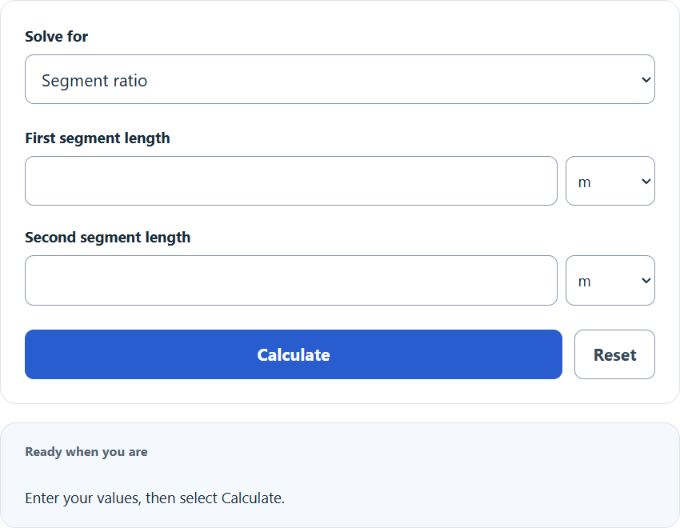
Choose the segment ratio or missing length to calculate, then enter the two known values. Lengths can use meters, centimeters, millimeters, kilometers, feet, or inches; the calculator converts them to a common unit.
Related Calculators
- Distance Between Points Calculator
- Average Slope Calculator
- Dilation Rule Calculator
- Simplify Fraction Calculator
- All Math and Numbers Calculators
Segment Ratio Formula
A segment ratio compares the length of one line segment to the length of another. It answers a simple question: how large is the first segment relative to the second? This makes the calculator useful in geometry, drafting, scaling, and any problem where two lengths must be compared proportionally.
- SR = segment ratio
- L1 = length of the first segment
- L2 = length of the second segment
The segment ratio is a unitless value. As long as both lengths are expressed in the same unit before dividing, the units cancel out.
Rearranged Forms
If you know the ratio and one segment length, you can solve for the other missing value.
These forms are helpful when the calculator is used to find a missing segment rather than the ratio itself.
How to Calculate Segment Ratio
- Measure the first segment and record it as L1.
- Measure the second segment and record it as L2.
- Convert both values to the same unit if needed.
- Divide the first length by the second length.
- Interpret the result based on whether the ratio is equal to, greater than, or less than 1.
How to Interpret the Result
- SR = 1: both segments are the same length.
- SR > 1: the first segment is longer than the second.
- 0 < SR < 1: the first segment is shorter than the second.
- SR = 0: the first segment has zero length, a degenerate case.
- SR cannot be calculated when L2 = 0: division by zero is undefined. Lengths cannot be negative; solving L2 requires positive L1 and SR.
The order matters. Comparing the first segment to the second is not the same as comparing the second to the first.
Example 1
If the first segment is 8 units and the second segment is 5 units, the ratio is:
This means the first segment is 1.6 times the length of the second segment.
Example 2
If the first segment is 18 cm and the second segment is 12 cm, then:
This shows the first segment is 50% longer than the second, and the same comparison can be described in simplest whole-number form as three to two.
Common Ratio Notation
A segment comparison may be written as a ratio statement or as a decimal value. Both represent the same proportional relationship.
For calculation, the fractional form is usually the most convenient because it directly converts to a decimal.
Useful Properties of Segment Ratios
- If both segment lengths are multiplied by the same nonzero number, the ratio stays the same.
- Ratios are best compared after simplifying or converting to decimal form.
- A ratio does not tell you the exact lengths by itself; it only describes their proportional relationship.
This property is why similar geometric figures preserve side ratios even when their actual sizes change.
Geometry Applications
Segment ratios appear often in geometry problems involving:
- comparing two sides or parts of a figure
- checking whether segments are proportional
- working with similar triangles
- dividing a segment into parts
- scaling drawings, maps, and models
If the segment lengths are not given directly but their endpoints are known on a coordinate plane, you can first compute each length with the distance formula and then apply the segment ratio formula.
Common Mistakes
- Mixing units: divide only after both lengths use the same unit.
- Reversing the order: L1 / L2 is different from L2 / L1.
- Using zero for the second segment: the ratio is undefined when the denominator is zero.
- Confusing ratio with difference: a ratio compares by division, not subtraction.
Why This Calculator Is Helpful
This calculator quickly evaluates the proportional relationship between two segments and can also solve for a missing segment when the ratio and one known length are provided. That makes it useful for fast geometry checks, classroom problems, design scaling, and any situation where comparing lengths accurately matters.