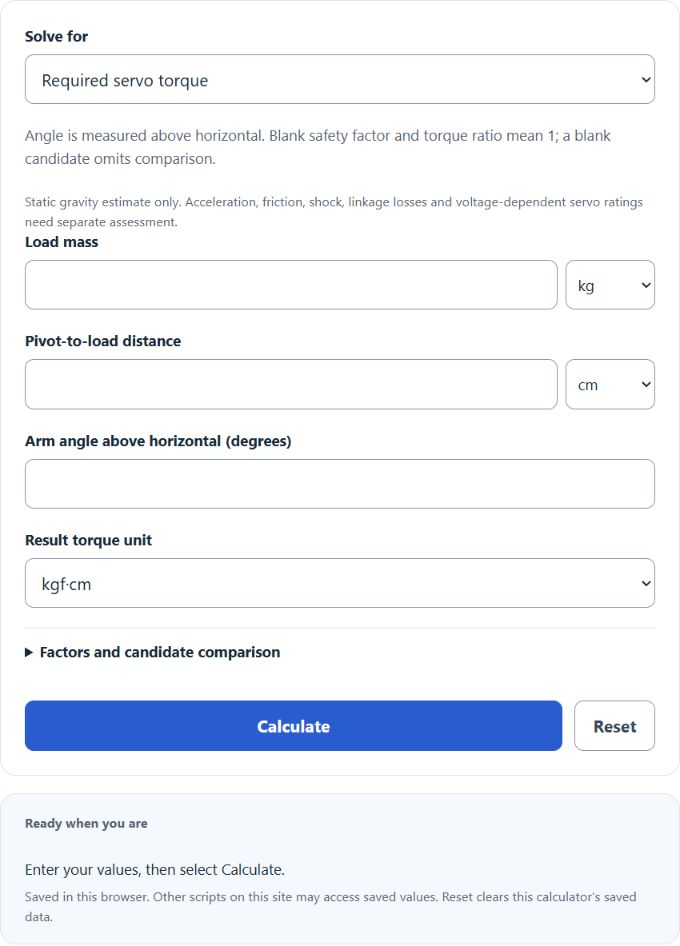
Calculate servo torque from load, arm length, angle, safety factor, and linkage ratio, or reverse-solve maximum load and arm with common servo units.
- All Physics Calculators
- All Torque Calculators
- Stepper Motor Torque Calculator
- Stall Torque Calculator
- Torque Loss Calculator
Servo Torque Formula
The calculator above estimates static gravity torque: required servo torque = m × 9.80665 × r × cos(θ) × safety factor × servo/load torque ratio. Here θ is the arm angle above horizontal, so 0° gives the maximum gravity moment and 90° gives zero. The ratio means required servo torque divided by load torque, before the safety factor; it is 1 for direct drive. A blank safety factor or ratio means 1, adding no safety allowance.
It can also solve load mass or arm distance for available torque. At a vertical arm or zero inverse denominator it cannot identify a finite unique limit. This model excludes acceleration, friction, shock and unmodeled linkage losses. A candidate comparison is not a continuous-duty or safe-selection certification.
The separate dynamic direct-drive relation below is background, not an input mode of the widget. It combines inertia and gravity when the signs of both contributions act in the stated required direction; actual dynamics can require a signed torque balance and additional loads. Its angle φ is measured from vertical, unlike the widget’s angle above horizontal. See OpenStax’s torque definition. Torque-unit conversions follow NIST SI conversion guidance.
- Where Tservo is the Servo Torque (N·m)
- I is the moment of inertia about the servo axis (kg·m²)
- α is the angular acceleration (rad/s²)
- m is the mass (kg)
- g is the acceleration due to gravity (9.81 m/s²)
- r is the lever arm radius (m)
- φ is the angle from vertical (gravity direction): φ = 0° gives zero gravity torque; φ = 90° gives maximum gravity torque
How to Calculate Servo Torque?
The following worked examples illustrate the dynamic direct-drive formula, with no separate safety or linkage factor. They use g ≈ 9.81 m/s² and are not calculator test cases because the widget models static gravity only. For a widget example, 2 kg at 10 cm, 0° above horizontal, safety factor 1.5 and ratio 1 requires 2 × 9.80665 × 0.10 × 1.5 = 2.941995 N·m = 30 kgf·cm. A 40 kgf·cm candidate is about 33.3333% above this static requirement.
Example Problem #1
- First, determine the moment of inertia (kg·m²). In this example, the moment of inertia (kg·m²) is determined to be 5.
- Next, determine the angular acceleration (rad/s²). For this problem, the angular acceleration (rad/s²) is measured to be 12.
- Next, determine the mass (kg). In this case, the mass (kg) is found to be 4.
- Next, determine the radius. For this problem, this is 5 m, and assume the arm is horizontal so φ = 90° (maximum gravity torque).
- Finally, calculate the Servo Torque using the formula above:
Tservo = I*α + m * g * r * sin(φ)
Inserting the values from above and solving yields:
Tservo = 5*12 + 4 * 9.81 * 5 * sin(90°) = 256.2 (N·m)
Example Problem #2
Using the same method as above, determine the variables required by the formula. For this example problem, these are:
moment of inertia (kg·m²) = 89
angular acceleration (rad/s²) = 4
mass (kg) = 58
radius (m) = 2.5
Assume the arm is horizontal so φ = 90° (maximum gravity torque). Entering these given values yields:
Tservo = 89*4 + 58 * 9.81 * 2.5 * sin(90°) = 1778.45 (N·m)