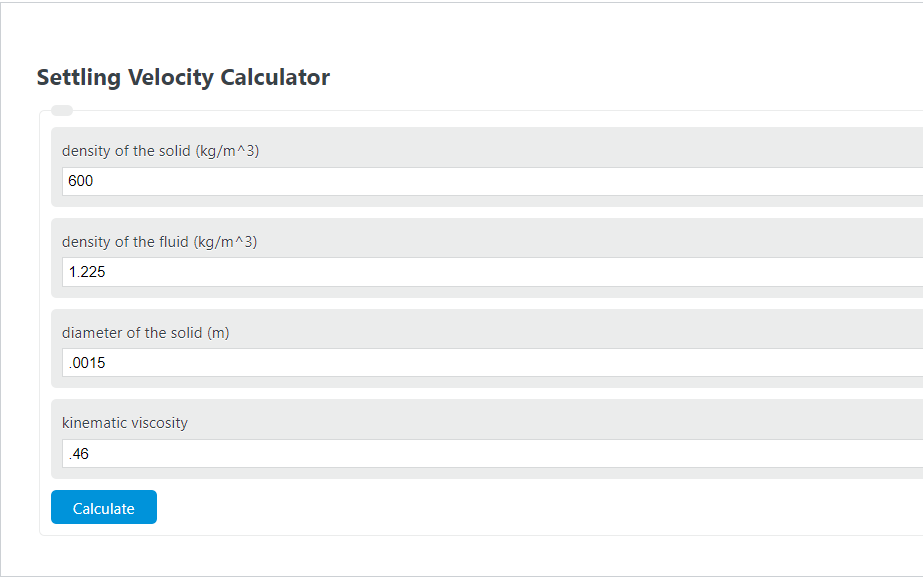
Calculate Stokes settling velocity, reverse-size particle diameter, or estimate settling time with unit conversion and Reynolds-regime checks.
Settling Velocity Formula
The settling velocity is the estimated downward speed of a particle moving through a fluid when gravity is balanced by viscous resistance. This calculator uses the Stokes-law form shown below.
| Symbol | Meaning | Typical SI Unit | Role in the Calculation |
|---|---|---|---|
| Vs | Settling velocity | m/s | Calculated output |
| ρs | Density of the solid particle | kg/m³ | Higher values increase settling speed |
| ρf | Density of the fluid | kg/m³ | Higher values reduce the density contrast |
| d | Particle diameter | m | Strongest input effect because diameter is squared |
| ν | Kinematic viscosity | m²/s | Higher viscosity slows settling |
| g | Gravitational acceleration | m/s² | Usually taken as 9.81 m/s² |
Because d is squared, small diameter changes can produce large differences in the final answer.
How to Calculate Settling Velocity
- Enter the density of the solid particle.
- Enter the density of the surrounding fluid.
- Enter the particle diameter, not the radius.
- Enter the fluid’s kinematic viscosity.
- Calculate the settling velocity and confirm the result is physically reasonable.
Unit note: if you only know the fluid’s dynamic viscosity, convert it to kinematic viscosity first.
| Input Change | Effect on Settling Velocity |
|---|---|
| Larger diameter | Increases strongly; doubling the diameter makes the settling velocity about 4 times larger. |
| Higher solid density | Increases settling speed. |
| Higher fluid density | Decreases the relative density difference and slows settling. |
| Higher viscosity | Decreases settling speed. |
When This Estimate Is Most Reliable
| Condition | Why It Matters |
|---|---|
| Small, nearly spherical particles | The Stokes form is derived for spherical-particle settling behavior. |
| Very low Reynolds number settling | Accuracy is best in the Stokes or creeping-flow range. |
| Particle Reynolds number less than about 1 | This is the usual range where the Stokes-law settling expression is most dependable. |
| Relatively calm fluid | Strong turbulence can change actual settling behavior and particle paths. |
If the calculated speed is large, use the result as a first estimate and verify that Stokes settling assumptions still make sense for your case.
Common Input Mistakes
- Using radius instead of diameter.
- Entering dynamic viscosity when the calculator expects kinematic viscosity.
- Mixing units while checking the math by hand.
- Using bulk material density instead of the actual particle density.
- Applying the equation to particles that are too large for Stokes settling.
Interpreting the Result
| Result | What It Means |
|---|---|
| Positive value | The particle tends to settle downward through the fluid. |
| Near zero | Settling is very slow, so particles may remain suspended longer. |
| Negative value | The particle is less dense than the fluid and will tend to rise rather than settle. |
| Unexpectedly large value | Recheck diameter and viscosity units first, then confirm the Stokes approximation is appropriate. |
Example
For a particle with ρs = 2650 kg/m³, ρf = 1000 kg/m³, d = 0.0002 m, and ν = 1.0 × 10⁻⁶ m²/s:
That is approximately 3.6 cm/s downward.