Calculate solvency ratio from net income, depreciation, and liabilities, plus debt-to-assets and interest coverage ratios with interpretations.
Solvency Ratio Formula
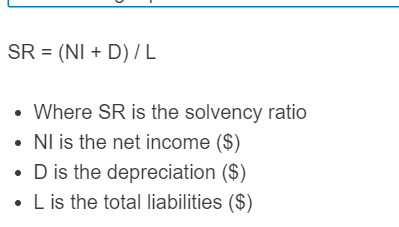
The following equation can be used to calculate the solvency ratio.
- Where SR is the solvency ratio
- NI is the net income ($)
- D is the depreciation ($)
- L is the total liabilities ($)
To calculate a solvency ratio, add the net income and depreciation together, then divide by the total liabilities.
Solvency Ratio Definition
The solvency ratio used here is net income plus depreciation divided by total liabilities. It is a screening proxy, not a direct measure of cash flow or an insurance regulatory solvency ratio.
Solvency Ratio Example
How to calculate a solvency ratio?
- First, determine the net income.
Calculate the total net income of the company.
- Next, determine the depreciation.
Calculate the value of the depreciation of the assets of the company.
- Next, determine the total liabilities.
Calculate the value of all liabilities of the business.
- Finally, calculate the solvency ratio.
Use the equation above to calculate the solvency ratio.
FAQ
This solvency ratio compares net income plus depreciation with total liabilities. A higher value means more of this earnings proxy per dollar of liabilities, but debt-paying capacity also depends on cash flow, debt terms and industry context.
Add net income and depreciation for a consistent reporting period, then divide by total liabilities. Interpret the result alongside industry benchmarks and other financial measures; no single threshold guarantees solvency.