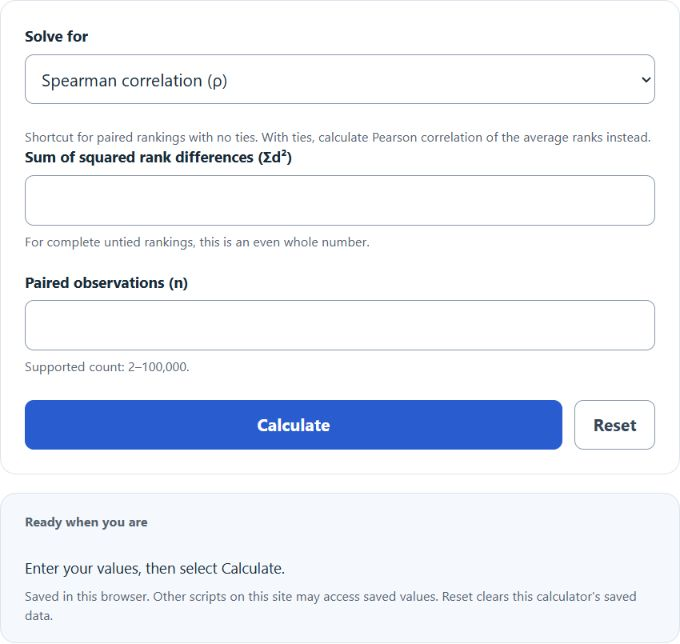
Select Spearman correlation, sum of squared rank differences or observation count. Enter the two displayed known values for complete paired rankings with no ties; inverse solves need unrounded inputs.
Related Calculators
- Inter-Rater Reliability Calculator
- Coefficient Of Dispersion Calculator
- Critical Difference Calculator
- HSD (Honestly Significant Difference) Calculator
- All Statistics Calculators
- Kendall Tau Rank Correlation Calculator
Spearman Rank Correlation Formula
Spearman’s rank correlation coefficient measures the strength and direction of a monotonic relationship between two variables after the data is converted to ranks. It is useful when your data is ordinal, when the relationship is not perfectly linear, or when outliers make a standard linear correlation less informative.
In this equation, ρ is Spearman’s rho, d is the difference between the two ranks for each paired observation, Σd² is the sum of all squared rank differences, and n is the number of paired observations. This shortcut form is intended for datasets with no tied ranks.
Variable Definitions
| Symbol | Meaning | What it Represents |
|---|---|---|
| ρ | Spearman rank correlation | The final correlation value, ranging from -1 to 1 |
| d | Rank difference | The difference between the rank of one observation in variable X and its rank in variable Y |
| Σd² | Sum of squared rank differences | The total of all squared rank differences across the dataset |
| n | Number of observations | The count of paired values being compared |
How to Use the Calculator
- Determine the rank of each value in the first variable.
- Determine the rank of each corresponding value in the second variable.
- Subtract the ranks for each pair to find the rank difference.
- Square each difference and add them together to get the sum of squared rank differences.
- Select Spearman correlation, then enter the sum of squared rank differences and the number of observations. For inverse solves, select the desired quantity and enter the displayed known values.
- The calculator returns Spearman’s rho, which tells you how closely the ranked variables move together.
Rearranged Formula
If you already know the unrounded correlation and the number of observations, you can solve for the sum of squared rank differences. Complete untied rankings require an even whole sum. The observation-count inverse solves n³ − n = 6Σd²/(1 − ρ), accepting an integer n from 2 to 100,000 within 1e-10 in ρ. When ρ = 1 and Σd² = 0, n is not uniquely determined.
Example
Suppose five observations are ranked in two different ways:
| Observation | Rank X | Rank Y | d | d² |
|---|---|---|---|---|
| A | 1 | 1 | 0 | 0 |
| B | 2 | 3 | -1 | 1 |
| C | 3 | 2 | 1 | 1 |
| D | 4 | 4 | 0 | 0 |
| E | 5 | 5 | 0 | 0 |
A result of 0.90 indicates a very strong positive association between the two ranked variables. As one rank increases, the other rank usually increases as well.
How to Interpret Spearman’s Rho
| ρ Value | Interpretation | Practical Meaning |
|---|---|---|
| 1.00 | Perfect positive relationship | The rankings match exactly |
| 0.70 to 0.99 | Strong positive relationship | Higher ranks in one variable usually align with higher ranks in the other |
| 0.30 to 0.69 | Moderate positive relationship | There is a noticeable upward rank association |
| -0.29 to 0.29 | Weak or little relationship | The ranked variables show little consistent pattern |
| -0.69 to -0.30 | Moderate negative relationship | Higher ranks in one variable often align with lower ranks in the other |
| -0.99 to -0.70 | Strong negative relationship | The variables tend to move in opposite ranked order |
| -1.00 | Perfect negative relationship | One ranking is the exact reverse of the other |
These ranges are best treated as general guidelines. The meaning of a correlation depends on the field, sample size, and how noisy the underlying data is.
When Spearman Correlation Is the Better Choice
- You are comparing ordinal data such as survey scales, ratings, or competition placements.
- The relationship is monotonic but not necessarily linear.
- Your dataset contains outliers that would distort a linear correlation.
- The data is skewed or does not follow a normal distribution.
- You care more about relative order than the exact spacing between values.
Important Notes
- Spearman correlation measures association, not causation.
- Each X value must be paired with the correct Y value from the same observation.
- The shortcut formula shown above is exact when there are no tied ranks. If ties exist, a full Spearman calculation using ranked data is preferred.
- Very small sample sizes can produce unstable correlation values, so interpretation should always include context.
- A value near zero does not always mean “no relationship”; it means there is little evidence of a consistent monotonic ranking pattern.