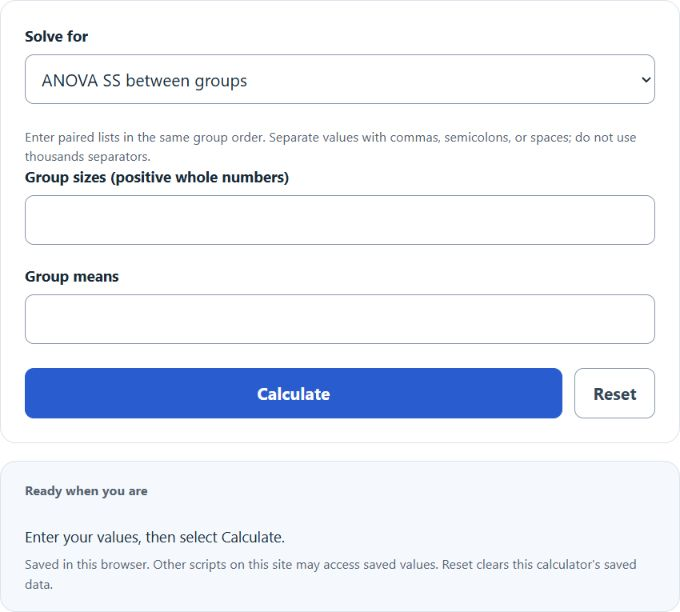
Calculate ANOVA sum of squares between groups (SSB) from paired group sizes and means using the weighted grand mean. A separate supplied-mean mode preserves reference-centered squared deviations and labels them distinctly.
Related Calculators
- Welch’s T Test Calculator
- T Statistic Calculator (T-Value)
- Weighted Mean Calculator
- Cochran’s Sample Size Calculator
- All Statistics Calculators
SS Between Formula
SS Between, also called the sum of squares between groups, measures how far each group mean is from the grand mean after weighting each group by its size. In one-way ANOVA, this is the part of total variability explained by differences between groups.
For ANOVA, the grand mean is the weighted mean of the group means. A different supplied reference produces a different squared-deviation total and must not be substituted for ANOVA SSB.
What each term means
- SSB
- Sum of squares between groups.
- ni
- Size of group i, or the number of observations in that group.
- Mi
- Mean of group i.
- GM
- Grand mean across all observations from all groups.
- k
- Total number of groups.
How to calculate SS Between
- List the size of each group and the mean for each group.
- Find the grand mean. If group sizes are different, use the weighted grand mean.
- For each group, subtract the grand mean from the group mean.
- Square each difference.
- Multiply each squared difference by that group’s size.
- Add all group contributions together.
Key interpretation points
- Larger SSB means the group means are more spread out around the grand mean.
- SSB is always nonnegative because squared deviations cannot be negative.
- SSB equals 0 only when every group mean is exactly the same as the grand mean.
- Group size matters because larger groups contribute more to the total between-group variation.
- The units are squared, so SSB is measured in squared units of the original variable.
Why the grand mean should usually be weighted
When group sizes are unequal, the grand mean is not the simple average of the group means. Each group mean must be weighted by its number of observations. If all groups have the same size, the weighted and unweighted grand means are the same.
Example
Suppose there are three groups with sizes 8, 10, and 6, and their means are 72, 81, and 75.
So the sum of squares between groups is 378.
How SS Between fits into ANOVA
In one-way ANOVA, total variability is split into between-group variation and within-group variation.
SS Between is then converted into a mean square by dividing by its degrees of freedom.
The ANOVA F statistic compares between-group variation to within-group variation.
This means SSB by itself does not determine statistical significance. It must be interpreted together with within-group variability.
Useful special case
If every group has the same number of observations, the formula simplifies because the common group size can be factored out.
Common input mistakes
- Entering a different number of group sizes and group means.
- Using a simple average of the group means instead of the weighted grand mean when group sizes are unequal.
- Entering raw scores instead of group means.
- Using negative or zero group sizes.
- Assuming a large SSB automatically means the ANOVA result is significant.
Tips for using the calculator
- Enter group sizes as a comma-separated list, with one size for each group.
- Enter group means in the same order as the group sizes.
- Select ANOVA SS between groups to calculate the weighted grand mean automatically.
- Select the supplied-mean mode for squared deviations about a chosen reference; the result also shows the true ANOVA SSB for comparison.
- Decimals are fine for means, but group sizes should be whole numbers.