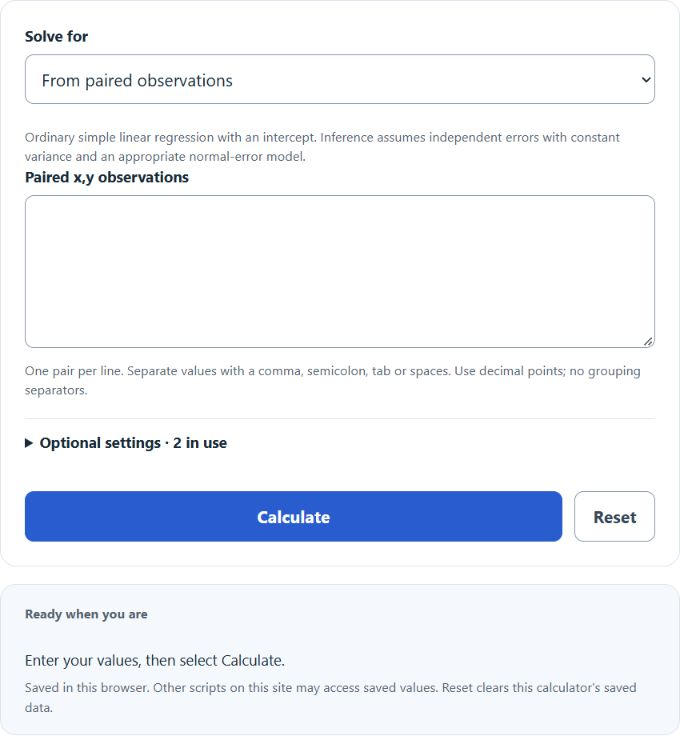
Calculate the standard error of slope from paired X,Y data or regression summary stats, with Sxx, residual error, and slope confidence intervals at 90%, 95%, or 99%.
- All Statistics Calculators
- Standard Error Of Difference Calculator
- Standard Error Of Measurement Calculator
Standard Error Of Slope Formula
The standard error of the slope measures how precisely a simple linear regression estimates the slope of the line. It tells you how much the slope would be expected to vary from sample to sample if the same underlying relationship were measured repeatedly.
Where:
- SEb = standard error of the estimated slope
- se = residual standard error, representing the typical vertical scatter around the regression line
- Sxx = total spread of the x-values around their mean
This means the standard error of the slope gets smaller when the regression line fits the data more tightly and when the x-values are spread out over a wider range.
What the Standard Error of the Slope Tells You
The result is a precision measure for the slope coefficient, not a measure of the slope’s size by itself.
- Smaller standard error: the slope estimate is more stable and more precise.
- Larger standard error: the slope estimate is less certain and more sensitive to random variation in the sample.
- Useful for inference: it is the key input for slope confidence intervals and t-tests.
- Not the same as residual error: residual standard error measures scatter around the line, while the standard error of the slope measures uncertainty in the slope coefficient.
How to Use This Calculator
From Dataset
- Paste paired observations as x,y with one pair per line.
- The calculator fits the regression line, computes residuals, finds SSE, and then calculates the slope standard error automatically.
- This option is best when you have the raw data and want the full regression-based result.
From Summary Statistics
- Choose residual standard error or residual sum of squares, then enter Sxx. Sample size is required with SSE; in residual-error mode it is optional unless a confidence interval is wanted.
- Enter the residual standard error directly, or enter SSE so the calculator can derive it.
- An optional slope estimate enables its t-statistic when SE is nonzero. Supply both sample size and slope for a Student-t confidence interval at 90%, 95%, or 99%.
Confidence Interval and Significance Testing
The standard error of the slope is what connects a slope estimate to statistical inference.
A narrow confidence interval indicates a more precise estimate of the slope. A wide interval means the data allow a broad range of plausible slope values.
Example
If the residual standard error is 15 and Sxx is 250, then the standard error of the slope is:
This result means the estimated slope has an uncertainty of about 0.949 slope units. If the estimated slope were 3.5, that uncertainty would be fairly small relative to the coefficient itself; if the estimated slope were 0.4, it would be large relative to the coefficient and would suggest a much weaker signal.
What Affects the Result
- Residual scatter: more unexplained variation increases the standard error.
- Spread of x-values: a wider x-range increases Sxx and lowers the standard error.
- Sample size: more observations usually improve precision because they help stabilize both the residual estimate and the x-value spread.
- Outliers and leverage points: unusual observations can strongly change both the slope and its standard error.
Common Interpretation Guidelines
- Use the standard error together with the slope estimate, not by itself.
- Compare the slope to its standard error when judging how strong the linear trend is.
- A slope that is several times larger than its standard error generally provides stronger evidence of a real relationship.
- A small slope with a very small standard error can still be statistically meaningful, while a large slope with a large standard error may be highly uncertain.
Assumptions Behind the Calculation
The number is most useful when the basic assumptions of simple linear regression are reasonably satisfied:
- The relationship between x and y is approximately linear.
- Observations are independent.
- The spread of residuals is roughly constant across the range of x.
- Normal errors support exact small-sample Student-t inference. Dependent or unequal-variance errors need a different variance estimator.
Common Input Mistakes
- Using x-values that are not paired correctly with y-values in dataset mode.
- Entering total variation in x without centering around the mean when computing Sxx manually.
- Confusing SSE with residual standard error.
- Forgetting that slope inference in simple linear regression uses two degrees of freedom less than the sample size.