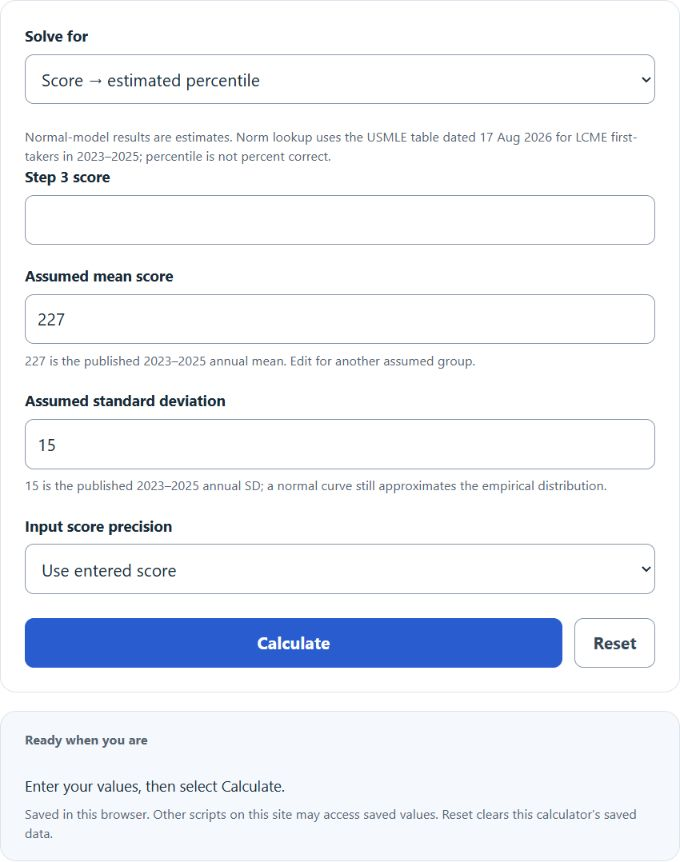
Estimate a USMLE Step 3 percentile or score under a normal model, or use the published norm lookup. These methods are distinct; percentile does not measure percent correct or establish clinical competence.
- All Statistics Calculators
- 40th Percentile Calculator
- IQ Percentile Calculator
- Salary Range Percentile Calculator
Step 3 Percentile Formula
The normal model below estimates rank from an assumed mean and standard deviation. Defaults of 227 and 15 match annual LCME first-taker statistics for 2023–2025. The separate norm lookup uses Table 2 of the USMLE guidelines dated 17 August 2026, for the 2023–2025 Step 3 cohort. It returns the published rounded rank at an anchor score, or bounds between anchors. It does not invent intermediate ranks or performance grades. The minimum passing score is 200 from 1 January 2024, verified 20 October 2026; only USMLE determines an actual pass/fail result.
This calculator estimates a Step 3 percentile rank by comparing an individual score to an assumed score distribution. It is most useful when you know, or want to assume, a mean score and standard deviation for the group being compared. The process has two parts: first convert the raw score into a standardized score, then convert that standardized score into a percentile.
In this method, the percentile is an estimated relative rank under a normal-distribution assumption. That means the output depends on the distribution values entered into the calculator.
Variable Definitions
| Variable | Meaning | What it Represents |
|---|---|---|
| S | Step 3 score | The score being evaluated |
| M | Mean score | The average score in the comparison group |
| SD | Standard deviation | How spread out the scores are around the mean |
| z | z-score | How many standard deviations the score is above or below the mean |
| P | Percentile rank | The percentage of scores estimated to fall below the given score |
How the Calculator Works
- Select score-to-percentile or percentile-to-score for the normal model; select Published norm lookup for table ranks.
- Enter the assumed mean for the comparison group.
- Enter the assumed standard deviation.
- The calculator computes the z-score to measure distance from the mean.
- That z-score is converted into a percentile rank using the standard normal cumulative distribution.
If the score is above the mean, the z-score is positive and the percentile will be above the middle of the distribution. If the score is below the mean, the z-score is negative and the percentile will be below the middle.
Example
Suppose a score is 240, the assumed mean is 228, and the assumed standard deviation is 15.
Under that assumed distribution, a score of 240 would be estimated at about the 78.8th percentile. In practical terms, that means the score is higher than roughly 78.8% of the comparison group.
How to Interpret the Percentile
A percentile is a relative standing, not a percentage of questions answered correctly. A percentile tells you where a score falls compared with other scores in the same distribution.
- 50th percentile means the score is near the center of the distribution.
- 75th percentile means the score is above about three-fourths of the group.
- 90th percentile means the score is higher than about nine out of ten scores.
- 25th percentile means the score is above about one-fourth of the group and below most of the rest.
Quick Interpretation Guide
| Percentile Range | General Interpretation |
|---|---|
| Below 10 | Far below the center of the assumed distribution |
| 10 to 25 | Below average relative position |
| 25 to 75 | Typical middle range of the distribution |
| 75 to 90 | Clearly above average relative position |
| Above 90 | High relative standing within the assumed group |
Custom Distribution vs. Quick Percentile
This calculator can be used in two practical ways:
- Custom distribution: best when you want to enter your own mean and standard deviation.
- Published norm lookup: returns dated USMLE table ranks or bounds between published score anchors.
If you have access to a specific score distribution, use the custom option because it better matches the group you actually want to compare against. If you use a generic or example distribution, the percentile should be treated as an approximation.
Why the Standard Deviation Matters
The standard deviation controls how tightly scores cluster around the mean:
- A smaller standard deviation means scores are packed more closely together, so a small change in score can move the percentile more noticeably.
- A larger standard deviation means scores are more spread out, so the same point difference may shift the percentile less.
Because of this, two identical Step 3 scores can produce different percentile estimates if they are evaluated under different assumed distributions.
Important Notes
- This method assumes the score distribution is approximately normal.
- The result is only as accurate as the mean and standard deviation entered.
- If the real score distribution is skewed or irregular, the estimate may differ from an empirical percentile table.
- A score equal to the mean will usually fall near the middle of the distribution.
Common Questions
Is percentile the same as percent correct?
No. Percent correct measures how many items were answered correctly. Percentile measures how a score ranks relative to other scores.
What does a negative z-score mean?
A negative z-score means the Step 3 score is below the assumed mean. The farther below zero it is, the lower the percentile estimate will be.
Can this calculator be used for any assumed score distribution?
Yes, as long as you have a score, a mean, and a standard deviation. Just remember that the percentile returned is tied to the distribution assumptions you provide.
When should I use this calculator?
Use it when you want a fast estimate of where a Step 3 score falls within a comparison group, especially when you are modeling performance under a known or assumed normal distribution.
Reference review: October 20, 2026. The 17 August 2026 USMLE guidelines retain the 2023–2025 Step 3 norm cohort and annual mean 227 / SD 15. Published norms are updated annually; select the current norm lookup for reported ranks and use the separate normal model only as an approximation.