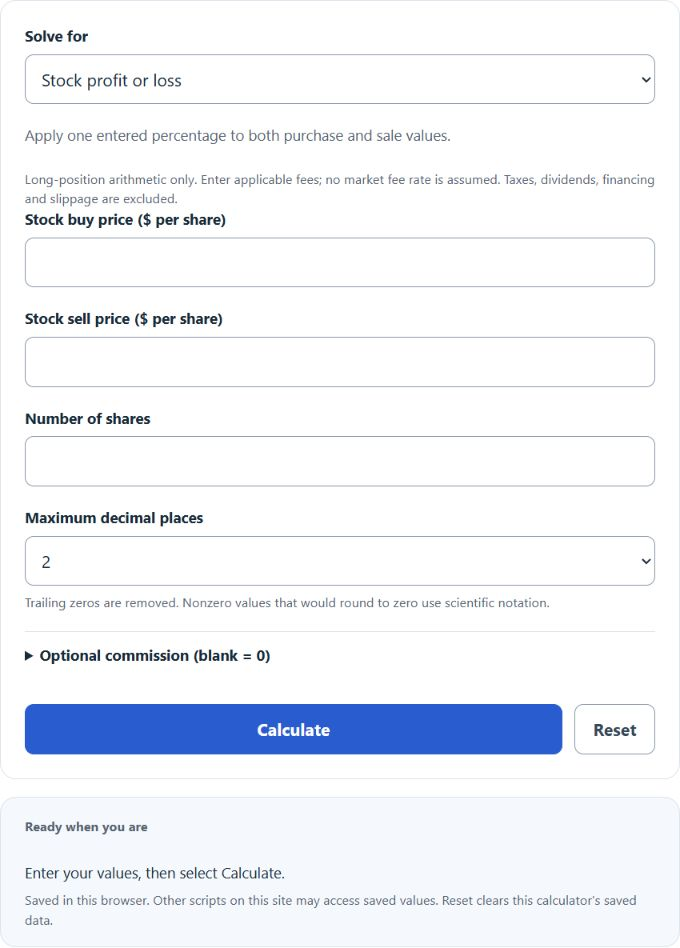
Calculate long-position stock profit or loss from buy price, sell price, fractional or whole shares and an entered commission assumption, or solve for a missing trade value. Additional solves cover day trades, planned reward/risk and commodity price-change arithmetic. No market fee rate, exchange rate or futures contract multiplier is assumed.
Stock Profit Formula
This formula models the price gain or loss on a long stock trade after the same entered percentage commission is applied to the purchase and sale values. Actual fee structures vary; check the applicable fee schedule and disclosures.
- Where S is the selling price of the stock
- N is the positive number of shares in the trade; fractional shares are supported
- c is the commission fraction on each side: entered percentage C divided by 100. A blank entered percentage means 0%; it is not a current broker rate.
- P is the purchase price of the stock
Stock Profit Definition
Here R is the modeled long-position price profit or loss: sale value minus purchase value and the entered commissions. It excludes dividends, taxes, financing and other charges, so it is not total investment return. Return on purchase value uses buy price times shares as its denominator, excluding the buy commission.
For day-trade profit and break-even, trade size means shares or price units with multiplier 1. Planned long reward/risk is (target - entry) / (entry - stop), with 0 ≤ stop < entry and target ≥ entry; stops do not guarantee fills, and this ratio excludes fees and slippage. The alternate legacy arithmetic, (exit - break-even) / (break-even - entry), is labeled reward / break-even cost and is not trade risk. Commodity currency and unit choices are labels only: price denominator and quantity unit must match, with no automatic FX or cross-unit conversion.
How to calculate stock profit?
How to calculate stock profit
- First, determine the purchase price of the stock
Use the actual purchase price per share for the long-position trade.
- Next, determine the number of shares purchased
This is as simple as using the number of shares you plan to sell or had bought previously.
- Next, enter the commission assumption
This model applies the same entered percentage to purchase and sale values. Blank means zero. Check the broker’s actual fees and disclosures.
- Determine the selling price
Check the current price of the stock you plan to sell.
- Calculate the stock profit
Enter the information from above into the formula or calculator.
FAQ
For this calculator, stock profit or loss is the long-position selling value minus purchase value and the entered commissions. It measures price gain or loss, excluding dividends, taxes, financing and other fees. It is not total investment return.
Fees vary by broker, product and service. This simplified stock model applies the same entered percentage to purchase and sale values; the commission fraction is the percentage divided by 100. Blank means zero. Consult the applicable fee schedule and disclosures; no current commission rate is assumed.
For a long position, sale proceeds must exceed purchase cost and modeled transaction fees to show a positive price-trade result. This arithmetic does not predict prices or guarantee profit. Dividends and short selling are different sources of return and are outside this model.
Sources
CME Group: risk measured from entry to an identified stop; SEC Investor.gov: investment fees, costs and disclosures.