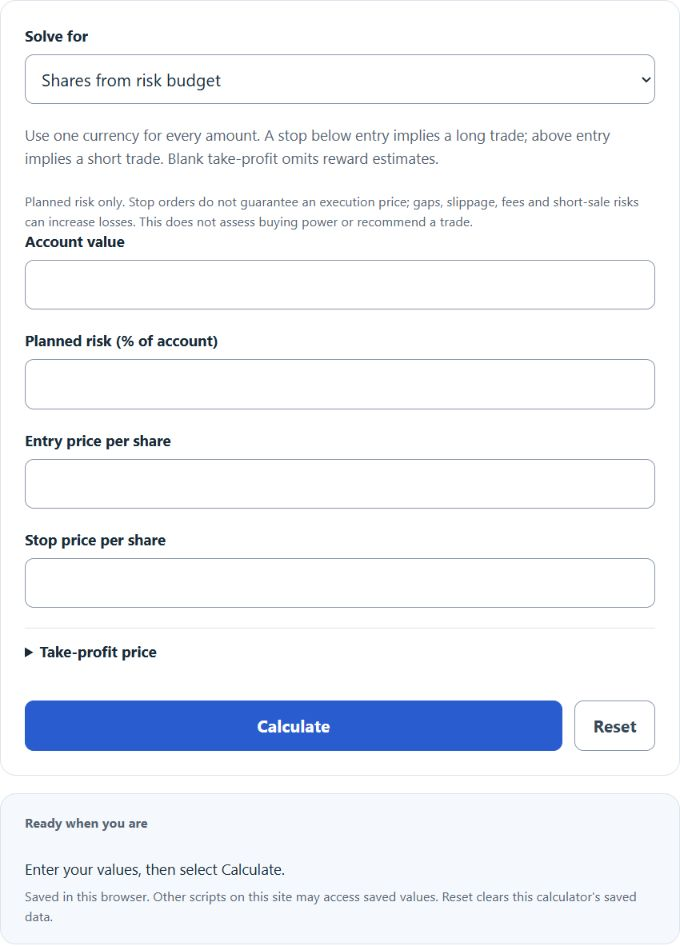
Calculate the right number of shares to trade based on your account size, risk tolerance, and stop-loss distance, plus the resulting risk amount and reward-to-risk ratio.
Stock Position Size Formula
When you solve for the number of shares, the position size is the dollar amount you are willing to risk divided by the risk per share:
Shares = floor((Account Size x Risk % / 100) / |Entry Price - Stop-Loss Price|)
When you already know the share count and want the risk it carries, rearrange to solve for the risk percentage:
Risk % = (Shares x |Entry Price - Stop-Loss Price|) / Account Size x 100
Where:
- Account Size is the total trading capital in your account.
- Risk % is the share of your account you accept losing if the stop-loss is hit.
- Entry Price is the price at which you open the position.
- Stop-Loss Price is the planned exit trigger. Actual execution may occur at a different price.
- Risk per Share is the absolute difference between the entry price and the stop-loss price.
The number of shares is rounded down so the planned price loss at the entered stop is no more than the risk budget. Gaps, slippage and costs can increase actual losses; a stop order does not guarantee an execution price.
Risk Percentage Guidelines
The following percentages are illustrative scenarios, not recommended risk limits or verified norms for each trader type. Dollar amounts use a $10,000 account.
| Trader Type | Typical Risk per Trade | Risk on $10,000 |
|---|---|---|
| Long-term / swing | 0.25% to 0.5% | $25 to $50 |
| Standard | 0.5% to 1% | $50 to $100 |
| Active day trader | 1% to 2% | $100 to $200 |
The next table shows how risk per share changes the number of shares you can hold while keeping a fixed $100 risk amount.
| Risk Amount | Risk per Share | Shares |
|---|---|---|
| $100 | $1 | 100 |
| $100 | $4 | 25 |
| $100 | $10 | 10 |
Example Problems
Example 1. Your account size is $10,000 and you risk 1% per trade. You plan to enter a stock at $185 with a stop-loss at $181.
Risk amount = $10,000 x 0.01 = $100. Risk per share = |185 – 181| = $4. Position size = $100 / $4 = 25 shares. The position value is 25 x $185 = $4,625, which is about 46.25% of the account.
Example 2. You already hold 200 shares bought at $50 with a stop-loss at $47, and your account is $20,000. Risk per share = |50 – 47| = $3. Risk amount = 200 x $3 = $600. Risk percentage = $600 / $20,000 x 100 = 3% of the account.
FAQ
What is position sizing in stock trading? Position sizing is the process of choosing how many shares to buy based on your account size and how much you are willing to lose if the trade goes against you. It ties the size of every trade to a fixed risk limit instead of a fixed dollar or share amount.
Why does the calculator round shares down? Buying more shares than the formula returns would push your loss past your chosen risk limit if the stop-loss is hit. Rounding down keeps the modeled price loss at the entered stop within the risk budget, but does not cap the actual worst-case loss.
Does the position value have to fit inside my account? Not always. The position value can exceed your cash if you use margin, but the loss at the stop-loss is what the risk percentage controls. Check that the position value is one you are comfortable holding before placing the trade.