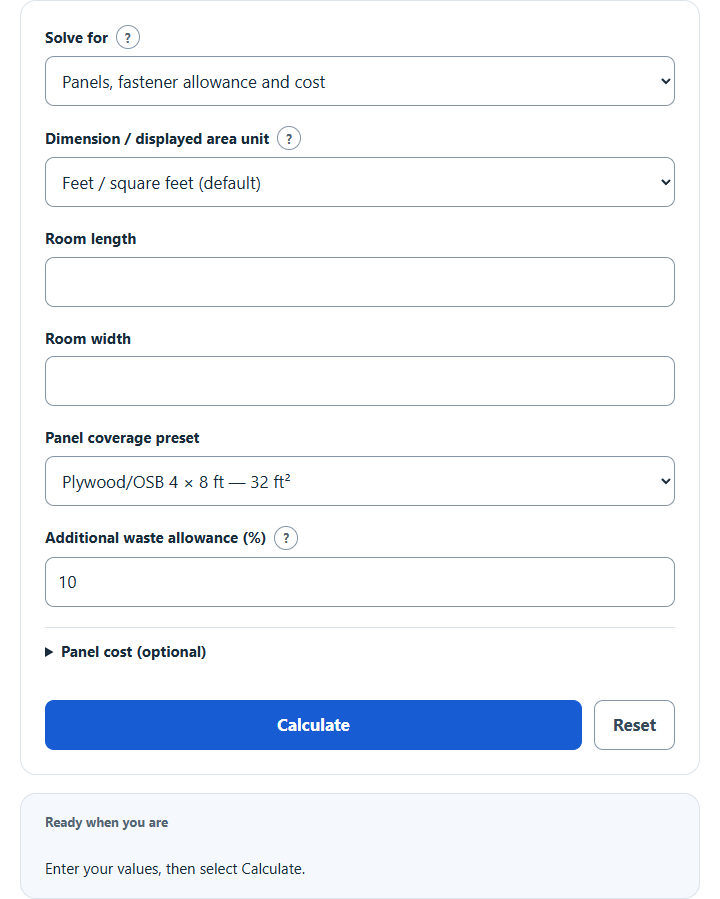
Calculate how many plywood or OSB subfloor panels you need from room length and width, including waste, square footage and an optional panel cost.
- All Construction Calculators
- Flooring Waste Calculator
- Gross Floor Area Calculator
- Carpet Area Calculator
- Self-Leveling Coverage Calculator
- Cost Per Square Foot Calculator
Calculator Functions
| Function | What it does | What it requires |
|---|---|---|
| Panels, fastener allowance and cost | Finds the whole subfloor panels to buy for a rectangular room, with a fastener allowance and a material subtotal | Requires room length and width, a panel type and a waste allowance. Cost per panel is optional |
| Room area only | Finds the floor area of a rectangular room in square feet and square meters | Requires room length and width |
| Net coverage from a panel budget | Finds how much floor a budget covers when only whole panels are bought | Requires a panel type, a waste allowance, the cost per panel and the available budget |
Dimensions are entered in feet or meters. The panel types are 4 × 8 ft plywood or OSB (32 ft²), 4 × 10 ft plywood or OSB (40 ft²), 5 × 5 ft plywood (25 ft²), 3 × 5 ft cement board (15 ft²) and modular panels counted at 3.3 ft² each. The waste allowance starts at 10%.
Subfloor Formulas
| SF | Net floor area (ft²), before waste and rounding to whole panels |
| L | Room length (ft) |
| W | Room width (ft) |
Panels, fastener allowance and cost
N is the number of panels, w is the waste allowance in percent, C is the coverage of one panel in square feet and ⌈ ⌉ means rounding up to the next whole panel. A 20 × 15 ft room is 300 ft². With 10% waste it needs 330 ft², and 330 ÷ 32 = 10.31, so 11 panels of 4 × 8 ft plywood or OSB. Those 11 panels cover 352 ft², which leaves 22 ft² beyond the waste allowance.
The fastener allowance is the panel count times a fixed number per panel: 48 for a 4 × 8 ft panel, 60 for 4 × 10 ft, 40 for 5 × 5 ft, 30 for cement board and 4 for a modular panel. For the 11 panels above that is 528 fasteners. The 4 × 8 figure sits a little above a common nailing pattern of 6 inches apart along panel ends and 12 inches apart along the joists in between [1], which comes to about 43 nails for a panel laid across joists 16 inches apart. With a cost per panel entered, the material subtotal is N × cost, so 11 panels at $30 is $330.
Room area only
The main formula applies directly. A 10 × 8 ft room is 80 ft², shown also as 7.432 m². Dimensions entered in meters are converted at exactly 0.3048 m per foot.
Net coverage from a panel budget
B is the budget, P is the cost per panel and ⌊ ⌋ means rounding down to whole panels. A $400 budget at $30 per 4 × 8 ft panel buys 13 panels with $10 left over. Those panels total 416 ft², and with a 10% waste allowance they cover a net floor area of 416 ÷ 1.1 = 378.18 ft².
Limits of This Estimate
- The result is a quantity for planning. It does not choose panel thickness or span rating and does not check joist spacing, load capacity, moisture protection or code compliance.
- The room is treated as one rectangle. L-shaped rooms, openings and offcuts that can be reused change the real count.
- The fastener counts and the 3.3 ft² modular coverage are rough allowances and not a fastening schedule. The panel maker’s instructions, the designer or the building code may call for closer spacing [1], and some modular panels need no fasteners. These estimates are based on the best available data and estimations.
- The subtotal covers panels only. Labor, delivery, tax, adhesive and the fasteners themselves are not included. Cement board is an underlayment for tile and needs a structural floor beneath it.
Sources
- LP Building Solutions, 8 Common Sub-Floor Installation Mistakes and How to Avoid Them: nail spacing of 6 inches along panel ends and 12 inches along intermediate supports, and the note that a designer or code may require closer spacing. It does not give a fastener count per panel