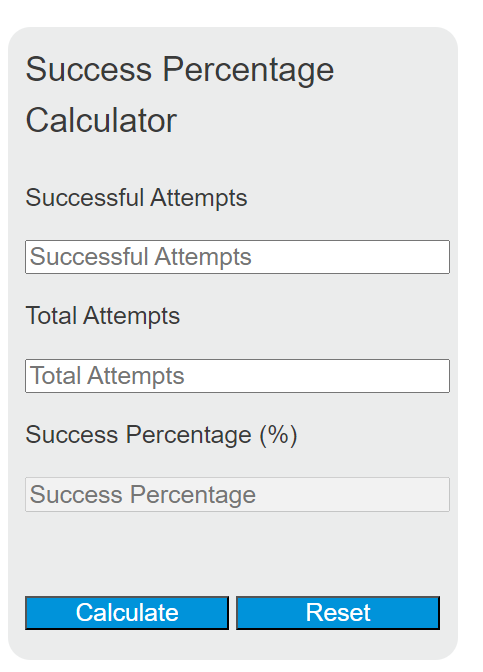
Calculate success percentage, successful attempts, or total attempts by entering any two values to find the missing result from your data.
Related Calculators
- Attainment Percentage Calculator
- Passing Score Calculator
- Match Percent Calculator
- Combined Percentage Calculator
- All Math and Numbers Calculators
Success Percentage Formula
The success percentage measures how often an attempt ends in a successful outcome. It is calculated by dividing successful attempts by total attempts and converting the result to a percentage.
| Variable | Meaning |
|---|---|
| SP | Success percentage |
| SA | Number of successful attempts |
| TA | Total number of attempts |
This calculator is useful when you know any two of the three values and want to solve for the third. That makes it helpful for performance tracking, testing, sales conversion reviews, sports analysis, production quality checks, and academic scoring situations.
Rearranged Formulas
If you need to solve for successful attempts or total attempts instead of the percentage, use these equivalent forms:
These forms are especially useful when setting targets. For example, if you want a specific success percentage and already know how many attempts were made, you can estimate how many successful outcomes are required.
How to Calculate Success Percentage
- Count the number of successful attempts.
- Count the total number of attempts.
- Divide successful attempts by total attempts.
- Multiply the result by 100 to convert it into a percentage.
For the result to make sense, total attempts should be greater than 0, and successful attempts should normally be between 0 and total attempts.
Examples
Example 1: If 75 out of 100 attempts are successful:
Example 2: If 18 out of 24 attempts are successful:
Example 3: If your target success percentage is 92% across 250 attempts, the number of successful attempts needed is:
How to Interpret the Result
- 100% means every attempt was successful.
- 50% means half of all attempts were successful.
- 0% means no attempts were successful.
A higher percentage generally indicates better performance, but context still matters. A 90% success rate across 10 attempts is less informative than a 90% success rate across 10,000 attempts because the larger sample gives a more stable view of performance.
Success Percentage vs. Failure Percentage
If you also want to know the percentage of unsuccessful attempts, first calculate failures:
Then calculate the failure percentage directly or subtract the success percentage from 100:
This is useful in quality control, customer support, sales pipelines, and sports statistics where both positive and negative outcomes are tracked.
Common Uses
- Education: quiz accuracy, test pass rates, assignment completion success
- Business: conversion rates, closed deals, customer retention actions
- Manufacturing: passed inspections, accepted parts, defect-free output
- Sports: shot accuracy, free-throw percentage, successful plays
- Operations: completed tasks, approved applications, resolved tickets
Important Notes and Edge Cases
- If TA = 0, the percentage cannot be calculated because division by zero is undefined.
- If SA > TA, the inputs are inconsistent for most real-world success-rate scenarios.
- If you enter a percentage and total attempts, the calculated number of successful attempts may need rounding to a whole number because attempts are usually counted as integers.
- When comparing success percentages, also compare the total number of attempts so the results are not misleading.
Quick Reference Table
| Task | Formula |
|---|---|
| Find success percentage | SP = (SA) / (TA) × 100 |
| Find successful attempts | SA = (SP) / (100) × TA |
| Find total attempts | TA = (SA × 100) / (SP) |
| Find failure percentage | FP = 100 - SP |
Frequently Asked Questions
Is success percentage the same as probability?
Not exactly. Success percentage usually describes observed results from actual attempts, while probability often describes the expected likelihood of success before or across repeated trials.
Can success percentage be more than 100%?
In a standard success-versus-total-attempts calculation, no. The result should normally fall between 0% and 100%.
Should I round the result?
Yes, rounding to one or two decimal places is common when the exact percentage is not a whole number.
Why does sample size matter?
A percentage based on a small number of attempts can change dramatically with one additional result, while a percentage based on a large number of attempts is usually more reliable for comparison.