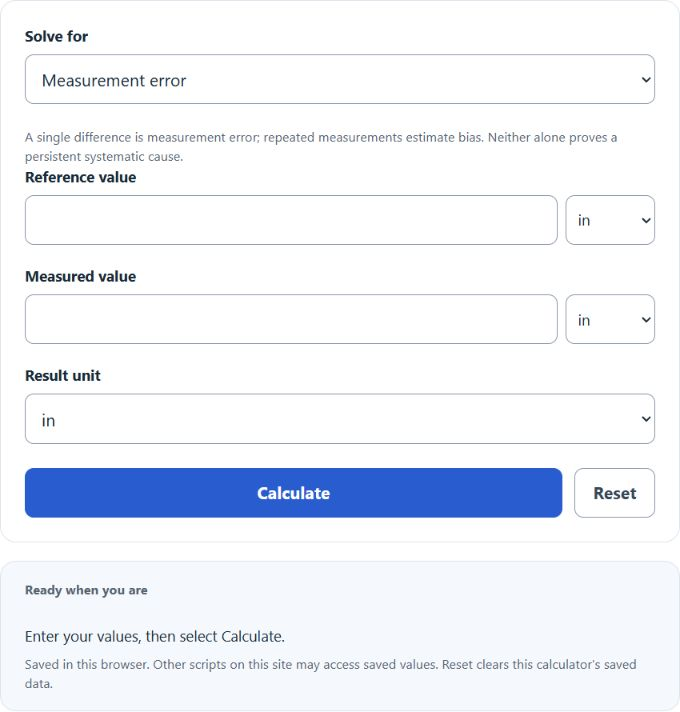
Calculate systematic error, percent error, and bias direction from true and measured values or repeated measurements in mm, cm, m, in, or ft.
Related Calculators
- Average Error Calculator
- RMS Error Calculator
- Type I Error Calculator
- T Statistic Calculator (T-Value)
- All Statistics Calculators
Systematic Error Formula
The following formula gives signed measurement error relative to a supplied reference. With repeated measurements, replace MV with their mean to estimate bias; a single difference does not establish a systematic cause.
Variables:
- SE is the signed measurement error (or estimated bias when MV is a repeat-measurement mean)
- MV is the measured value
- TV is the true value
Subtract the reference value from the measured value. The calculator also solves for either value, estimates bias from repeated measurements, and subtracts a known constant offset.
What is Systematic Error?
Systematic error is a consistent, repeatable error associated with faulty equipment or a flawed experiment design. Unlike random errors, which are caused by unpredictable statistical fluctuations, systematic errors affect the accuracy of a measurement and can often be identified and corrected. Understanding and minimizing systematic errors is crucial for improving the reliability of experimental results.
How to Calculate Systematic Error?
The following steps outline how to calculate the systematic error:
- First, determine the true value (TV).
- Next, determine the measured value (MV).
- Use the formula SE = MV - TV to calculate the systematic error (SE).
- Finally, compare the systematic error with the acceptable limits for your experiment or measurement to assess the significance of the error.
- After inserting the variables and calculating the result, check your answer with the calculator above.
Example Problem:
Use the following variables as an example problem to test your knowledge.
Reference value (TV) = 100 in
Measured value (MV) = 102 in; signed error = 2 in, or 2% of the reference.