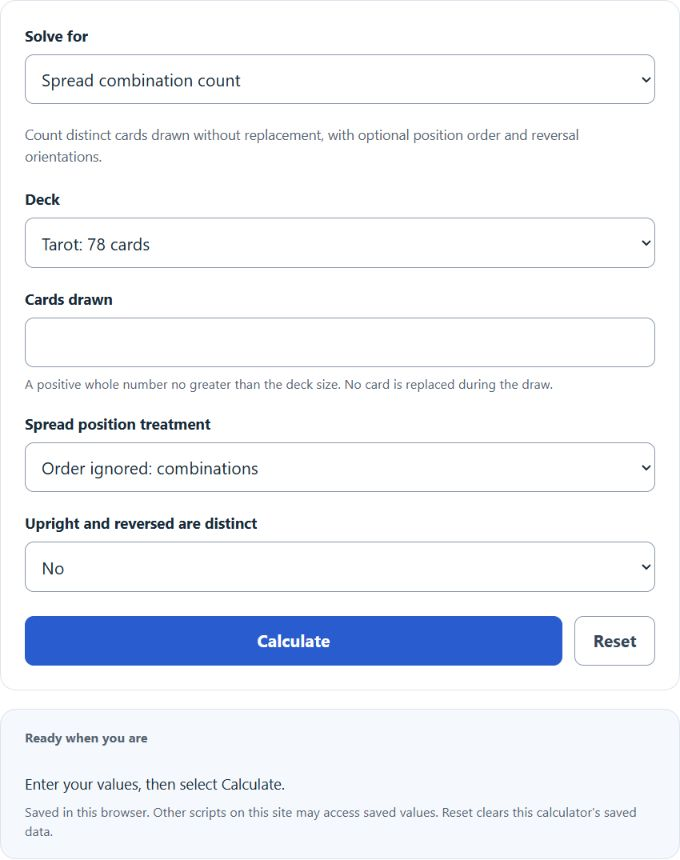
Count Tarot card combinations or ordered spreads with optional reversals, and calculate exact or at-least-one probabilities for Major Arcana or any chosen subset.
Related Calculators
- Binomial Coefficient Calculator
- Permutation Multiplication Calculator
- Letter Combination Calculator
- Compound Probability Calculator
- Probability of Success After N Trials Calculator
- All Everyday Life and Education Calculators
Tarot Combinations Formula
The following formula counts unordered selections of distinct cards drawn without replacement. It ignores spread positions and upright/reversed orientations.
Variables:
- C is the number of combinations
- n is the total number of Tarot cards in the deck
- r is the number of cards drawn
- ! denotes factorial, which is the product of all positive integers up to that number
To calculate the number of combinations, first calculate the factorial of the total number of Tarot cards in the deck. Then, calculate the factorial of the number of cards drawn and the factorial of the difference between the total number of cards and the number of cards drawn. Divide the first result by the product of the second and third results.
When spread positions are distinct, use the ordered count P(n,r) = n! / (n-r)!. If upright and reversed orientations are counted separately, multiply the selected unordered or ordered count by 2r. A particular counted outcome has probability 1 divided by the count only when those outcomes are equally likely; for oriented outcomes this also requires independent, equally likely upright/reversed orientations.
For a special subset of s cards in a uniformly random draw without replacement, P(exactly k special cards) = C(s,k) × C(n-s,r-k) / C(n,r), and P(at least one) = 1 − C(n-s,r) / C(n,r). A combination requiring more cards than available is zero. The expected special-card count is r × s / n. Independently assigning fair orientations changes neither subset probability because the same orientation factor occurs in favorable and total outcomes.
The calculator keeps the counts and probability decisions exact before rounding their displays. Very large values and tiny positive probabilities use a marked approximate scientific display; a rounded 100% should not be read as certainty when a positive complementary probability is still shown. The mathematical models follow the OpenStax counting principles and hypergeometric distribution.
What are tarot combinations?
The mathematical counts above are separate from interpreting a reading. Tarot combinations refer to the blending of meanings of two or more tarot cards that appear together in a reading. Each card in a tarot deck has its own individual symbolism and interpretation, but when they are read together, their meanings can change or deepen, creating a more nuanced and detailed message. This combination can provide a more comprehensive understanding of the situation or question at hand. The interpretation of these combinations can vary greatly depending on the reader’s intuition, the context of the question, and the specific tarot spread used.
How to Calculate Tarot Combinations?
The following steps outline how to calculate Tarot Combinations using the formula: C = n! / (r!(n-r)!)
- First, determine the total number of Tarot cards in the deck (n).
- Next, determine the number of cards drawn (r).
- Next, calculate the factorial of n, denoted as n!.
- Next, calculate the factorial of r, denoted as r!.
- Next, calculate the factorial of (n-r), denoted as (n-r)!
- Finally, calculate the number of combinations (C) using the formula C = n! / (r!(n-r)!).
- After inserting the values of n and r into the formula and calculating the result, you will get the number of Tarot combinations.
Example Problem:
Use the following variables as an example problem to test your knowledge:
Total number of Tarot cards in the deck (n) = 78
Number of cards drawn (r) = 3. For unordered draws without distinct orientations, C(78,3) = 78 × 77 × 76 / (3 × 2 × 1) = 76,076 combinations.