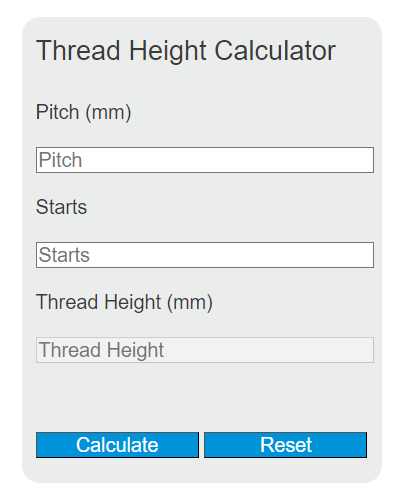
Calculate thread lead from pitch and starts, or pitch from lead, in mm, in, or cm with results for single- and multi-start screws.
Related Calculators
- Thread Engagement Length Calculator
- Bolt Root Area Calculator
- Breakaway Torque Calculator
- Spindle Speed Calculator
- All Construction Calculators
Thread Lead Formula
Thread lead is the axial distance a screw, bolt, or nut advances in one full revolution. This calculator uses the thread pitch and the number of starts to determine lead.
Variables
- L = thread lead
- P = thread pitch
- S = number of thread starts
If you are solving for a different variable, rearrange the relationship as follows:
The pitch and lead must use the same length units. The number of starts is unitless.
Pitch vs. Lead vs. Thread Height
These terms are often confused, but they describe different thread characteristics:
- Pitch is the distance from one thread crest to the next, measured parallel to the fastener axis.
- Lead is the linear distance the thread advances in one complete turn.
- Thread height usually refers to the radial depth or profile height of the thread form, not the axial travel per revolution.
If your goal is to find how far a threaded part moves with each turn, you want lead. That is what this calculator determines.
How the Result Changes with Thread Starts
The number of starts has a direct effect on how quickly the thread advances:
- Single-start thread: lead equals pitch.
- Multi-start thread: lead is greater than pitch.
For a single-start thread:
For a double-start thread:
For a triple-start thread:
This is why multi-start threads are used when faster axial travel is needed without making the thread pitch excessively large.
How to Calculate Thread Lead
- Measure or identify the thread pitch.
- Determine the number of starts in the thread.
- Multiply the pitch by the number of starts.
- Report the lead in the same unit used for pitch.
Use consistent units throughout the calculation. If pitch is entered in millimeters, the lead will also be in millimeters. If pitch is entered in inches, the lead will also be in inches.
Examples
Example 1: Single-start thread
A screw has a pitch of 1.5 mm and 1 start.
The thread advances 1.5 mm for every full turn.
Example 2: Double-start thread
A screw has a pitch of 2 mm and 2 starts.
The thread advances 4 mm for every full turn.
Example 3: Solving for pitch
A threaded component advances 6 mm per revolution and has 3 starts.
The pitch is 2 mm.
Quick Reference Table
| Pitch | Starts | Lead | Interpretation |
|---|---|---|---|
| 1 mm | 1 | 1 mm | Standard single-start behavior |
| 1 mm | 2 | 2 mm | Twice the axial travel per turn |
| 1.5 mm | 1 | 1.5 mm | Lead equals pitch |
| 1.5 mm | 4 | 6 mm | High travel per revolution |
| 0.125 in | 2 | 0.25 in | Imperial example with multi-start thread |
Why Thread Lead Matters
Lead affects the mechanical behavior of threaded components in several ways:
- Linear travel: determines how far the part moves per revolution.
- Speed of motion: larger lead produces faster axial movement.
- Control and resolution: smaller lead provides finer positioning.
- Application fit: helps distinguish between fastening threads and motion-transmission threads.
In power screws, actuators, jacks, vises, and linear positioning systems, lead is one of the most important thread dimensions because it connects rotational input to linear output.
Common Input Errors
- Confusing pitch with lead: they are only equal for single-start threads.
- Using mixed units: do not combine inches and millimeters in the same calculation.
- Entering starts as a decimal: starts are normally whole numbers such as 1, 2, 3, or 4.
- Using thread count instead of pitch: if your specification is threads per inch, convert it to pitch before using this calculator.
Practical Notes
- Fasteners commonly use single-start threads, so lead often equals pitch.
- Multi-start threads are useful when quick engagement or faster motion is desired.
- A larger lead does not automatically mean a stronger thread; it only describes axial advance per turn.
- When reviewing drawings or specifications, verify whether the document lists pitch, lead, or thread form dimensions separately.
Frequently Asked Questions
Does lead always equal pitch?
No. Lead equals pitch only in a single-start thread. In any multi-start thread, lead is greater than pitch.
What does “starts” mean?
Starts is the number of independent helical thread paths wrapped around the same cylinder. More starts increase lead for the same pitch.
Can I use inches or millimeters?
Yes. The formula works with any length unit as long as pitch and lead use the same unit.
Why would someone use a multi-start thread?
Multi-start threads allow more axial movement per turn, which can improve speed of engagement and linear travel in certain mechanical designs.