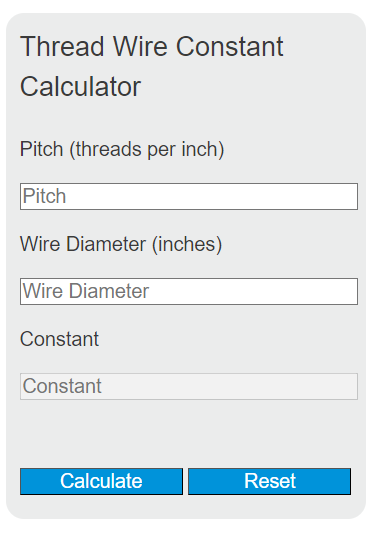
Thread Wire Constant Calculator finds the 60-degree three-wire constant, pitch diameter, or over-wires measurement in inch or metric systems with wire guidance.
Thread Wire Constant Formula
The thread wire constant is the geometric offset used in the three-wire method for ideal 60° threads. Once the wire diameter and thread count are known, the constant lets you convert between the measurement taken over the wires and the thread pitch diameter.
If you know the linear pitch distance per thread instead of thread count, the same relationship can be written as:
| Symbol | Meaning | Unit Guidance |
|---|---|---|
| C | Thread wire constant | Same linear unit as the wire diameter |
| D | Wire diameter | Inches, centimeters, or another linear unit |
| P | Thread count per unit length | Examples: threads per inch, threads per cm |
| p | Linear pitch distance per thread | Inverse of thread count |
| M | Measurement over wires | Same linear unit as C and D |
| E | Pitch diameter | Same linear unit as M |
How the Constant Is Used
In three-wire thread measurement, the micrometer reads the dimension over the wires. The constant is the amount that links that measurement to the pitch diameter.
This makes the constant useful whenever you already know the wire size and thread count and want a fast path to pitch diameter.
How to Use the Calculator Correctly
- Enter the thread count as threads per unit length.
- Enter the wire diameter in the matching linear unit.
- Keep units consistent throughout the calculation.
- Use the resulting constant with your measurement over wires if you also need pitch diameter.
Important: the calculator input labeled for pitch is using thread count per unit length, not the linear distance from one thread crest to the next. If you know linear pitch distance, convert it first.
Examples of consistent inputs:
- TPI + inches → constant in inches
- threads/cm + centimeters → constant in centimeters
Example Calculation
For a 20 TPI thread measured with wires that are 0.035 inches in diameter:
Rounded to practical shop precision, the thread wire constant is 0.0617 in.
If the measurement over wires is 0.5000 in, the pitch diameter is:
Best-Size Wire Reference
For ideal 60° threads, a common reference wire size is the best-size wire. This size contacts the thread close to the pitch line and is often preferred for precision measurement.
If you use a wire that is larger or smaller than the best size, the thread wire constant changes directly because the constant depends on the actual wire diameter used in the measurement.
Practical Notes
- This calculation assumes ideal 60° thread geometry.
- A larger wire diameter increases the constant because the 3D term increases.
- A finer thread changes the subtraction term because the pitch distance becomes smaller.
- The constant is not the pitch diameter itself; it is the offset used to reach pitch diameter from the measurement over wires.
- The most common input mistake is mixing thread count in one unit system with wire diameter in another.