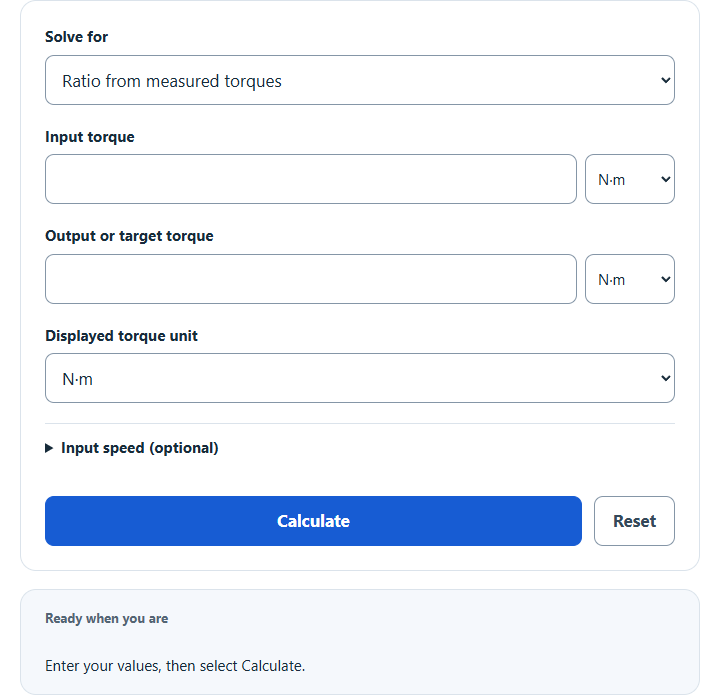
Calculate a torque ratio from input and output torque, output torque from gear teeth, or the input torque to set with a 4:1 or other torque multiplier.
Related Calculators
- Spiral Torsion Spring Calculator
- Period of Revolution Calculator
- Power to Acceleration Calculator
- Average Force Calculator
- All Physics Calculators
Calculator Functions
| Function | What it does | What it requires |
|---|---|---|
| Ratio from measured torques | Finds the torque ratio of a drive from its input torque and output torque | Requires an input torque above zero and the output torque |
| Output torque from gears | Finds the output torque of a gear pair from the input torque and the tooth counts | Requires the input torque, the driver and driven gear teeth and the drivetrain efficiency, which is 100% unless changed |
| Input torque for desired output | Finds the input torque a gear pair needs to deliver a target output torque | Requires the target output torque, the driver and driven gear teeth and the drivetrain efficiency |
| Input torque for a torque multiplier | Finds the torque wrench setting that makes a torque multiplier deliver a target torque | Requires the target torque, the multiplier ratio (4 for a 4:1 multiplier) and the efficiency, which is 100% unless changed |
Torque can be entered and displayed in N·m, lbf·ft, lbf·in or kgf·m. The first three functions accept an optional input speed in rpm, which adds the output speed and the mechanical power in kW to the result.
Torque Ratio Formulas
| TR | Torque ratio, written as TR:1 |
| Tout | Output torque |
| Tin | Input torque, in the same unit |
For a pair of gears the torque ratio is set by the teeth: it equals the number of teeth on the driven (output) gear divided by the number on the driver (input) gear [1]. A ratio above 1 raises torque and lowers speed by the same factor.
Ratio from measured torques
The main formula applies directly. An input of 50 N·m and an output of 200 N·m give 200 ÷ 50 = 4:1, a torque change of (4 − 1) × 100 = 300%. With an input speed entered, the comparison output speed is the input rpm divided by the ratio, which assumes no power is lost.
Output torque from gears
N1 is the driver gear teeth, N2 the driven gear teeth and η the efficiency as a decimal. The tooth-count relation holds for a drive without losses, which is the 100% default. An input of 50 N·m through a 12-tooth driver and a 48-tooth driven gear at 95% efficiency gives 50 × 4 × 0.95 = 190 N·m. Output speed is the input rpm divided by N2 ÷ N1, and power in kW is torque in N·m × rpm × 2π ÷ 60,000.
Input torque for desired output
This is the gear formula reversed. A target of 190 N·m through the same 12 and 48 tooth gears at 95% needs 190 ÷ 4 ÷ 0.95 = 50 N·m at the input.
Input torque for a torque multiplier
The torque to set on the wrench is the torque the fastener needs divided by the multiplier ratio [2]. A fastener that needs 3,000 lbf·ft through an 11.1:1 multiplier takes 3,000 ÷ 11.1 = 270.27 lbf·ft at the wrench. If the multiplier comes with a calibrated torque factor, that factor goes in the ratio field in place of the nominal ratio.
Limits of This Estimate
- The 100% efficiency default is an ideal drive with no losses. Real gears lose some torque to friction, and the efficiency to enter comes from the maker’s data or a measurement. These estimates are based on the best available data and estimations.
- The gear functions describe one pair of gears at steady speed. Starting loads, shock, heat limits and service factors are not covered.
- A torque multiplier must be anchored or used with its reaction bar [2], and the maker’s chart overrides the calculated wrench setting.
- A measured torque ratio does not on its own give the real output speed, the efficiency or a safe load.
Sources
- J. Kammet, Brooklyn College (CUNY), CORC 3303 Supplemental notes on gear ratios, torque and speed: gear ratio from tooth counts as the ratio of output torque to input torque
- U.S. Army, TM 1-1500-204-23-9, General Aircraft Maintenance Manual, Volume 9: Tools and Ground Support Equipment: wrench setting for a torque multiplier and the need for a reaction bar