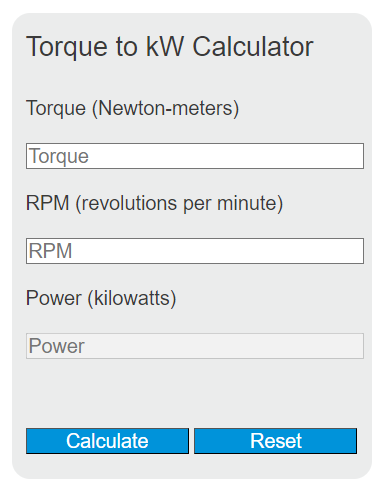
Calculate torque, RPM, or power from the other two values in Nm, ft-lbs, kg-m, kW, HP, or W with this torque to kW calculator in one step.
| Torque to kW | kW to Torque |
|---|---|
| 5 Nm @ 1500 RPM = 0.7854 kW | 0.75 kW @ 1500 RPM = 4.7746 Nm |
| 10 Nm @ 1500 RPM = 1.5708 kW | 1 kW @ 1500 RPM = 6.3662 Nm |
| 15 Nm @ 1500 RPM = 2.3562 kW | 1.5 kW @ 1500 RPM = 9.5493 Nm |
| 20 Nm @ 1500 RPM = 3.1416 kW | 2 kW @ 1500 RPM = 12.7324 Nm |
| 25 Nm @ 1500 RPM = 3.9270 kW | 3 kW @ 1500 RPM = 19.0986 Nm |
| 30 Nm @ 1500 RPM = 4.7124 kW | 5 kW @ 1500 RPM = 31.8310 Nm |
| 40 Nm @ 1500 RPM = 6.2832 kW | 7.5 kW @ 1500 RPM = 47.7465 Nm |
| 50 Nm @ 1500 RPM = 7.8540 kW | 10 kW @ 1500 RPM = 63.6620 Nm |
| 75 Nm @ 1500 RPM = 11.7810 kW | 15 kW @ 1500 RPM = 95.4930 Nm |
| 100 Nm @ 1500 RPM = 15.7080 kW | 20 kW @ 1500 RPM = 127.3240 Nm |
| Formulas: kW = (Nm x RPM) / 9549.2966 and Nm = (kW x 9549.2966) / RPM. | |
| Torque to kW | kW to Torque |
|---|---|
| 10 Nm @ 3000 RPM = 3.1416 kW | 1 kW @ 3000 RPM = 3.1831 Nm |
| 20 Nm @ 3000 RPM = 6.2832 kW | 2.5 kW @ 3000 RPM = 7.9577 Nm |
| 30 Nm @ 3000 RPM = 9.4248 kW | 5 kW @ 3000 RPM = 15.9155 Nm |
| 40 Nm @ 3000 RPM = 12.5664 kW | 7.5 kW @ 3000 RPM = 23.8732 Nm |
| 50 Nm @ 3000 RPM = 15.7080 kW | 10 kW @ 3000 RPM = 31.8310 Nm |
| 60 Nm @ 3000 RPM = 18.8496 kW | 15 kW @ 3000 RPM = 47.7465 Nm |
| 80 Nm @ 3000 RPM = 25.1327 kW | 20 kW @ 3000 RPM = 63.6620 Nm |
| 100 Nm @ 3000 RPM = 31.4159 kW | 30 kW @ 3000 RPM = 95.4930 Nm |
| 150 Nm @ 3000 RPM = 47.1239 kW | 40 kW @ 3000 RPM = 127.3240 Nm |
| 200 Nm @ 3000 RPM = 62.8319 kW | 50 kW @ 3000 RPM = 159.1550 Nm |
| Formulas: kW = (Nm x RPM) / 9549.2966 and Nm = (kW x 9549.2966) / RPM. | |
- All Unit Converters
- Torque to Weight Ratio Calculator
- Torque to Pressure Calculator
- Torque to Power Calculator
Torque to kW Formula
The standard formula for converting torque and rotational speed to power in kilowatts is:
Variables:
- P is the mechanical shaft power in kilowatts (kW)
- T is the torque in newton-meters (Nm)
- N is the rotational speed in revolutions per minute (RPM)
The inverse forms are equally useful. To find torque from power: T = (P x 9549.2966) / N. To find speed from power and torque: N = (P x 9549.2966) / T.
Where the 9549 Constant Comes From
The fundamental relationship between power, torque, and rotation is P = T x w, where w (omega) is angular velocity in radians per second. Since most real-world equipment measures speed in RPM rather than rad/s, a unit conversion is needed. One revolution equals 2pi radians, and one minute equals 60 seconds, so w = (2pi x N) / 60. Substituting this into P = T x w gives P(W) = T(Nm) x 2pi x N(RPM) / 60. Dividing both sides by 1000 to convert watts to kilowatts produces the constant: 60,000 / (2pi) = 9549.2966. This is not an approximation. It is an exact unit conversion factor.
Torque and Power in Electric Motors
In an electric motor, torque is the rotational force delivered at the output shaft. The relationship between torque and kilowatts is not a fixed ratio because it depends entirely on operating speed. A 10 kW motor running at 1500 RPM produces 63.66 Nm, but the same 10 kW motor running at 3000 RPM produces only 31.83 Nm. This is why motor nameplates always list both rated power and rated speed together.
Standard induction motors operate at synchronous speeds determined by their pole count and supply frequency. On a 50 Hz supply, a 2-pole motor runs near 3000 RPM, a 4-pole motor near 1500 RPM, a 6-pole near 1000 RPM, and an 8-pole near 750 RPM. On a 60 Hz supply (common in North America), these shift to approximately 3600, 1800, 1200, and 900 RPM respectively. Actual shaft speed is slightly lower due to slip, typically 1 to 5% below synchronous speed under load.
Torque Types in Motor Design
Motors produce different torque values at different points during operation. Rated (full-load) torque is the continuous torque at nameplate speed and power. Starting torque (locked-rotor torque) is the torque available at zero speed when the motor first energizes, typically 150 to 300% of rated torque for standard NEMA Design B / IEC Design N motors. Pull-up torque is the minimum torque during acceleration from standstill to full speed, and it must exceed the load torque at every point during startup. Breakdown torque is the maximum torque the motor can produce before stalling, usually 200 to 300% of rated torque. If load torque exceeds breakdown torque, the motor decelerates rapidly and draws excessive current.
Motor Efficiency and Actual Shaft Power
The torque-to-kW formula gives mechanical shaft power, not electrical input power. Electrical input is always higher because of losses in the motor (copper losses in windings, iron losses in the core, friction, and windage). The IEC 60034-30-1 standard defines four efficiency classes that quantify these losses: IE1 (Standard Efficiency), IE2 (High Efficiency), IE3 (Premium Efficiency), and IE4 (Super Premium Efficiency).
As a reference point, a 4-pole 7.5 kW motor at 50 Hz has approximate minimum efficiencies of 86.0% at IE1, 88.6% at IE2, 90.4% at IE3, and 91.7% at IE4. A larger 75 kW motor of the same type reaches 93.0% (IE2), 94.0% (IE3), and 95.0% (IE4). Smaller motors lose proportionally more energy; a 0.75 kW motor may only reach 72 to 82% efficiency depending on its class. When sizing electrical supply and switchgear, divide shaft kW by the motor efficiency to find the required electrical kW input.
IEC vs. NEMA Motor Standards
IEC (International Electrotechnical Commission) and NEMA (National Electrical Manufacturers Association) are the two dominant frameworks for motor specification globally. IEC motors rate shaft output in kilowatts and follow preferred sizes (0.75, 1.1, 1.5, 2.2, 3, 4, 5.5, 7.5, 11, 15, 18.5, 22, 30, 37, 45, 55, 75, 90, 110 kW and above). NEMA motors rate output in horsepower with their own preferred sizes (1, 1.5, 2, 3, 5, 7.5, 10, 15, 20, 25, 30, 40, 50, 60, 75, 100 HP and above). The conversion between them is 1 HP = 0.7457 kW. IEC frame sizes are specified in millimeters (shaft center height), while NEMA uses a proprietary numbering system. IEC Design N motors are broadly equivalent to NEMA Design B, which is the most common general-purpose type in industrial applications.
Motor Sizing by Application
The torque-to-kW conversion is essential when selecting a motor for a specific mechanical load. Different applications have distinct torque profiles that affect sizing decisions.
Centrifugal pumps and fans follow a variable-torque load curve where torque scales with the square of speed. A pump requiring 15 kW at 1750 RPM needs at least 81.9 Nm of continuous torque. Because starting torque for centrifugal loads is low (typically 20 to 40% of full-load torque), standard motors handle these applications without oversizing.
Conveyors and hoists present constant-torque loads where the required torque stays roughly the same regardless of speed. A conveyor needing 150 Nm at 1500 RPM draws 23.6 kW. These loads often demand higher starting torque because the belt or hoist must overcome static friction and full load from zero speed.
Compressors, especially positive-displacement types, require constant power across their speed range, meaning torque increases as speed decreases. A screw compressor rated at 22 kW with a 1.15 service factor needs an actual motor input of 25.3 kW to ensure reliable continuous operation with margin.
Common Unit Conversions
Torque and power are measured in different unit systems depending on region and industry. Key conversion factors: 1 ft-lb = 1.35582 Nm, 1 kg-m = 9.80665 Nm, 1 HP = 0.7457 kW = 745.7 W, and 1 kW = 1.341 HP. To use the torque-to-kW formula with foot-pounds, multiply the ft-lb value by 1.35582 first to convert to Nm, then apply the standard formula. The calculator above handles these conversions automatically through its unit selector.