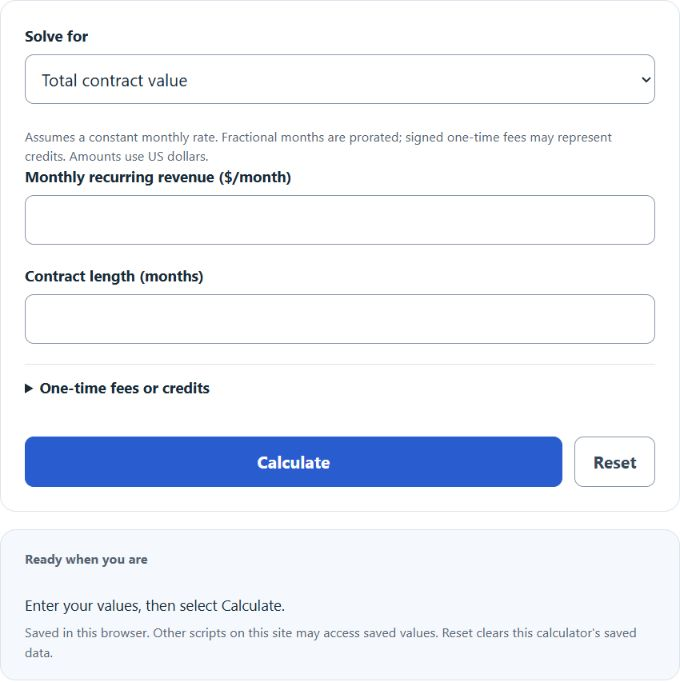
Choose total contract value, monthly recurring revenue, contract length, or one-time fees to solve for, then enter the applicable known values. Blank optional fees mean $0.
TCV Formula
Total Contract Value (TCV) measures the full dollar value of a contract over its stated term. It is commonly used to estimate the total size of a deal by combining recurring revenue across the contract period with any one-time contract fees.
- TCV = total contract value
- MRR = monthly recurring revenue
- CL = contract length in months
- CF = one-time contract fees, setup fees, onboarding fees, or other non-recurring charges
Choose the value to solve for. The calculator rearranges the formula using the other known values; one-time fees or credits may be omitted as $0 where shown as optional:
How to Calculate Total Contract Value
- Determine the monthly recurring revenue generated by the agreement.
- Convert the full contract term into months.
- Add any one-time fees tied to the contract.
- Multiply recurring revenue by the contract length, then add the one-time fees.
This calculator assumes a constant monthly rate. Convert an annual rate to its monthly equivalent first. Fractional months are prorated proportionally; actual billing calendars or changing rates need a contract-specific calculation. Monetary answers round to cents.
Example Calculation
A software contract charges $2,500 per month for 24 months and includes a $4,000 implementation fee.
The total contract value is $64,000.
What TCV Includes
TCV is intended to represent the total stated value of the signed agreement. Depending on how your organization defines the metric, TCV may include:
- Recurring subscription or service revenue over the full contract term
- Implementation or setup fees
- Onboarding charges
- Professional services included in the signed deal
- Other fixed one-time charges written into the contract
Many teams exclude usage-based charges, uncertain renewals, or revenue that is not contractually committed. For reporting consistency, use the same TCV definition across all deals.
When TCV Is Useful
- Sales forecasting: Compare the size of opportunities and closed deals.
- Pipeline analysis: Evaluate the total value of contracts expected to close.
- Finance reporting: Measure contracted value separate from cash collection timing.
- Compensation planning: Support quota and commission calculations when TCV-based credit is used.
- Contract comparison: Contrast short-term and long-term agreements on a consistent basis.
TCV vs. Monthly Revenue and Annual Value
| Metric | What It Represents | Best Use |
|---|---|---|
| MRR | Recurring revenue generated each month | Monthly trend tracking and recurring revenue analysis |
| TCV | Total value of the full contract term plus applicable fees | Deal size, contract comparison, and pipeline valuation |
| ACV | Average annual value of the contract | Normalizing multi-year contracts into annual terms |
If you need annual contract value from total contract value, divide the recurring portion of the deal by the number of years, or apply your company’s internal ACV definition consistently.
Common Mistakes
- Mixing time units: If revenue is monthly, the contract length should also be in months.
- Forgetting one-time fees: Implementation or onboarding charges can materially change TCV.
- Including uncommitted renewals: Only count periods that are part of the signed agreement.
- Double-counting services: Make sure fees are added once, not folded into recurring revenue and added again.
- Confusing TCV with cash flow: TCV shows contract value, not necessarily when payments are received.
Practical Interpretation
A higher TCV usually means a larger contract, but it does not automatically mean better short-term cash performance or higher monthly recurring revenue. For example, a long-term deal may have a large TCV while producing less monthly revenue than a shorter contract with a higher monthly rate. That is why many teams review TCV, MRR, and margin together.
FAQ
Does TCV include one-time fees?
Yes, when those fees are part of the signed contract. Common examples include setup, implementation, and onboarding fees.
Should renewals be included in TCV?
Only if the renewal term is contractually committed. Optional or expected renewals are usually excluded.
Can TCV be negative?
This calculator requires nonnegative total value and recurring revenue. One-time credits may be negative, but cannot make total value negative. Review any contract whose credits exceed its recurring value.
What if the contract term is given in years?
Convert years to months before using monthly recurring revenue.
This keeps the units consistent and makes the TCV calculation accurate.