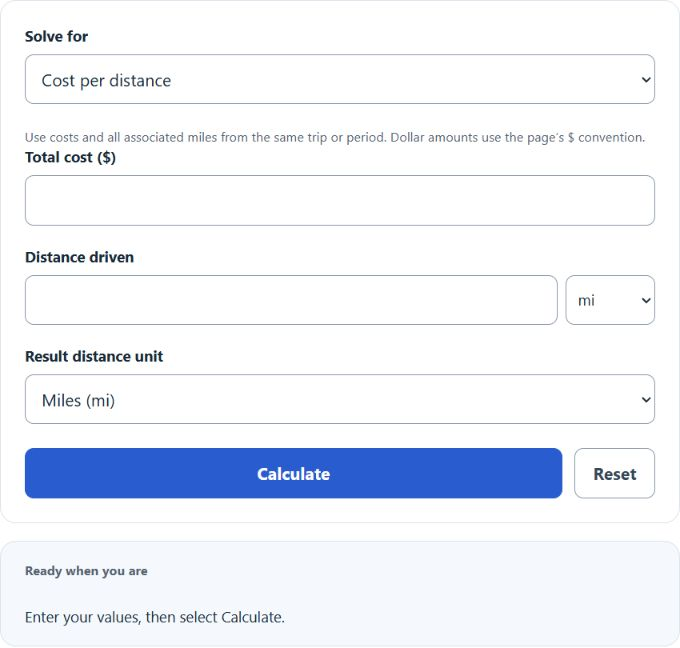
Choose cost per distance, total cost or distance to solve for, then enter the two displayed values and select units.
Related Calculators
- Reverse Markup Calculator
- Predetermined Overhead Rate Calculator
- Landed Cost Calculator
- Incremental Cost Calculator
- All Business Calculators
Trucking CPM Formula
Trucking CPM, or cost per mile, shows how much it costs to operate a truck for each mile driven. It is one of the most useful metrics for quoting loads, checking route profitability, comparing trucks, and understanding whether revenue is keeping up with expenses.
Where:
- CPM = cost per mile
- T = total trip cost
- M = total miles driven
If you know any two values, you can rearrange the formula to solve for the third:
How to Use the Trucking CPM Calculator
- Choose the quantity to solve for. For cost per distance, enter the total cost of the trip.
- Enter the total distance driven in miles or kilometers.
- The calculator returns the cost per distance for the trip.
- Select Total cost to enter the known unit cost and distance, or select Distance to enter total cost and unit cost. A zero unit cost can make the distance inverse impossible or nonunique.
For the most accurate result, use the full route distance, including loaded miles and any empty or repositioning miles tied to the trip.
What Should Be Included in Total Trip Cost?
Total trip cost should reflect all meaningful operating expenses connected to the movement of the truck, not just fuel.
| Cost Category | Typical Items | Why It Matters |
|---|---|---|
| Fuel | Diesel, DEF, idling fuel, reefer fuel | Usually the largest variable cost on long trips |
| Driver Cost | Wages, per diem, benefits, payroll burden | Directly affects trip profitability |
| Maintenance | Repairs, preventive service, tires, fluids | Ignoring these makes CPM look artificially low |
| Equipment Cost | Lease payments, financing, depreciation | Captures the true cost of owning or operating the truck |
| Insurance and Compliance | Physical damage, liability, permits, IFTA, registration | Fixed costs still need to be recovered through mileage |
| Trip Expenses | Tolls, parking, scale fees, lodging | Often small individually but meaningful over time |
| Overhead | Dispatch, admin, software, office costs | Important for business-level pricing decisions |
How to Interpret the Result
CPM becomes much more useful when compared with the amount you earn per mile on a load.
Where:
- PPM = profit per mile
- RPM = revenue per mile
- CPM = cost per mile
- If PPM > 0, the trip is covering cost and producing operating margin.
- If PPM = 0, the trip is roughly break-even.
- If PPM < 0, the trip is losing money on a per-mile basis.
This is why a carrier can appear busy yet still be unprofitable: miles alone do not create profit unless the rate per mile stays above the real cost per mile.
Example
If a trip costs $900 and covers 600 miles, the trucking CPM is:
That means the truck costs $1.50 per mile to operate for that trip.
If the load pays $2.10 per mile, then the margin per mile is:
In that case, the trip leaves $0.60 per mile before any additional untracked expenses.
Common Reasons CPM Gets Misstated
- Using loaded miles only when the truck also traveled empty miles related to the load
- Leaving out fixed costs such as insurance, permits, truck payments, or depreciation
- Mixing units by entering kilometers while thinking in miles, or vice versa
- Ignoring maintenance reserves for future repairs and tire replacement
- Using unusually low fuel cost assumptions from a single fill-up instead of an average
- Failing to allocate overhead when using CPM to set customer rates
Tips for Better Trucking Cost Analysis
- Track CPM by truck, driver, and lane to identify strong and weak routes.
- Review CPM over a 30-day or 90-day average instead of relying only on one trip.
- Separate fixed costs and variable costs so pricing decisions are clearer.
- Recalculate often when fuel prices, driver pay, or maintenance costs change.
- Use all miles driven if the goal is to understand the true operating cost of a route.
Trucking CPM vs. Rate Per Mile
Cost per mile is an internal cost metric. Rate per mile is what the customer pays. A trucking business needs the rate per mile to exceed the real CPM by enough margin to cover risk, downtime, and profit goals.
Used consistently, CPM helps answer practical questions such as:
- Is this load worth taking?
- Which lanes are truly profitable?
- How much do fuel increases affect my pricing?
- What is my minimum acceptable rate per mile?
The calculator above provides a quick way to estimate trucking CPM so you can make better dispatching, pricing, and operational decisions.