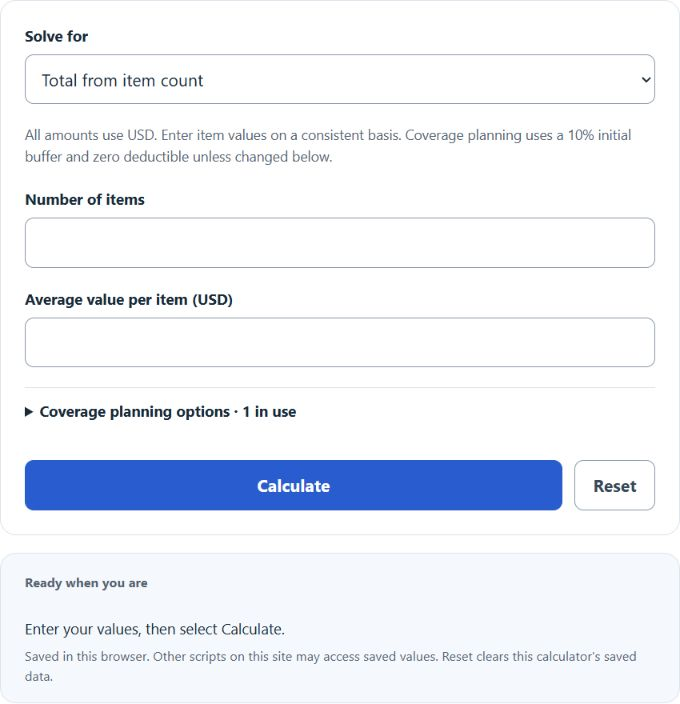
Estimate the value of your household goods from an item count or category totals, or the used value after depreciation, to plan contents insurance.
Value of Household Goods Formula
For the item-count estimate, use the formula below. Enter a consistent valuation basis, such as current replacement costs.
Variables:
- TV is the total value of household goods ($)
- Q is the quantity of items
- AV is the average value per item ($)
To calculate the total value of household goods, multiply the quantity of items by the average value per item. Category mode adds your entered replacement costs. The straight-line model uses replacement subtotal × max(1 − age ÷ useful life, retained-value floor ÷ 100). The planning amount adds your selected buffer to the replacement subtotal.
Replacement cost and depreciated value are different measures. This model is a planning estimate; policy terms, limits and valuation methods determine coverage and claim payments. See the NAIC explanation of replacement cost and actual cash value.
What is the Value of Household Goods?
The value of household goods is an estimate of personal items and furnishings in a home. A replacement-cost inventory can help with contents coverage planning. Current market value reflects what used goods may sell for and can differ from replacement cost. Keep these bases separate when valuing items or using the planning buffer.
How to Calculate the Value of Household Goods?
The following steps outline how to calculate the Value of Household Goods.
- First, count the total quantity of items (Q) you want to value.
- Next, determine the average value per item (AV) in dollars.
- Use the formula from above = TV = Q * AV.
- Finally, calculate the Total Value (TV) in dollars.
- After inserting the variables and calculating the result, check your answer with the calculator above.
Example Problem :
Use the following variables as an example problem to test your knowledge.
Quantity of items (Q) = 50
Average value per item (AV) = $200
The item-count total is 50 × $200 = $10,000. A 10% planning buffer gives $11,000 before considering policy terms; the $10,000 estimated goods value itself does not include that buffer.