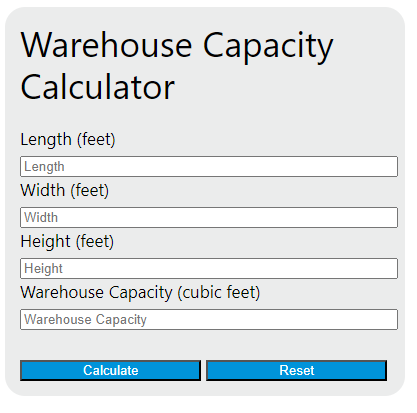
Estimate pallet storage positions from floor area and rack levels, calculate usable storage cube, or compare current pallet occupancy with estimated warehouse capacity.
Related Calculators
- Occupancy Rate Index Calculator
- Stockout Probability Calculator
- Cost Function Calculator
- Total Cost Calculator
- All Business Calculators
Warehouse Capacity Formula
Warehouse capacity is the total internal volume available inside a storage space. For a simple rectangular warehouse, capacity is found by multiplying the inside length by the inside width by the usable height. This calculator can also rearrange the relationship to solve for a missing dimension when the other three values are known.
| Variable | Meaning | Common Units |
|---|---|---|
| WC | Warehouse capacity | ft³, m³, L, gal |
| L | Inside length of the warehouse | ft, m, in, cm |
| W | Inside width of the warehouse | ft, m, in, cm |
| H | Usable interior height | ft, m, in, cm |
This result is the gross cubic capacity of the space. It tells you the geometric volume of the building, which is useful for planning storage, comparing buildings, estimating racking needs, and checking how much vertical space is available.
How to Calculate Warehouse Capacity
- Measure the inside length of the warehouse.
- Measure the inside width.
- Measure the usable height, not just the building peak. In many facilities, usable height is limited by racks, lights, sprinklers, beams, or safety clearance.
- Multiply length × width × height to get total cubic capacity.
- If needed, convert the result into cubic meters, liters, or gallons for reporting.
For the most accurate result, use interior dimensions and keep all measurements in the same unit before calculating.
Solving for a Missing Dimension
If you know warehouse capacity and two dimensions, you can solve for the missing side using the same relationship rearranged:
This is useful when planning a target storage volume and checking how large a building or stacking height must be to support it.
Gross Capacity vs. Usable Capacity
The formula above gives the maximum geometric volume. In real operations, the amount of space that can actually be used for inventory is often lower because some of the warehouse must remain open for movement, access, and safety.
- Aisles and cross-aisles
- Loading and staging zones
- Columns, walls, and irregular corners
- Fire safety and sprinkler clearance
- Rack framing and pallet overhang
- Forklift turning radius and travel lanes
- Reserved space for picking, packing, or returns
A simple planning method is to apply a utilization factor to the gross warehouse capacity:
Where:
- UC = usable capacity
- WC = gross warehouse capacity
- U = utilization factor expressed as a decimal
This adjusted figure is often more realistic when evaluating actual storage potential.
Example
If a warehouse is 100 ft long, 80 ft wide, and 24 ft high, the gross capacity is:
If only 65% of that space is practically usable for storage:
This distinction matters when comparing a building’s theoretical volume to the space you can actually fill with goods.
Unit Conversions
The calculator may display capacity in multiple units. These conversions are commonly used when reporting warehouse size across different systems:
If your dimensions are entered in inches or centimeters, make sure the final capacity unit still matches your reporting needs.
For Irregular Warehouse Layouts
Not every warehouse is a perfect rectangle. If the building has separate rooms, mezzanines, or sections with different heights, divide the warehouse into smaller rectangular zones, calculate each zone separately, and add them together.
This method is especially useful for facilities with partial-height storage areas, office build-outs, or segmented temperature-controlled rooms.
Common Mistakes
- Using exterior dimensions: exterior wall measurements overstate the actual internal volume.
- Using full building height instead of usable height: obstructions and safety clearances reduce stackable volume.
- Mixing units: combining feet with meters or inches with feet creates incorrect results.
- Ignoring non-storage space: docks, offices, staging, and travel lanes reduce practical capacity.
- Assuming cubic volume equals pallet capacity: pallet count also depends on rack spacing, aisle width, SKU dimensions, and stacking rules.
Warehouse Capacity Planning Tips
- Measure clear interior dimensions, not nominal building size.
- Use the actual stacking height allowed by your rack system and safety requirements.
- Separate bulk storage, rack storage, and floor staging when estimating usable capacity.
- Recalculate capacity after layout changes, new equipment, or rack reconfiguration.
- For inventory planning, combine cubic capacity with pallet dimensions or carton dimensions to estimate unit counts.
Frequently Asked Questions
Is warehouse capacity the same as storage capacity?
No. Warehouse capacity usually starts as total cubic building volume. Storage capacity is the portion of that volume that can actually hold inventory after accounting for aisles, clearances, equipment, and layout constraints.
Should I use floor-to-ceiling height?
Only if that full height is truly usable. In many cases, the correct input is the clear stacking height rather than the structural ceiling height.
What if my warehouse has different ceiling heights?
Break the building into sections, calculate each section individually, and sum the results. This gives a more accurate total than using one average height.
Can this calculator help with expansion planning?
Yes. By solving for a missing dimension, you can estimate how much extra width, length, or height is needed to reach a target warehouse volume.
Why is cubic capacity important?
It helps with warehouse design, slotting strategy, racking decisions, occupancy tracking, and understanding whether available building space can support expected inventory levels.