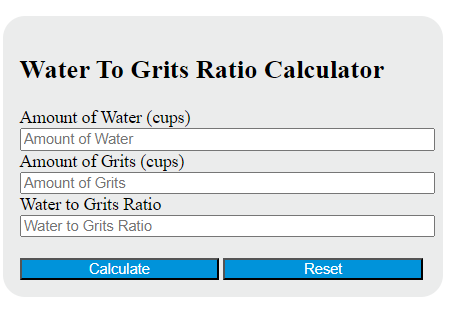
Calculate the right water-to-grits ratio by dry amount or servings, with liquid breakdown, estimated servings, salt, and cook time.
Related Calculators
- Bread Hydration Calculator
- Dry To Cooked Pasta Calculator
- Baking Ratio Calculator
- Moisture Ratio Calculator
- All Food and Cooking Calculators
Water To Grits Ratio Formula
The water-to-grits ratio tells you how much cooking liquid is used for each equal volume of grits. This calculator compares the two inputs as a simple ratio, so the result is unitless as long as both measurements use the same unit.
Where:
- WR = water-to-grits ratio
- W = amount of water
- G = amount of grits
If you already know the ratio you want, you can also rearrange the formula to solve for either ingredient:
What the Ratio Means
A result of 4 means you are using 4 parts water for every 1 part grits. In practice, a higher ratio usually produces softer, looser grits, while a lower ratio produces thicker, firmer grits. This makes the ratio one of the easiest ways to control final texture before you start cooking.
How to Calculate Water to Grits Ratio
- Measure the amount of water.
- Measure the amount of grits.
- Make sure both are expressed in the same unit.
- Divide water by grits.
- Interpret the result as “parts of water per 1 part grits.”
For example, if both values are entered in cups, the ratio is still valid. If both are entered in milliliters, the ratio is also valid. What matters is that the units match.
Typical Water-to-Grits Ranges
| Texture Target | Common Ratio | General Result |
|---|---|---|
| Very thick | 3:1 |
Dense, firm grits with less looseness in the bowl. |
| Classic stovetop texture | 4:1 |
A balanced consistency that is creamy without being too thin. |
| Soft and creamy | 5:1 |
Looser, smoother grits that continue to thicken as they stand. |
These are practical starting points, not strict rules. Quick grits, regular grits, and stone-ground grits can absorb liquid differently, and added butter, cheese, milk, or cream can change the final consistency.
Examples
If you use 8 cups of water and 2 cups of grits:
This means the mixture is at a 4:1 water-to-grits ratio.
If you want a 4:1 ratio and you have 0.75 cups of grits:
You would need 3 cups of water.
Why This Calculator Is Useful
- Recipe scaling: Increase or decrease servings while keeping texture consistent.
- Texture control: Decide whether you want thick, classic, or creamy grits before cooking.
- Unit flexibility: The ratio works with cups, liters, milliliters, or fluid ounces as long as both inputs match.
- Reverse planning: Start from the amount of grits you have and calculate how much water you need.
Unit Notes
- This calculator is based on volume, not weight.
- Do not mix units unless you convert first.
- If water is entered in milliliters, grits should also be entered in milliliters.
- If the amount of grits is zero, the ratio is undefined because division by zero is not possible.
Texture and Cooking Tips
- If the grits are too thick, whisk in a little more hot water gradually.
- If the grits are too thin, simmer longer so excess liquid reduces.
- Grits usually thicken as they cool, so a slightly looser texture in the pot may become ideal when served.
- Stirring regularly helps reduce clumping and improves consistency.
- For richer grits, some of the liquid can be replaced after calculation with milk, broth, cream, or another cooking liquid.
Frequently Asked Questions
Is 4:1 a good starting ratio?
Yes. For many recipes, a 4:1 ratio is a practical middle ground between very thick and very loose grits.
Does a higher ratio always mean better grits?
No. A higher ratio simply means more liquid relative to the grits. Whether that is better depends on the texture you want.
Can I use this calculator for any type of grits?
Yes, but different styles absorb liquid differently. The ratio gives you a strong starting point, and final texture can be adjusted during cooking.
What if I want to double a recipe?
Multiply both the water and the grits by the same factor. The ratio stays the same, so the texture target remains consistent.