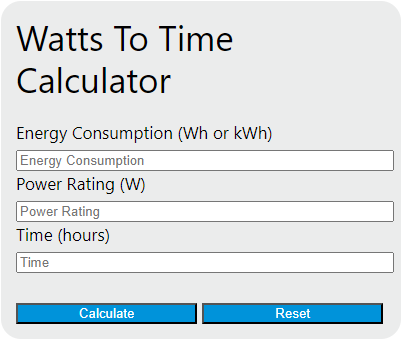
Calculate runtime from watts and watt-hours, or solve for energy or power. Supports Wh, kWh, joules, battery Ah, time units, usable capacity, and efficiency.
- All Unit Converters
- Electricity, Magnetism, & Electronics Unit Converters
- Watts To METs Calculator
- Watts To Lux Calculator
- Watts To Photons Per Second Calculator
- Watts to Volts
Watts To Time Formula
The calculator uses watt-hours as the base energy unit, watts as the base power unit, and hours as the base time unit.
- T = time in hours
- E = energy consumption in watt-hours, Wh
- P = power rating in watts, W
To find time, enter energy and power. The calculator divides watt-hours by watts to get hours.
To find energy consumption, enter power and time. The calculator multiplies watts by hours to get watt-hours.
To find power rating, enter energy and time. The calculator divides watt-hours by hours to get watts.
If you choose kWh, kW, seconds, or minutes, the values are converted before the formula is applied. The result is then converted back to the unit you selected.
Common Energy, Power, and Time Conversions
| Conversion | Equivalent value |
|---|---|
| 1 kWh | 1,000 Wh |
| 1 kW | 1,000 W |
| 1 hour | 60 minutes |
| 1 hour | 3,600 seconds |
Typical Run Times for Common Loads
| Energy available | Power load | Approximate time |
|---|---|---|
| 100 Wh | 10 W | 10 hours |
| 500 Wh | 100 W | 5 hours |
| 1 kWh | 250 W | 4 hours |
| 2 kWh | 1 kW | 2 hours |
Examples
Example 1: Find time from watts and watt-hours
You have 600 Wh of energy and a device that uses 120 W.
The run time is 5 hours.
Example 2: Find energy from watts and time
A 75 W device runs for 8 hours.
The energy consumption is 600 Wh, or 0.6 kWh.
FAQ
How do you convert watts to time?
You need the energy amount as well as the watt value. Watts alone do not tell you time. Use time = energy ÷ power. For example, 1,000 Wh divided by 200 W equals 5 hours.
What is the difference between watts and watt-hours?
Watts measure power. They show the rate at which energy is used. Watt-hours measure energy. They show how much total energy is used or stored over time.
Why is my result different from real battery run time?
The formula gives an ideal estimate. Real run time can be lower because of inverter losses, battery limits, heat, device startup power, and changing power draw. If you are estimating battery use, allow extra capacity for these losses.