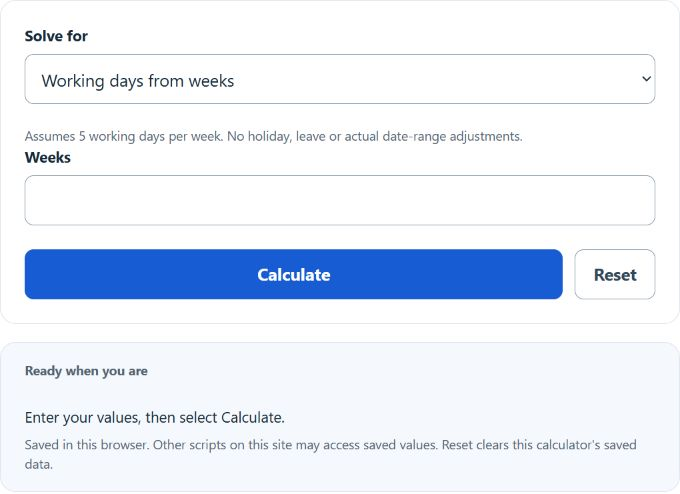
Convert weeks to working days or working days to weeks using a standard 5-day workweek for quick business schedule and time planning.
| Weeks to Working Days | Working Days to Weeks |
|---|---|
| 0.5 weeks = 2.5 working days | 1 working day = 0.2 weeks |
| 1 week = 5 working days | 2 working days = 0.4 weeks |
| 2 weeks = 10 working days | 3 working days = 0.6 weeks |
| 3 weeks = 15 working days | 5 working days = 1 week |
| 4 weeks = 20 working days | 7 working days = 1.4 weeks |
| 5 weeks = 25 working days | 10 working days = 2 weeks |
| 6 weeks = 30 working days | 15 working days = 3 weeks |
| 7 weeks = 35 working days | 20 working days = 4 weeks |
| 8 weeks = 40 working days | 22 working days = 4.4 weeks |
| 10 weeks = 50 working days | 25 working days = 5 weeks |
| 12 weeks = 60 working days | 30 working days = 6 weeks |
| 13 weeks = 65 working days | 40 working days = 8 weeks |
| 14 weeks = 70 working days | 45 working days = 9 weeks |
| 15 weeks = 75 working days | 50 working days = 10 weeks |
| 16 weeks = 80 working days | 60 working days = 12 weeks |
| 20 weeks = 100 working days | 65 working days = 13 weeks |
| 24 weeks = 120 working days | 80 working days = 16 weeks |
| 26 weeks = 130 working days | 100 working days = 20 weeks |
| 40 weeks = 200 working days | 125 working days = 25 weeks |
| 52 weeks = 260 working days | 220 working days = 44 weeks |
| Formulas: working days = weeks x 5 and weeks = working days / 5. Assumes a 5-day work week (excludes holidays). | |
- All Unit Converters
- Weeks To Go Calculator
- Days To Working Hours Calculator
- Days To Months Calculator
- Days To Years Calculator
- Years To Days Calculator
- Months Into Years Calculator
Weeks To Working Days Formula
The following formula converts weeks to working days under a fixed five-day workweek assumption. It does not count a specific calendar interval.
Variables:
- WD is the number of working days
- W is the number of weeks
To calculate the number of working days, multiply the number of weeks by 5 (considering a five-day work week from Monday to Friday). This gives a proportional baseline; fractional weeks do not necessarily contain exactly that many actual working dates. Holidays and leave are not subtracted.
What Are Working Days?
A working day (also called a business day) is any day when most commercial and government operations are active. In the United States, Canada, the United Kingdom, and most of Europe, working days run Monday through Friday, giving each calendar week 5 working days and 2 weekend rest days. This Monday-to-Friday pattern became standard across most Western economies by the mid-1950s. The concept of a two-day weekend only became widespread after decades of labor organizing; before the 1930s, six-day work weeks were the norm in the U.S.
Working days exclude weekends and, in most practical contexts, also exclude public holidays. That distinction matters because the simple formula WD = W x 5 gives a baseline number that does not account for holidays. A standard calendar year contains 52 weeks and 1 extra day (or 2 in a leap year), yielding 260 to 262 weekdays before subtracting any holidays.
Working Days Per Month in 2026 (United States)
The actual number of working days in a given month depends on how weekdays fall on the calendar and which federal holidays occur. Below is the month-by-month breakdown for the United States in 2026, accounting for all 11 observed federal holidays for a Monday-to-Friday schedule, including Independence Day observed on Friday, July 3.
| Month | Working Days | Quarter Total |
|---|---|---|
| January | 20 | Q1: 61 |
| February | 19 | |
| March | 22 | |
| April | 22 | Q2: 63 |
| May | 20 | |
| June | 21 | |
| July | 22 | Q3: 64 |
| August | 21 | |
| September | 21 | |
| October | 21 | Q4: 62 |
| November | 19 | |
| December | 22 | |
| 2026 Total: 250 working days (261 weekdays minus 11 federal holidays on weekdays) | ||
February and November are the shortest working months in 2026 at 19 days each. March, April, July, and December are tied for the longest at 22 days. Q3 offers the most working days (64), while Q1 has the fewest (61).
Working Days and Hours by Country
Working schedules vary by employer and country. Average weekly hours do not determine how many days an individual works: a short average may reflect part-time work, shorter days or a mix of schedules. Use the actual scheduled working days per week for planning.
| Scheduled days per week | Working days over 52 weeks |
|---|---|
| 4 | 208 |
| 5 (this calculator) | 260 |
| 6 | 312 |
| Arithmetic scenarios, not country statistics or actual calendar-year counts. | |
The table shows schedule assumptions only. OECD hours-worked measures include full-time and part-time work; dividing average hours by eight is not a reliable way to infer actual working days.
The Four-Day Work Week Movement
The definition of a working day is actively evolving. As of 2025, several countries have implemented or trialed four-day work weeks. Belgium legislated a four-day option in 2022. Iceland ran public sector trials from 2015 to 2019; by 2022, over 51% of its workforce had shifted to shorter schedules. Germany ran a 41-company pilot in 2023-2024, after which 73% wanted to continue. Tokyo introduced a four-day week for government employees starting April 2025. In the UK, over 2.7 million workers (11% of the workforce) reported working a four-day week as of 2025.
For a four-day work week, the adjusted formula is WD = W x 4, yielding 208 working days over exactly 52 weeks before holidays and leave, compared with 260 under a five-day schedule.
Where Weeks-to-Working-Days Conversions Matter
Converting weeks to working days comes up in project management, payroll, and legal contexts. A 12-week project is 60 working days, but if it spans a quarter with 3 federal holidays, you actually have 57 productive days. The table’s 250-day total applies to a Monday-to-Friday 2026 schedule observing the listed U.S. federal holidays. Individual employers, leave policies and pay periods can differ; actual payroll requires the applicable schedule and hours.
Legal rules can define business days differently. The FTC Cooling-Off Rule includes Saturdays and excludes Sundays and federal holidays; this five-day converter does not calculate that deadline. FMLA leave is measured against an eligible employee’s normal workweek, so 12 workweeks is not universally 60 working days. Consult the applicable rule and schedule rather than this baseline converter.