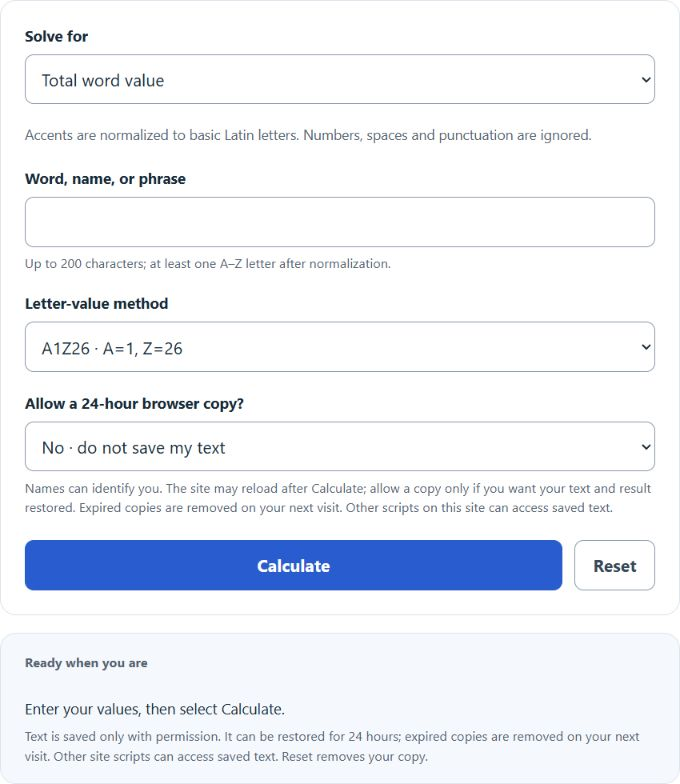
Calculate a word, name, or phrase total or digital root using A1Z26, reverse alphabet, Pythagorean, or English Scrabble letter values. With permission, your text can be restored for 24 hours; expired copies are removed on your next visit.
Related Calculators
- Round to the Nearest Tenth Calculator
- Common Difference Calculator
- Fourth Root Calculator (4th Sqrt)
- Natural Log Calculator
- All Math and Numbers Calculators
Word Value Formula
The calculator converts each letter to a number using the chosen scheme, then combines those numbers based on the selected output.
Sum = v(L1) + v(L2) + … + v(Ln).
For N > 0: DigitalRoot(N) = 1 + ((N − 1) mod 9).
- v(L) = numeric value assigned to letter L by the chosen method
- L1…Ln = each countable A–Z letter after normalization
- N = the raw sum to reduce
- DigitalRoot(0) = 0
Assumptions: text is case insensitive and Unicode compatibility normalization removes common Latin accents (café becomes CAFE). Only resulting A–Z letters count; numbers, spaces, punctuation and remaining characters are ignored. A1Z26 and Pythagorean sums have the same digital root for the same counted letters.
Calculator modes:
- Total word value adds the chosen letter values across the whole input.
- Digital root repeatedly adds the digits of the letter-value sum until one digit remains.
- Browser copy is off by default. You can allow your text to be restored for 24 hours after Calculate; Reset removes that copy. Other scripts on this site can access browser storage.
Letter Value Reference Tables
Use the four supported method columns to spot-check results. The existing Chaldean and Phone columns are supplemental references; they are not calculator options.
| Letter | A1Z26 | Reverse | Pythagorean | Chaldean | Phone | Scrabble |
|---|---|---|---|---|---|---|
| A | 1 | 26 | 1 | 1 | 2 | 1 |
| E | 5 | 22 | 5 | 5 | 3 | 1 |
| I | 9 | 18 | 9 | 1 | 4 | 1 |
| M | 13 | 14 | 4 | 4 | 6 | 3 |
| Q | 17 | 10 | 8 | 1 | 7 | 10 |
| S | 19 | 8 | 1 | 3 | 7 | 1 |
| W | 23 | 4 | 5 | 6 | 9 | 4 |
| Z | 26 | 1 | 8 | 7 | 9 | 10 |
Common reference totals to sanity check your output:
| Word | A1Z26 sum | Digital root | Scrabble sum |
|---|---|---|---|
| CAT | 24 | 6 | 5 |
| LOVE | 54 | 9 | 7 |
| HELLO | 52 | 7 | 8 |
| QUIZ | 73 | 1 | 22 |
| ABCDEFGHIJKLMNOPQRSTUVWXYZ | 351 | 9 | 87 |
Worked Examples and FAQ
Example 1: A1Z26 sum of CODE. C=3, O=15, D=4, E=5. Sum = 3 + 15 + 4 + 5 = 27. Digital root = 2 + 7 = 9.
Example 2: Pythagorean reduction of NAME. N=5, A=1, M=4, E=5. Sum = 15. Digital root = 6.
Example 3: Scrabble score of QUIZ. Q=10, U=1, I=1, Z=10. Sum = 22. This matches the raw tile score before any board bonuses.
Example 4: Reverse alphabet. CAT has C=24, A=26 and T=7. Its total is 57 and its digital root is 3.
Why does my digital root differ between methods? Method assignments can change the sum and root. A1Z26 and Pythagorean always have the same digital root for the same counted letters: HELLO gives sums 52 and 25, both with root 7. Reverse alphabet and Scrabble use different assignments.
What happens to spaces, punctuation, and accents? Spaces and punctuation are ignored. Accents are stripped before counting, so É is treated as E.
Are numbers included? No. Digits are ignored; at least one A–Z letter after normalization is required.
What does the score mean? It is the result of the selected letter-scoring rule. It does not establish a personal trait, outcome or prediction.
Are Chaldean and phone-keypad methods available? Those columns remain as supplemental article references. The calculator offers A1Z26, reverse alphabet, Pythagorean and English Scrabble.