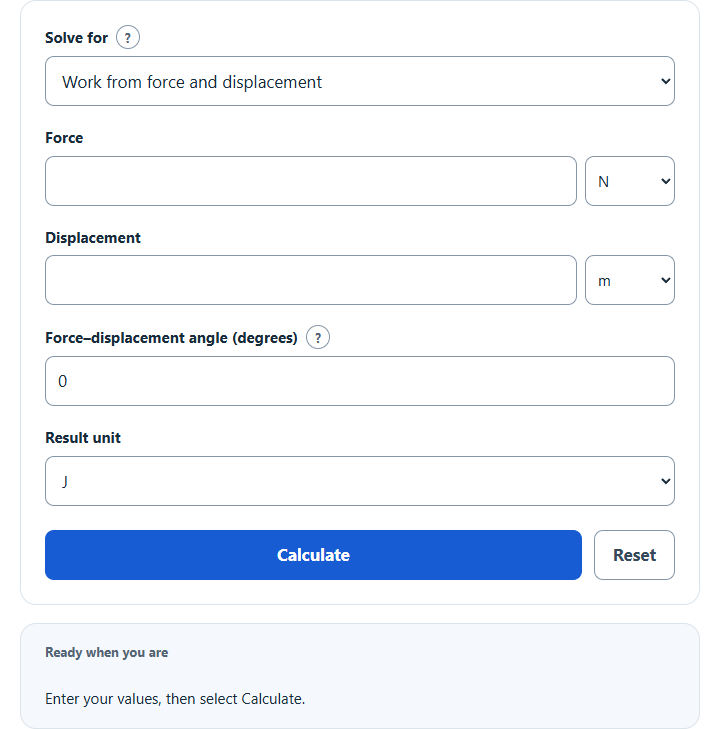
Calculate work from force, displacement, and angle, find power from work and time, or estimate incline net work using mass and friction.
Work Formula
Work is the total amount of energy exerted on an object or system through some force over a distance. Work can be calculated through the following formula.
- Where W is the work
- F is the total force
- D is the total displacement
To calculate work, simply multiply the force by the displacement or distance.
This equation applies when force is applied to an object directly at 0 degrees. When a force is applied at an angle, the formula will be the following:
W = F × d × cos(θ), where θ is the angle between force and displacement.
Theta is the angle of force applied relative to the displacement of the object. The SI unit of work is the joule (J). The SI units for force and distance (displacement) are newtons (N) and meters (m), respectively. Choose each input unit and the result unit. The calculator converts supported quantities through SI units; angles are entered in degrees. The level-friction method retains the approximation N = mg, and the incline method includes gravity and kinetic friction only.
How to calculate work
As we know from the equation above, work is calculated through the product of force and distance. This force is then a product of mass and acceleration. So to calculate work, the first step is to calculate acceleration. To do that, you can visit the acceleration calculator or simply use the formula F=ma.
The next step is to calculate distance. This can be done in several ways. If two coordinate points are given, you can simply calculate the distance through the distance between points calculator or a formula. Other times, the total distance can be calculated through the average velocity. Simply take the average velocity of an object and multiply it by the total time passed.
Now that you have your force and distance, simply multiply the two values to get work. Sometimes, however, the force acting on an object is not acting directly in the same direction as the movement. In these cases, you must take into consideration the angle of the force, as explained in the above formula.
FAQ
Work is energy transferred by a force through displacement. For a constant force, W = Fd cos(θ).