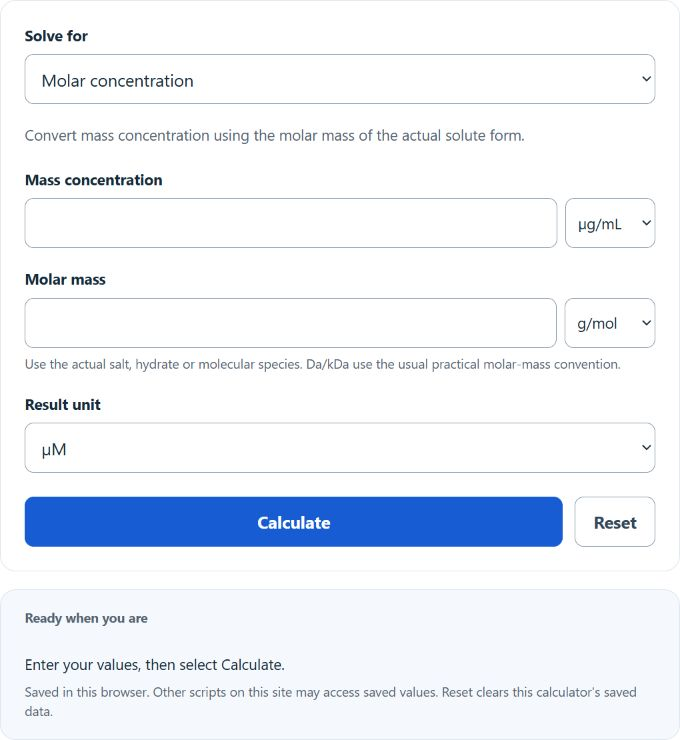
Choose molar concentration, mass concentration or molar mass, then enter the two known values and their units.
Common Mistakes Quick tips
- Choose the quantity to solve for, then enter the two displayed known quantities. The calculated answer appears in the result area.
- Mixing up mass units:
- mg/mL is 1000× larger than µg/mL.
- µg/L is 0.001× µg/mL.
- mg/L is numerically equal to µg/mL (1 mg/L = 1 µg/mL).
- Choosing the wrong molecular-weight unit:
- kDa vs Da: molecular mass of 50 kDa practically corresponds to molar mass of 50,000 g/mol. Entering 50 Da instead changes the value by 1000×.
- mg/mol vs g/mol: entering a g/mol value while “mg/mol” is selected causes a 1000× error.
- Da is treated numerically the same as g/mol for practical conversions; this is not an exact metrological identity under the current SI.
- Using the wrong molar mass for the compound form. Use the molar mass of the actual species in solution (e.g., salt or hydrate), not the free base/acid unless that’s what you prepared.
- Reading the result in the wrong unit. mM, µM, nM, and pM differ by powers of 1000; a unit mismatch causes 10³–10⁶ errors.
- Negative concentrations are invalid and molar mass must be positive. Zero concentration is valid for conversion with a known molar mass; both concentrations must be positive to infer molar mass.
- Applying this to mixtures/polymers with broad MW distributions. Results will be approximate at best.
When to Use This Calculator
- Convert a mass concentration (µg/mL, mg/mL, µg/L, mg/L) to molarity (µM, mM, nM, pM) when the molecular weight is known.
- Determine what mass concentration you need to reach a target molarity for solution prep.
- Solve for molecular weight from known mass concentration and molarity (sanity-checks for compounds, peptides, or oligomers).
- Standardize units across protocols, publications, or instruments that report different units.
- Not a dilution or %w/v calculator—use a dedicated dilution tool to compute mix volumes.
Input Definitions
- Concentration — mass per volume of the solute.
- µg/mL — micrograms per milliliter (base mass unit in this tool).
- mg/mL — milligrams per milliliter (1 mg/mL = 1000 µg/mL).
- µg/L — micrograms per liter (1 µg/L = 0.001 µg/mL).
- mg/L — milligrams per liter (1 mg/L = 1 µg/mL).
- Molecular Weight (Molar Mass) — mass of one mole of the compound.
- g/mol — base unit.
- mg/mol — 0.001 g/mol.
- kDa — kilodalton; its numerical value is multiplied by 1000 for the practical g/mol convention.
- Da — dalton; numerically treated as g/mol for practical molar-mass entries.
- Molar concentration — amount of solute per volume of solution.
- µM — micromolar (base molar unit in this tool).
- mM — millimolar (1 mM = 1000 µM).
- nM — nanomolar (1 µM = 1000 nM).
- pM — picomolar (1 µM = 1,000,000 pM).
- Formulas used
- µM = (µg/mL ÷ g/mol) × 1000
- µg/mL = (µM × g/mol) ÷ 1000
- g/mol = (µg/mL ÷ µM) × 1000
- All Chemistry Calculators
- M to mg/mL Calculator
- Medical and Health Unit Converters
- mM to mg/mL Calculator
- µg/mL to Molarity Converter
- mg/mL to Molarity Calculator
- ng/mL to Molarity Calculator
µg/mL to µM Conversion Formula
The following formula is used to convert µg/mL to µM.
Variables:
- µM is the concentration in micromolar
- µg/mL is the concentration in micrograms per milliliter
- MW is the molecular weight in grams per mole (g/mol)
To convert µg/mL to µM, divide the concentration in µg/mL by the molecular weight in g/mol and then multiply by 1000 to convert to micromolar.
What is µg/mL to µM Conversion?
Converting µg/mL to µM is a common task in chemistry and biology, particularly in the context of preparing solutions for experiments. The concentration in µg/mL measures the mass of a substance in micrograms present in one milliliter of solution, while µM measures micromoles of a substance per liter of solution. This conversion is necessary when the molecular weight of the substance is known and one needs to express concentration in terms of molarity, which is a more useful unit in chemical reactions.
How to Calculate µg/mL to µM?
The following steps outline how to convert µg/mL to µM.
- First, determine the concentration in µg/mL.
- Next, determine the molecular weight (MW) of the substance in g/mol.
- Use the formula µM = (µg/mL / MW) * 1000.
- Finally, calculate the concentration in µM.
- After inserting the variables and calculating the result, check your answer with the calculator above.
Example Problem :
Use the following variables as an example problem to test your knowledge.
Concentration (µg/mL) = 150 µg/mL
Molecular Weight (g/mol) = 300 g/mol. The result is (150 ÷ 300) × 1000 = 500 µM.