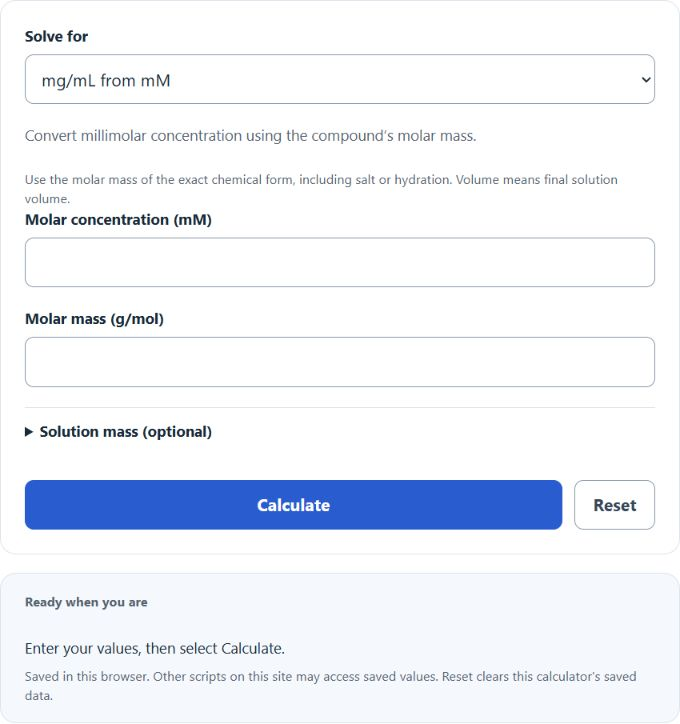
Convert between millimolar (mM) and mg/mL concentrations using the molar mass of the exact chemical form. Optionally enter a final solution volume to calculate solute mass.
| mM to mg/mL | mg/mL to mM |
|---|---|
| 0.1 mM = 0.00584 mg/mL | 0.01 mg/mL = 0.171 mM |
| 0.2 mM = 0.0117 mg/mL | 0.05 mg/mL = 0.856 mM |
| 0.5 mM = 0.0292 mg/mL | 0.1 mg/mL = 1.711 mM |
| 1 mM = 0.0584 mg/mL | 0.25 mg/mL = 4.278 mM |
| 2 mM = 0.1169 mg/mL | 0.5 mg/mL = 8.556 mM |
| 5 mM = 0.2922 mg/mL | 0.5844 mg/mL = 10.00 mM |
| 10 mM = 0.5844 mg/mL | 1 mg/mL = 17.11 mM |
| 25 mM = 1.461 mg/mL | 2 mg/mL = 34.22 mM |
| 50 mM = 2.922 mg/mL | 5 mg/mL = 85.56 mM |
| 75 mM = 4.383 mg/mL | 9 mg/mL = 154.0 mM |
| 100 mM = 5.844 mg/mL | 10 mg/mL = 171.1 mM |
| 154 mM = 9.000 mg/mL | 15 mg/mL = 256.7 mM |
| 200 mM = 11.688 mg/mL | 20 mg/mL = 342.2 mM |
| 250 mM = 14.610 mg/mL | 25 mg/mL = 427.8 mM |
| 300 mM = 17.532 mg/mL | 30 mg/mL = 513.4 mM |
| 500 mM = 29.220 mg/mL | 50 mg/mL = 855.6 mM |
| 1000 mM (1 M) = 58.440 mg/mL | 58.44 mg/mL = 1000 mM (1 M) |
| 2000 mM (2 M) = 116.880 mg/mL | 100 mg/mL = 1711 mM |
| 3000 mM (3 M) = 175.320 mg/mL | 150 mg/mL = 2567 mM |
| 5000 mM (5 M) = 292.200 mg/mL | 200 mg/mL = 3422 mM |
| NaCl MW = 58.44 g/mol. Formulas: mg/mL = (mM x MW) / 1000 and mM = (mg/mL x 1000) / MW. | |
- All Chemistry Calculators
- mM to µg/mL Calculator
- mmol to Grams Calculator
- mg/mL to Molarity Calculator
- Molarity Calculator
- ng/mL to Molarity Calculator
- PPM to Molarity Calculator
mM to mg/mL Formula
To convert a millimolar concentration to mg/mL, multiply the concentration by the molecular weight and divide by 1000:
C = mM * MW / 1000
To go the other way and find the molar concentration from a mass concentration, rearrange the same relationship:
mM = C * 1000 / MW
Variables:
- C is the mass concentration in mg/mL
- mM is the molar concentration in millimolar, which means millimoles per liter (mmol/L)
- MW is the molecular weight, or molar mass, of the compound in g/mol
- 1000 is the factor that accounts for the difference between the liter used in molarity and the milliliter used in mg/mL, and between grams and milligrams
Pick what you want to find at the top of the calculator. In “mg/mL from mM” mode you enter a millimolar concentration and the molar mass, and the tool returns the mass concentration. In “mM from mg/mL” mode you enter a mg/mL value and the molecular weight, and the tool returns the millimolar concentration. The molecular weight is required in both modes because millimolar counts moles while mg/mL measures mass, and the molar mass is what links the two.
If you also enter a solution volume, the calculator returns the mass you need to weigh out to prepare that solution, using mass in mg equal to the mass concentration times the volume in mL:
mass(mg) = C * V(mL)
mg/mL Values at Common Molecular Weights
This table shows the mg/mL concentration for a 1 mM and a 10 mM solution of several common lab compounds. Because a 1 mM solution equals MW divided by 1000 in mg/mL, you can scale any of these up or down with the concentration.
| Compound | MW (g/mol) | 1 mM (mg/mL) | 10 mM (mg/mL) |
|---|---|---|---|
| Sodium chloride (NaCl) | 58.44 | 0.0584 | 0.584 |
| Glycine | 75.07 | 0.0751 | 0.751 |
| Tris | 121.14 | 0.121 | 1.211 |
| Glucose | 180.16 | 0.180 | 1.802 |
| Caffeine | 194.19 | 0.194 | 1.942 |
| HEPES | 238.30 | 0.238 | 2.383 |
| EDTA (free acid) | 292.24 | 0.292 | 2.922 |
| Sucrose | 342.30 | 0.342 | 3.423 |
The next table lists the unit relationships the conversion relies on, so you can move between molar and mass units without redoing the whole calculation.
| Relationship | Equivalent |
|---|---|
| 1 M | 1000 mM |
| 1 mM | 1000 µM |
| 1 mM | 1 mmol/L |
| 1 mg/mL | 1000 µg/mL |
| 1 mg/mL | 1 g/L |
| 1 µg/mL | 1 mg/L |
Example Problems
Example 1: Convert mM to mg/mL.
You have a 5 mM caffeine solution and want its concentration in mg/mL. Caffeine has a molecular weight of 194.19 g/mol. Multiply the concentration by the molecular weight and divide by 1000:
C = 5 * 194.19 / 1000 = 0.97095 mg/mL (about 0.971 mg/mL). The solute mass for a final solution volume of 50 mL is 0.97095 * 50 = 48.5475 mg (about 48.5 mg).
Example 2: Convert mg/mL to mM.
Normal saline is 9 mg/mL sodium chloride, which has a molecular weight of 58.44 g/mol. Multiply the mass concentration by 1000 and divide by the molecular weight:
mM = 9 * 1000 / 58.44 ≈ 154.004 mM. So 9 mg/mL saline is about 154 mM in sodium chloride.
Frequently Asked Questions
Do you need the molecular weight to convert mM to mg/mL?
Yes. Millimolar counts the number of moles in a liter, while mg/mL measures mass in a volume, so you need the molecular weight to move between a count of molecules and a mass. The two numbers are only equal when the molecular weight is exactly 1000 g/mol. For anything lighter the mg/mL value is smaller than the mM value, and for anything heavier it is larger.
Is mM the same as mmol/mL?
No. Millimolar means millimoles per liter, not per milliliter. One mM is 1 mmol/L, which is 0.001 mmol/mL. Mixing these up shifts the result by a factor of 1000, so keep the concentration on a per-liter basis when you apply the formula.
How do you convert mg/mL back to mM?
Multiply the mg/mL value by 1000 and divide by the molecular weight. For example, 2 mg/mL of a compound with a molecular weight of 250 g/mol is 2 * 1000 / 250 = 8 mM. Switch the calculator to “mM from mg/mL” mode to do this automatically. Use the molar mass of the exact salt, hydrate or other chemical form. These relationships use final solution volume and do not require a dilute aqueous solution.