Calculate mass in grams from mmol and molar mass, or solve for amount or molar mass with μmol, mmol, mol, mg, g, kg and g/mol units.
| mmol to grams | grams to mmol |
|---|---|
| 0.1 mmol = 0.00584 g | 0.01 g = 0.171 mmol |
| 0.25 mmol = 0.01461 g | 0.02 g = 0.342 mmol |
| 0.5 mmol = 0.02922 g | 0.05 g = 0.856 mmol |
| 1 mmol = 0.05844 g | 0.1 g = 1.711 mmol |
| 2 mmol = 0.1169 g | 0.25 g = 4.278 mmol |
| 5 mmol = 0.2922 g | 0.5 g = 8.556 mmol |
| 10 mmol = 0.5844 g | 1 g = 17.11 mmol |
| 25 mmol = 1.461 g | 2 g = 34.22 mmol |
| 50 mmol = 2.922 g | 5 g = 85.56 mmol |
| 100 mmol = 5.844 g | 10 g = 171.1 mmol |
| Formulas: grams = (mmol × M) ÷ 1000 and mmol = (grams × 1000) ÷ M. Table assumes NaCl molar mass M = 58.44 g/mol. | |
| mmol to grams | grams to mmol |
|---|---|
| 0.1 mmol = 0.01802 g | 0.02 g = 0.111 mmol |
| 0.25 mmol = 0.04504 g | 0.05 g = 0.277 mmol |
| 0.5 mmol = 0.09008 g | 0.1 g = 0.555 mmol |
| 1 mmol = 0.1802 g | 0.2 g = 1.110 mmol |
| 2 mmol = 0.3603 g | 0.5 g = 2.775 mmol |
| 5 mmol = 0.9008 g | 1 g = 5.550 mmol |
| 10 mmol = 1.802 g | 2 g = 11.10 mmol |
| 20 mmol = 3.603 g | 5 g = 27.75 mmol |
| 50 mmol = 9.008 g | 10 g = 55.50 mmol |
| 100 mmol = 18.02 g | 20 g = 111.0 mmol |
| Formulas: grams = (mmol × M) ÷ 1000 and mmol = (grams × 1000) ÷ M. Table assumes glucose molar mass M = 180.16 g/mol. | |
- All Chemistry Calculators
- mmol/L to mg/dL Calculator
- mmol/L to Grams Calculator
- Grams to Millimolar Calculator
- Moles to Mass Calculator
- g-mol to Grams Calculator
- mmol to mEq Converter
mmol to Grams Formula
The amount in millimoles is turned into a mass using the molar mass of the substance:
grams = mmol * M / 1000
The calculator rearranges the same relationship to solve for the amount or the molar mass instead:
mmol = grams * 1000 / M
M = grams * 1000 / mmol
Variables:
- grams is the mass of the sample (g)
- mmol is the amount of substance (millimoles)
- M is the molar mass of the substance (g/mol)
- 1000 is the number of millimoles in one mole, which links mmol to grams
Set “Solve for” to Mass in grams to turn an amount into a weight, to Amount in mmol to find how many millimoles a given weight contains, or to Molar mass when you already know the amount and the mass. The compound list fills the molar mass field with common values, so you do not have to add up atomic weights by hand. The unit menus let you enter umol, mmol, or mol for the amount and ug, mg, g, or kg for the mass.
Common Molar Masses and Conversion Reference
The molar mass sets the size of every mmol to grams conversion. These are the values used by the compound list in the calculator.
| Compound | Formula | Molar mass (g/mol) |
|---|---|---|
| Water | H2O | 18.02 |
| Sodium chloride | NaCl | 58.44 |
| Glucose | C6H12O6 | 180.16 |
| Sucrose | C12H22O11 | 342.30 |
| Sodium hydroxide | NaOH | 40.00 |
| Sodium bicarbonate | NaHCO3 | 84.01 |
| Potassium chloride | KCl | 74.55 |
| Calcium carbonate | CaCO3 | 100.09 |
| Hydrochloric acid | HCl | 36.46 |
| Sulfuric acid | H2SO4 | 98.08 |
| Acetic acid | CH3COOH | 60.05 |
| Ethanol | C2H5OH | 46.07 |
This table shows the grams produced by a given number of millimoles for two common compounds, so you can check the calculator against a known value.
| Amount (mmol) | NaCl (58.44 g/mol) | Glucose (180.16 g/mol) |
|---|---|---|
| 1 | 0.05844 g | 0.1802 g |
| 2 | 0.1169 g | 0.3603 g |
| 5 | 0.2922 g | 0.9008 g |
| 10 | 0.5844 g | 1.802 g |
| 25 | 1.461 g | 4.504 g |
| 50 | 2.922 g | 9.008 g |
| 100 | 5.844 g | 18.02 g |
Example Problems
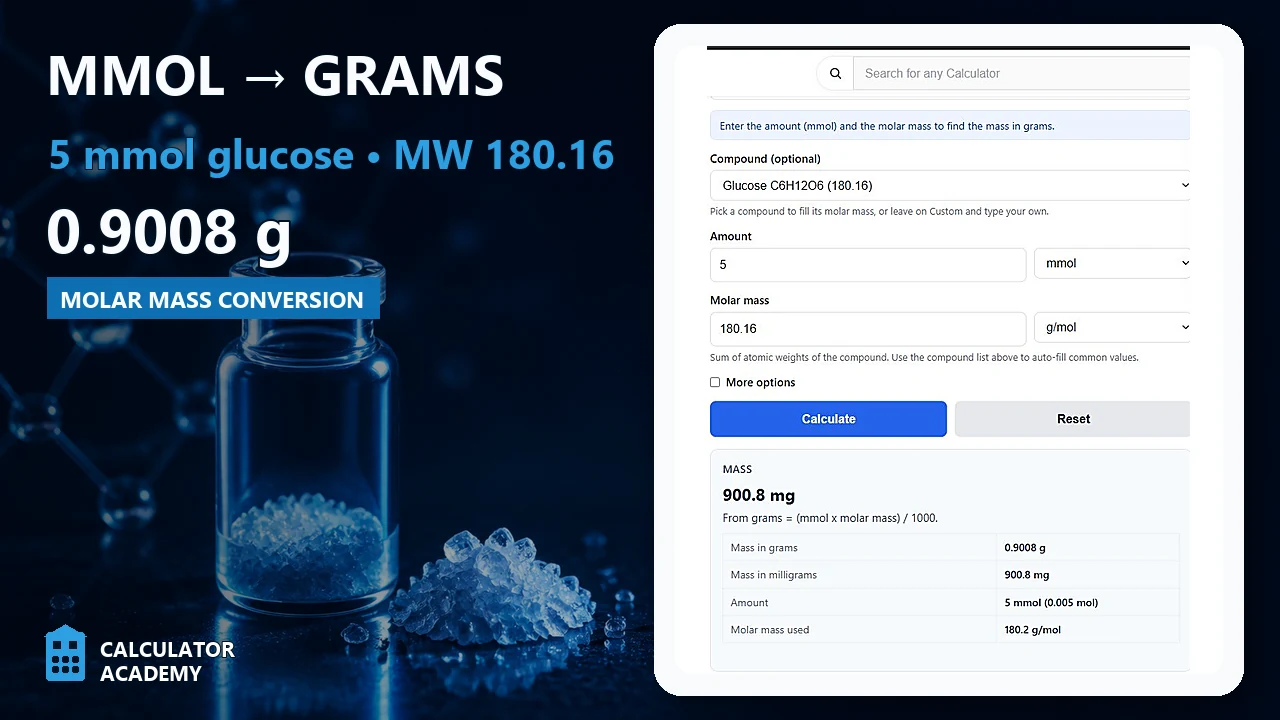
Example 1: mmol to grams. You have 5 mmol of glucose, which has a molar mass of 180.16 g/mol. Multiply the amount by the molar mass and divide by 1000: grams = 5 * 180.16 / 1000 = 0.9008 g. So 5 mmol of glucose weighs about 0.9 g.
Example 2: grams to mmol. You weigh out 10 g of sodium chloride (NaCl), molar mass 58.44 g/mol, and want the amount in millimoles: mmol = 10 * 1000 / 58.44 = 171.1 mmol. Set “Solve for” to Amount in mmol to get this result directly.
FAQ
Do you need the molar mass to convert mmol to grams?
Yes. Millimoles count particles, while grams measure mass, so you need the molar mass of the specific substance to move between them. Two samples with the same number of millimoles weigh different amounts when their molar masses differ.
How do you get milligrams instead of grams?
Milligrams come from the amount without the divide by 1000, since mg = mmol * M. You can also read the milligram value from the results table, or set the mass unit to mg when you solve for the amount.
Is mmol the same as millimolar (mM)?
No. A millimole (mmol) is an amount of substance. Millimolar (mM) is a concentration, equal to millimoles per liter. To turn mM into grams you first multiply by the solution volume in liters to get mmol, then convert that amount to grams with the molar mass.