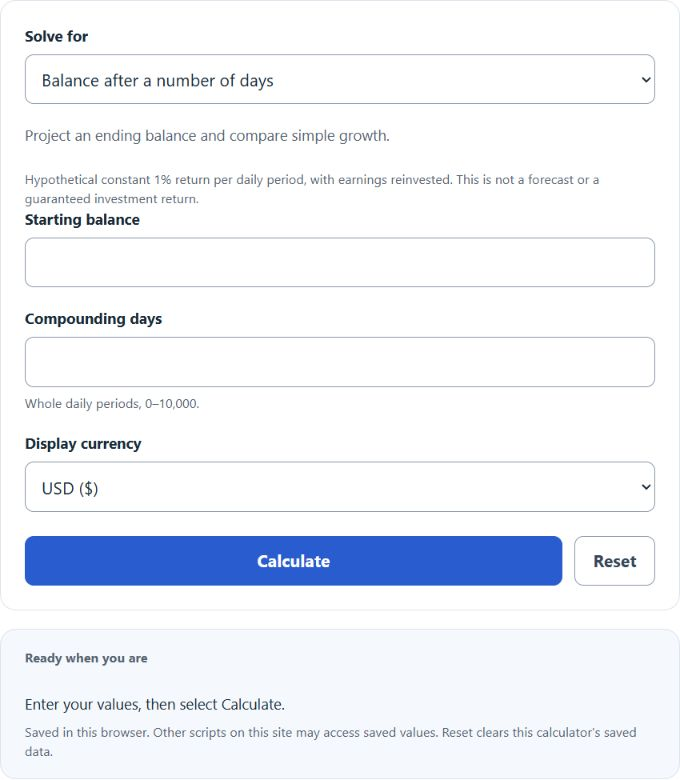
Project a starting balance compounded at 1% per day, compare simple growth, or calculate how many days a target balance would take to reach.
1 Percent Daily Return Formula
The following equation is used to calculate the 1 Percent Daily Return.
- Where FR is the final balance, including principal ($)
- PI is the principal or initial investment ($)
- D is the number of days
To calculate the final amount after a 1% daily return, multiply the principal by 1.01 raised to the number of days.
What is a 1 Percent Daily Return?
Definition:
In this calculator, a 1 percent daily return is a hypothetical constant growth assumption: the balance increases by 1% each daily period and all gains are reinvested. It illustrates compounding rather than predicting real investment performance.
How to Calculate 1 Percent Daily Return?
Example Problem:
The following example outlines the steps and information needed to calculate the 1 Percent Daily Return.
First, determine the number of days. In this example, an investor plans to invest for 10 days.
Next, determine the principal. Here, the initial investment is $1,000.
Finally, calculate the final return using the formula above:
FR = 1,000 x (1.01)^10
FR ≈ $1,104.62
After 10 days, the investment has grown to approximately $1,104.62.
FAQ
What factors can affect a 1% daily return?
Actual investment returns vary and can be negative. Market volatility, fees, taxes and other conditions affect results. The calculator assumes a constant 1% daily rate and excludes these effects; it does not establish that any instrument can reliably deliver or guarantee that return.
Is a 1% daily return guaranteed for all investments?
No. This mathematical assumption is not a guarantee or an expectation. Real investments can lose principal, and results depend on the asset, market conditions, costs and risks.
How does compounding daily at 1% compare to other compounding intervals?
When the same positive annual nominal rate is divided consistently across periods, more frequent compounding increases the effective annual rate. A stated 1% daily rate is different from 1% annually: for N daily periods its effective return is (1.01)^N − 1. This calculator uses the entered number of daily periods and no deposits or withdrawals.