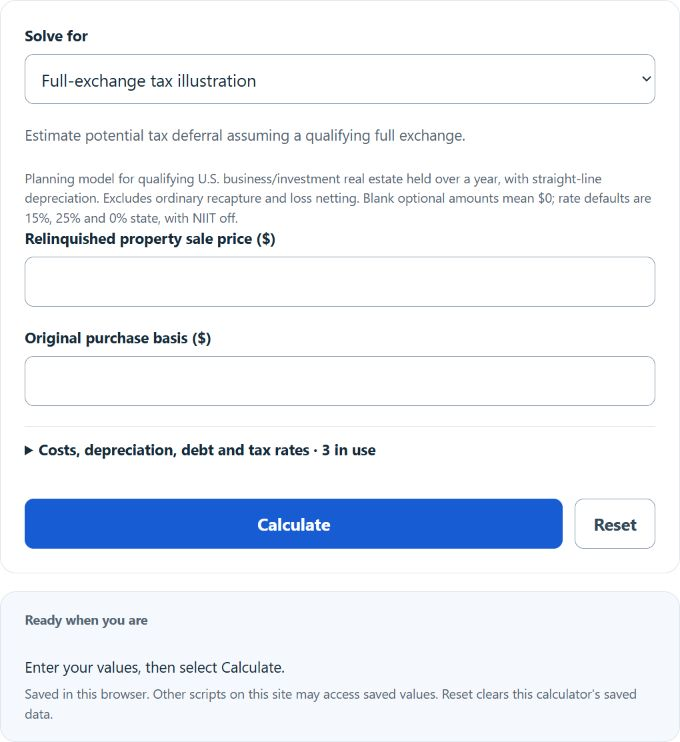
Illustrate potential 1031 tax deferral and tax on partial-exchange boot under a restricted planning model, and calculate ordinary 45-day and exchange-period limits.
1031 Exchange Formula
AB = PP + CI - D
RG = SP - SC - AB
G = max(RG, 0)
U = min(D, G)
TD = U*UR + (G-U)*CG
     + G*SR + G*NIIT
Debt Boot = max(
  Old Debt - New Debt - Added Cash,
  0
)
Recognized Gain = min(
  max(RG, 0),
  Net Cash + Debt Boot
)
NB = RP - (
  RG - Recognized Gain
)
- AB is the adjusted basis of the property you are selling ($)
- PP is the original purchase price ($)
- CI is the cost of capital improvements ($)
- D is depreciation allowed or allowable ($); U is the simplified assumed unrecaptured §1250 portion and UR is its selected planning rate (25% maximum-rate default)
- RG is the realized gain ($)
- SP is the sale price and SC is the selling costs ($)
- TD is the potential tax deferred in this simplified rate illustration ($)
- CG is your federal capital gains rate (0%, 15%, or 20%) and SR is your state rate
- NIIT is the 3.8% net investment income tax, if it applies to you
- RP is replacement property price and NB is the restricted model’s replacement basis ($). Net Cash is actual sale cash retained after the entered costs; Added Cash is new cash contributed.
The tax modes are planning illustrations for qualifying U.S. business or investment real property held over one year with straight-line depreciation. Adjusted basis and realized gain are calculated from the supplied values. Additional cash contributed offsets net debt relief, while extra borrowing does not erase actual cash boot. Replacement financing must balance. The model assumes the lesser of depreciation and modeled taxable gain is unrecaptured §1250 gain and applies the selected rate; 25% is a ceiling illustration, not automatic recapture tax. Ordinary recapture, §1231 lookback, loss netting, noncash boot and replacement costs are excluded. Replacement basis subtracts unrecognized realized gain or adds unrecognized loss. Date mode shows day 45 and the earlier of day 180 or the supplied applicable return due date, including extensions; special relief is not applied.
Tax Rates Deferred and State Clawback Rules
The first table shows the 2026 federal rates that apply if you sell an investment property outright instead of exchanging. The calculator uses selected rates for a simplified illustration; it does not derive your actual tax bracket, §1250 allocation, state liability or NIIT limitation.
| Tax | Rate | Applies to (2026) |
|---|---|---|
| Long-term capital gains | 0% | Taxable income up to $49,450 single / $98,900 joint |
| Long-term capital gains | 15% | Up to $545,500 single / $613,700 joint |
| Long-term capital gains | 20% | Income above the 15% thresholds |
| Unrecaptured Section 1250 gain | Up to 25% | Gain attributable to depreciation taken |
| Net investment income tax | 3.8% | MAGI thresholds: $200,000 single/head of household, $250,000 joint/qualifying surviving spouse, $125,000 married filing separately. The tax applies to the lesser of net investment income or excess MAGI. |
State sourcing and reporting rules can preserve obligations after an out-of-state exchange. The following examples do not replace the originating state’s current filing and sourcing requirements.
| State | Clawback rule |
|---|---|
| California | An exchange of California property for out-of-state replacement property generally requires annual Form FTB 3840 reporting while California-source gain remains deferred. |
| Oregon | Form OR-24 reports qualifying out-of-state exchanges in the exchange year and annually afterward until disposition. |
| Massachusetts | On subsequent disposition, gain reflecting appreciation of Massachusetts real estate remains Massachusetts-source income. |
1031 Exchange Example Problems
Example 1: full-exchange planning illustration. You sell a rental for $800,000 with $48,000 in selling costs. You paid $500,000, added $50,000 in improvements, and claimed $150,000 of depreciation. Your adjusted basis is 500,000 + 50,000 – 150,000 = $400,000. Your realized gain is 800,000 – 48,000 – 400,000 = $352,000. At a 15% federal rate with a 5% state rate, the modeled tax is 150,000 * 0.25 + 202,000 * 0.15 + 352,000 * 0.05 = 37,500 + 30,300 + 17,600 = $85,400. Full-deferral modeling assumes replacement value of at least $752,000 and all equity reinvested, as well as every other qualification requirement.
Example 2: partial-exchange planning illustration. With the same sale and a $300,000 old payoff, net equity is $452,000. Buy a $682,000 replacement using a $280,000 new loan and $402,000 reinvested equity, retaining $50,000 and adding no new cash. Net debt boot is $20,000 and total boot is $70,000. Modeled recognized gain is $70,000. Under the simplified assumed §1250 allocation, 25% federal maximum-rate illustration and 5% state assumption, modeled tax is $21,000. Deferred gain is $282,000; replacement basis in this model is $682,000 − $282,000 = $400,000. Actual liability and allocation can differ.
1031 Exchange Frequently Asked Questions
What are the 45-day and 180-day deadlines? Ordinarily identify replacement property in signed writing to a qualified recipient, such as your qualified intermediary, within 45 calendar days after transfer. Receive the replacement by the earlier of 180 days after transfer or the applicable transfer-year return due date, including extensions. Both periods run together; weekends and holidays count. Qualifying IRS disaster relief can postpone deadlines. Confirm the applicable dates rather than assuming day 180 always controls.
Does a 1031 exchange eliminate the tax? No. A qualifying exchange generally defers recognition through the replacement property’s basis. Tax treatment at a later sale, exchange or inheritance depends on the applicable law and circumstances; deferral is not a guarantee of eventual tax elimination.
What property qualifies as like-kind? Any real property held for investment or productive use in a trade or business can be exchanged for any other such real property in the United States: a rental house for raw land, an office for an apartment building. Your primary residence does not qualify, property held mainly for resale such as a fix-and-flip does not qualify, and since 2018 personal property like equipment or vehicles is excluded.
Sources: IRS Form 8824 instructions, Publication 544, 2026 federal thresholds, NIIT guidance, California FTB 3840, Oregon OR-24, and Massachusetts sourcing regulation.