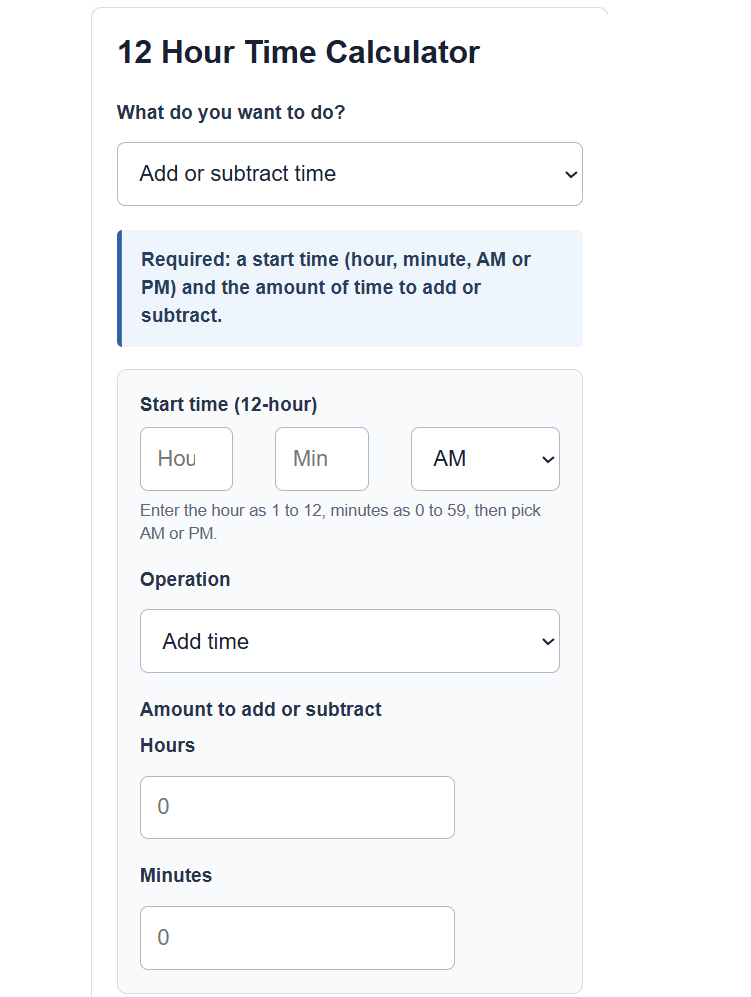
Calculate a new clock time, the time between two times, or convert between 12-hour and 24-hour format using AM and PM.
12 Hour Time Formula
The 12-hour clock runs from 12:00 to 11:59 twice a day, with AM for the hours after midnight and PM for the hours after noon. To do math on these times, you first turn the clock time into minutes since midnight, work in those minutes, then turn the answer back into a 12-hour time. The conversion that makes this possible is:
M = (H mod 12) * 60 + m + (720 if PM)
To add or subtract time, you adjust the start time by the elapsed minutes and wrap the result into a single 24-hour day:
result = (M_start +/- elapsed) mod 1440
To find the time between two times, you subtract the start from the end, adding a full day when the end falls earlier on the clock:
duration = (M_end - M_start + 1440) mod 1440
Where:
- M = the time written as minutes since midnight (0 to 1439)
- H = the hour shown on the 12-hour clock (1 to 12)
- m = the minutes shown on the clock (0 to 59)
- PM = adds 720 minutes (12 hours) for any PM time except 12 PM
- elapsed = the hours and minutes you are adding or subtracting, in minutes
- 1440 = the number of minutes in one full day, used to wrap past midnight
The “add or subtract” mode uses the second formula and reports a day offset whenever the answer crosses midnight, so you can see if the result lands on the next or previous day. The “time between” mode uses the third formula, and the +1440 term is what lets it handle an overnight span such as a shift that starts in the evening and ends the next morning. The “convert” mode uses only the first formula to move a time between 12-hour and 24-hour notation.
12-Hour to 24-Hour Conversion Chart
Every hour on the 12-hour clock maps to one hour on the 24-hour clock. AM hours keep the same number, except 12 AM which becomes 00. PM hours add 12, except 12 PM which stays 12.
| 12-hour | 24-hour | 12-hour | 24-hour |
|---|---|---|---|
| 12:00 AM | 00:00 | 12:00 PM | 12:00 |
| 1:00 AM | 01:00 | 1:00 PM | 13:00 |
| 2:00 AM | 02:00 | 2:00 PM | 14:00 |
| 6:00 AM | 06:00 | 6:00 PM | 18:00 |
| 9:00 AM | 09:00 | 9:00 PM | 21:00 |
| 11:00 AM | 11:00 | 11:00 PM | 23:00 |
The two cases people miss most often are the noon and midnight hours.
| Clock time | Meaning | 24-hour |
|---|---|---|
| 12:00 AM | Midnight (start of the day) | 00:00 |
| 12:00 PM | Noon (middle of the day) | 12:00 |
Example Problems
Example 1: Adding time. You start at 9:30 AM and add 2 hours and 45 minutes. In minutes since midnight, 9:30 AM is 570. The elapsed time is 2 x 60 + 45 = 165 minutes. Adding gives 570 + 165 = 735 minutes. Since 735 is less than 1440, it stays on the same day. Converting 735 back gives 12 hours and 15 minutes, which is 12:15 PM.
Example 2: Time between two times overnight. A shift runs from 10:00 PM to 6:00 AM. In 24-hour terms, 10:00 PM is 22:00 (1320 minutes) and 6:00 AM is 06:00 (360 minutes). Because the end is earlier than the start, add a full day: 360 + 1440 = 1800. The duration is 1800 – 1320 = 480 minutes, which is 8 hours and 0 minutes.
FAQ
Is 12 AM noon or midnight? 12 AM is midnight, the start of a new day, and 12 PM is noon, the middle of the day. This is the one spot where the 12-hour clock trips people up, because both use the number 12. In 24-hour time, midnight is 00:00 and noon is 12:00.
How do you add time that goes past midnight? You add the elapsed minutes to the start time, and if the total passes 11:59 PM it rolls over into the next day. For example, 11:00 PM plus 3 hours is 2:00 AM the following day. The calculator shows a day note so you know the answer landed on a different date.
How do you convert a PM time to 24-hour time? For any PM hour other than 12 PM, add 12 to the hour and keep the minutes the same, so 3:45 PM becomes 15:45. 12 PM stays 12:00. AM hours stay the same except 12 AM, which becomes 00:00.