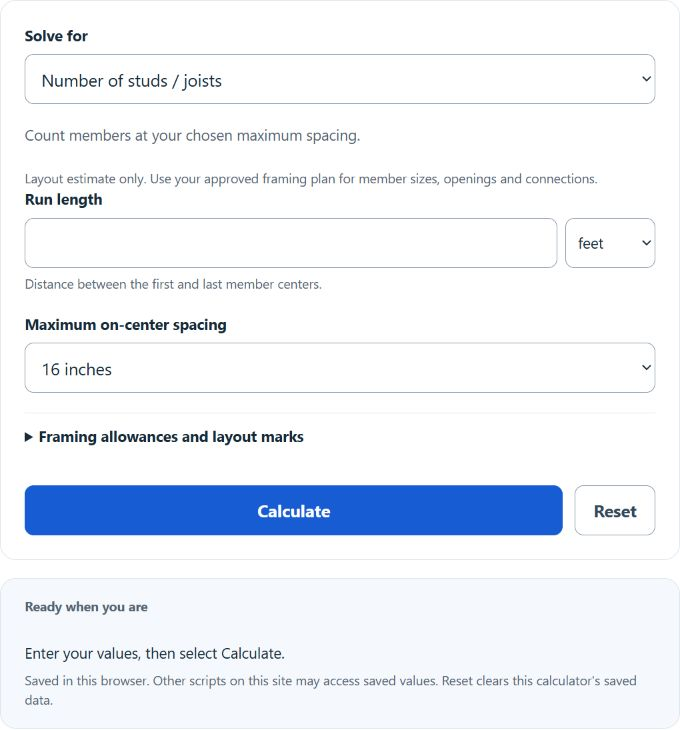
Calculate how many studs or joists you need at 16 inch on center spacing, with custom OC options, layout marks, and openings.
16 On Center Formula
When you solve for the number of framing members, the calculator uses:
N = ceil(L / OC) + 1
When you solve for the spacing that fits a set number of members across a run, it uses:
OC = L / (N - 1)
- N = number of studs or joists.
- L = idealized layout distance between the first and last member centers, in inches.
- OC = on-center spacing in inches (the distance from the center of one member to the center of the next).
- ceil = round up to the next whole number, because a partial bay still needs a full member.
The count formula divides the run by the spacing to find how many bays fit, then adds one member for the stud that starts the wall. The spacing formula works backward: with a fixed number of members, the gaps between centers equal the run divided by one less than the count. Optional inputs add planning allowances of two king studs per opening, two extra studs per corner, and one extra stud per intersection. The uninterrupted base grid is retained; allowances may overlap it and omit jack studs, cripples, headers and blocking. Final quantities depend on the approved framing plan.
Studs Needed at Common Spacings
These counts assume a straight run with no openings or corners. Round your own length up to the next whole stud the same way.
| Wall length | 12 in OC | 16 in OC | 24 in OC |
|---|---|---|---|
| 8 ft (96 in) | 9 | 7 | 5 |
| 10 ft (120 in) | 11 | 9 | 6 |
| 12 ft (144 in) | 13 | 10 | 7 |
| 16 ft (192 in) | 17 | 13 | 9 |
| 20 ft (240 in) | 21 | 16 | 11 |
| 24 ft (288 in) | 25 | 19 | 13 |
Where Each Spacing Is Used
| Spacing | Typical use |
|---|---|
| 12 in OC | Heavily loaded walls and floors, or where a stiffer finish is needed. |
| 16 in OC | The standard for load-bearing walls; lines up evenly with 48 in drywall and sheathing. |
| 19.2 in OC | Engineered floor joists; gives five bays per 8 ft sheet. |
| 24 in OC | Advanced framing and other applications where the approved design and code allow. |
Example Problems
Example 1. You frame a 12 ft wall at 16 in on center. Convert the length to inches: 12 x 12 = 144 in. Apply the formula: ceil(144 / 16) + 1 = ceil(9) + 1 = 9 + 1 = 10 studs.
Example 2. A 20 ft wall has 2 doors and 1 window (3 openings) and 2 corners. The straight run at 16 in OC is ceil(240 / 16) + 1 = 15 + 1 = 16 studs. Openings add 3 x 2 = 6 studs and corners add 2 x 2 = 4 studs, for a total of 16 + 6 + 4 = 26 studs.
Frequently Asked Questions
Does 16 on center measure to the edge or the center of the stud?
To the center. You measure 16 inches from the centerline of one stud to the centerline of the next. The displayed marks are idealized center positions from the starting member’s center. Physical plate layout requires the correct member-width offset; they are not stud-edge marks.
Why does the formula add one stud?
Dividing the length by the spacing counts the bays, or gaps, between studs. A run always has one more stud than it has bays because the wall starts and ends with a stud, so you add one to the bay count.
Does this work for floor joists and ceiling rafters?
Yes. The same spacing math applies to joists and rafters. Enter the layout distance between the first and last member centers and choose the on-center spacing your plan calls for. Remember the count covers only the repeating members, not headers, blocking, or rim joists.