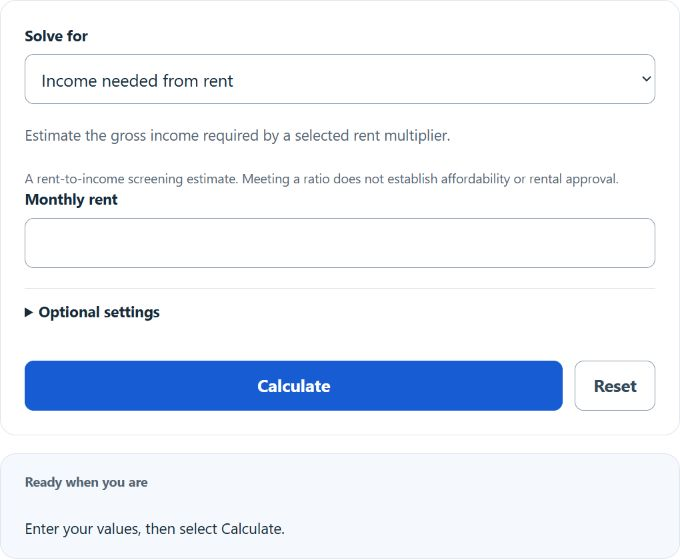
Calculate the annual income needed for a monthly rent amount using the 2.5x rent rule, or find the rent limit under that ratio from your income.
2.5 Times Rent Formula
The formula used to calculate the required annual income under the 2.5x rent standard:
Where Monthly Rent is the cost of rent per month in dollars. The multiplier of 2.5 represents the income-to-rent ratio, and 12 converts the monthly figure to an annual one. For example, $1,500/month rent requires $1,500 x 2.5 x 12 = $45,000/year in gross income.
What Is the 2.5 Times Rent Rule?
The 2.5 times rent rule is a tenant screening standard used by landlords and property managers. It requires a tenant's gross annual income to be at least 2.5 times the total annual rent. Under this rule, approximately 40% of a tenant's gross monthly income goes toward housing costs. This is a more lenient threshold than the widely used 3x rule, which caps rent at 33.3% of gross income.
Rental screening policies vary by property and program. Confirm the multiplier and accepted income with the property manager. A ratio alone does not determine approval or whether the rent fits your budget.
Income Requirement Reference Table
The table below shows the required gross monthly and annual income at various rent levels under the 2.5x rule.
| Monthly Rent | Required Monthly Income | Required Annual Income | Rent as % of Income |
|---|---|---|---|
| $800 | $2,000 | $24,000 | 40.0% |
| $1,000 | $2,500 | $30,000 | 40.0% |
| $1,250 | $3,125 | $37,500 | 40.0% |
| $1,500 | $3,750 | $45,000 | 40.0% |
| $1,750 | $4,375 | $52,500 | 40.0% |
| $2,000 | $5,000 | $60,000 | 40.0% |
| $2,500 | $6,250 | $75,000 | 40.0% |
| $3,000 | $7,500 | $90,000 | 40.0% |
| $3,500 | $8,750 | $105,000 | 40.0% |
| $4,000 | $10,000 | $120,000 | 40.0% |
2.5x Rule vs. 3x Rule vs. 30% Rule
Three income-to-rent standards are commonly used in the U.S. rental market. Each sets a different threshold for how much of a tenant's gross income should go toward rent. The table below compares all three using a $1,500/month rent example.
| Standard | Multiplier | Rent as % of Income | Required Annual Income ($1,500 Rent) |
|---|---|---|---|
| 2.5x Rule | 2.5 | 40.0% | $45,000 |
| 3x Rule | 3.0 | 33.3% | $54,000 |
| 30% Housing-Cost Comparison | 3.33 | 30.0% | $60,000 |
HUD housing-cost burden measures include utilities: costs exceeding 30% of income indicate a burden, and costs exceeding 50% indicate a severe burden. These statistical measures are separate from a property’s screening criteria. See HUD CHAS definitions.
Gross Income vs. Net Income
This calculator uses gross income before taxes and deductions. Confirm which income sources the property accepts. For your own budget, compare housing and other expenses with take-home pay, as described in the CFPB spending assessment.
For tenants, the practical impact is significant. A person earning $60,000 gross may take home only $45,000 to $50,000 after taxes. At a 2.5x requirement, they could qualify for $2,000/month rent, but that $2,000 would consume 48% to 53% of their actual take-home pay rather than the nominal 40%.
Rent Affordability by U.S. City
The figures below are illustrative rent scenarios, not verified current city medians or market forecasts. Multiply a monthly rent by 30 to estimate annual gross income under a 2.5x rule.
| City | Illustrative Monthly Rent | Required Annual Income (2.5x) |
|---|---|---|
| New York, NY | $4,320 | $129,600 |
| San Francisco, CA | $3,670 | $110,100 |
| Miami, FL | $2,600 | $78,000 |
| Chicago, IL | $1,900 | $57,000 |
| Dallas, TX | $1,400 | $42,000 |
| Austin, TX | $1,350 | $40,500 |
| Houston, TX | $1,250 | $37,500 |
Rent Burden in the U.S.
Housing cost-burden measures compare housing costs with income. Rent alone is 40% of gross income at a 2.5x ratio; utilities and other housing expenses can raise that share. National statistics depend on the survey year and definitions.
The share of take-home pay consumed by rent depends on actual deductions. Meeting the selected gross-income ratio does not guarantee room in your budget for food, transport, debt, savings or emergencies.
Options When You Don't Meet the Requirement
If you do not meet a property’s stated income requirement, ask about its written policy for guarantors, roommates and accepted income sources. Consider a lower rent or other housing options. Deposit limits and screening rules vary; do not assume paying a larger deposit guarantees approval.