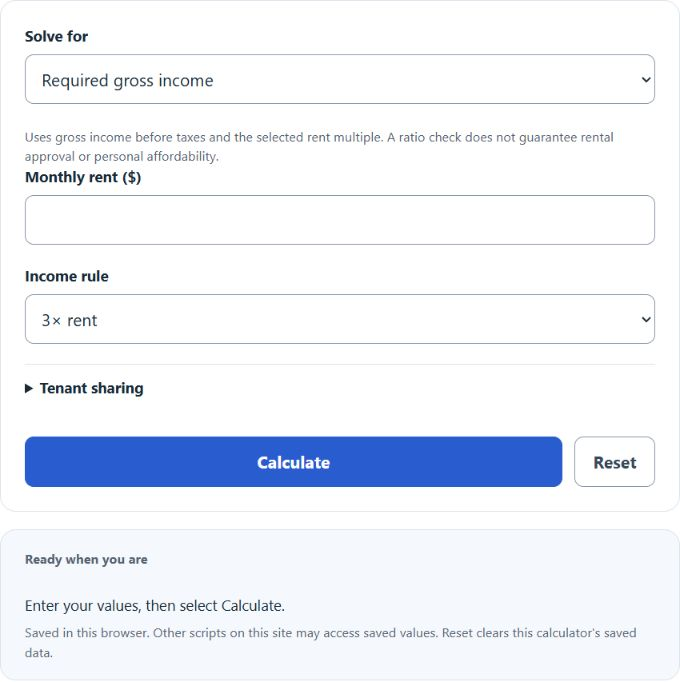
Calculate 3 times the rent: enter monthly rent to see the gross income you need, or enter your income to find the highest rent that fits the rule.
Calculator Functions
| Function | What it does | What it requires |
|---|---|---|
| Required gross income | Finds the gross monthly and annual income that a rent calls for under a 2.5×, 3×, 3.5× or 4× rule | Requires the monthly rent and an income rule. The number of tenants is optional |
| Rent limit from income | Finds the highest monthly rent that an income supports under the chosen rule | Requires gross income, whether it is monthly or annual, and an income rule |
| Check income rule | Tests whether an income meets the rule for a given rent and shows the shortfall or the headroom | Requires the monthly rent, gross income, its period and an income rule. A guarantor rule of 4×, 5× or 6× is optional |
Every function works in dollars and cents and uses gross income, which is income before taxes and deductions. The income rule starts at 3× rent. Minimum incomes are rounded up to the next cent and rent limits are rounded down, so a result never understates what the rule asks for.
3 Times Rent Formulas
| I | Gross monthly income the rule calls for ($) |
| M | Income rule: 3 by default, or 2.5, 3.5 or 4 |
| R | Monthly rent ($) |
An income standard of three times the rent is a screening policy that a housing provider sets for its own units [1]. It is not a law or a single national rule, which is why the multiple can be changed here. At 3×, rent takes up 33.3% of gross income. The Census Bureau counts a renter household as cost-burdened when housing costs pass 30% of income [2], so the 3× line sits close to that mark.
Required gross income
Share per tenant = I ÷ T
T is the number of tenants, and a blank entry counts as 1. For a $4,000 rent at 3×, the household needs $12,000 a month, which is $144,000 a year. Split evenly between 2 tenants, that is $6,000 a month each. The even split only applies where the landlord accepts combined income.
3 Times the Rent by Monthly Rent
Each row applies the 3× rule to a monthly rent. For a rent between two rows, multiply it by 3 for the monthly income and by 36 for the annual income.
| Monthly rent | Gross income per month | Gross income per year |
|---|---|---|
| $1,000 | $3,000 | $36,000 |
| $1,100 | $3,300 | $39,600 |
| $1,200 | $3,600 | $43,200 |
| $1,300 | $3,900 | $46,800 |
| $1,400 | $4,200 | $50,400 |
| $1,500 | $4,500 | $54,000 |
| $1,600 | $4,800 | $57,600 |
| $1,700 | $5,100 | $61,200 |
| $1,800 | $5,400 | $64,800 |
| $1,900 | $5,700 | $68,400 |
| $2,000 | $6,000 | $72,000 |
| $2,200 | $6,600 | $79,200 |
| $2,500 | $7,500 | $90,000 |
| $3,000 | $9,000 | $108,000 |
Rent limit from income
An annual income is divided by 12 first. A $60,000 salary is $5,000 a month, and $5,000 ÷ 3 gives a rent limit of $1,666.66 a month.
Check income rule
Here I is the income entered. With a $1,500 rent and $4,000 of monthly income, the 3× rule calls for $4,500, so the income falls $500 a month short and rent is 37.5% of income. When the income is short, the optional guarantor rule shows what a co-signer would need: at 5×, that is 5 × $1,500 = $7,500 a month, or $90,000 a year.
How to Calculate 3 Times the Rent
Multiply the monthly rent by 3. The answer is the gross monthly income needed, and multiplying it by 12 gives the yearly figure. To test an income instead, divide the gross monthly income by 3: any rent at or below that number passes. A $1,300 rent needs $3,900 a month, or $46,800 a year.
Limits of This Estimate
- Each landlord chooses the multiple, whether it is measured on gross or net income, and whether roommates can combine incomes. The listing or application states the rule that applies.
- Passing the ratio does not approve an application. Credit, rental history and other screening steps are separate, and the ratio says nothing about debts, utilities or other living costs.
- Where part of the rent is paid by a housing subsidy, the rule can change. In California, an income standard may only be applied to the share of rent the tenant pays, so a household paying $500 of a $2,500 rent can be asked for $1,500 a month, not $7,500 [1].
- The guarantor multiples are planning figures. Whether a guarantor is accepted, and at what income, is up to the landlord.
Sources
- California Civil Rights Department, Fair Housing and Source of Income (January 2024): a three-times-rent income standard as a housing provider policy, and its limit to the tenant-paid share of rent for voucher holders
- U.S. Census Bureau, Nearly Half of Renter Households Are Cost-Burdened (September 12, 2024): the 30% of income threshold for a cost-burdened renter household