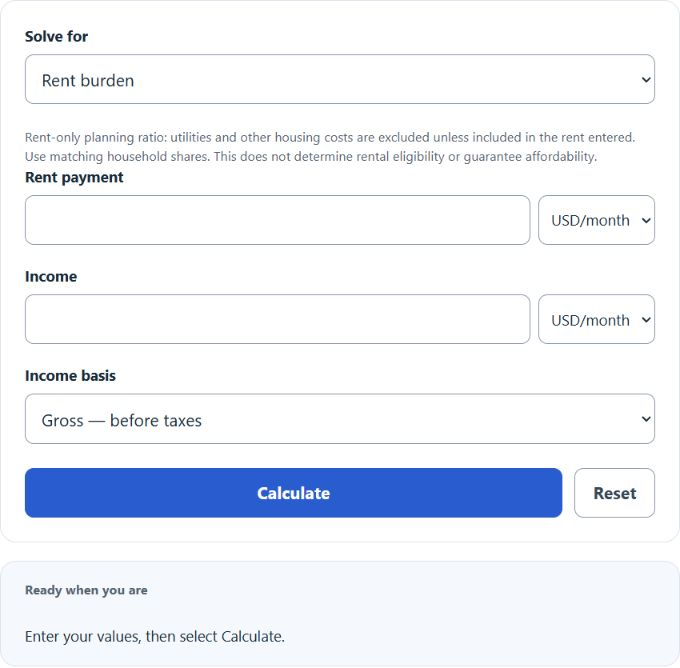
Choose rent burden, rent at a target percentage, or income at a target percentage. Enter the two known values; yearly amounts are converted to monthly amounts automatically.
Rent Burden Formula
Rent burden measures the share of monthly income used for rent. It is a simple affordability ratio that helps you estimate whether a housing payment fits comfortably within your budget.
- RB
- Rent burden as a percentage of monthly income
- R
- Monthly rent payment
- I
- Monthly income
A higher percentage means a larger portion of income is being committed to housing each month. The calculator can also be used in reverse to estimate either the rent amount or the income needed to hit a target burden.
Rearranged Forms
If you know your target burden and income, you can solve for the maximum rent. If you know rent and want to find the income required to support it, use the inverse formulas below.
How to Calculate Rent Burden
- Enter the monthly rent payment.
- Enter monthly income.
- Divide rent by income.
- Multiply by 100 to convert the result into a percentage.
If your income is annual, select USD/year and the calculator divides it by 12. If your income varies from month to month, using an average reliable monthly income usually gives a more realistic result.
Interpretation Guide
| Rent Burden | General Meaning |
|---|---|
| 30% or less | Often viewed as a more manageable housing-cost range |
| Over 30% through 50% | Commonly considered rent burdened |
| Over 50% | Commonly considered severely rent burdened |
These conventional housing-cost benchmarks use gross household income and housing costs including utilities; a base-rent-only or take-home-income ratio is not directly comparable. The percentage should not be the only affordability test. Debt payments, transportation costs, childcare, savings goals, medical expenses, and irregular income can all affect whether a rent payment is truly sustainable.
Planning Around a Target Percentage
Many renters use a target burden to decide what rent ceiling makes sense before they start searching. Let T represent your desired rent burden percentage.
- Use Rmax when you know your income and want to estimate a rent target at your chosen percentage.
- Use Imin when you know the rent and want to estimate the monthly income needed to support it.
Examples
Example 1: If rent is $1,200 and monthly income is $4,000, then the rent burden is 30%. That means 30 cents of every income dollar is going to rent.
Example 2: If rent is $1,850 and you want to stay at a 30% burden, the required monthly income is about $6,166.67.
Example 3: If monthly income is $5,500 and your target burden is 25%, the target maximum rent is $1,375.
What Counts as Rent?
For the most useful result, define your housing cost consistently before entering values. Some people use base rent only, while others include recurring required charges such as mandatory parking, pet rent, or other fixed monthly housing fees. Whatever approach you choose, keep it consistent when comparing apartments.
Gross Income vs. Net Income
The calculator works with either gross income or take-home income, but you should not mix them when comparing results. Using gross monthly income creates a broader affordability estimate. Using net income gives a stricter, cash-flow-based view of what you can realistically pay after taxes and deductions.
Roommates and Shared Housing
If you share housing, use your share of the rent and compare it to your share of the income. This produces a more accurate personal rent burden than using the full household rent against only one person’s income.
Practical Tips When Using This Calculator
- Choose USD/year for annual salary; the calculator divides it by 12.
- Use stable average income if your hours or commissions fluctuate.
- Compare several rent options using the same income basis.
- Test multiple targets such as 25%, 30%, and 35% to see how much flexibility you have.
- Remember that lower rent burden usually leaves more room for savings, emergencies, and non-housing expenses.
Why This Metric Matters
Rent burden is useful because it compresses a housing decision into a single percentage that is easy to compare across incomes and apartments. It can help with budgeting, apartment screening, relocation planning, and deciding whether an increase in rent is still workable within your monthly finances.