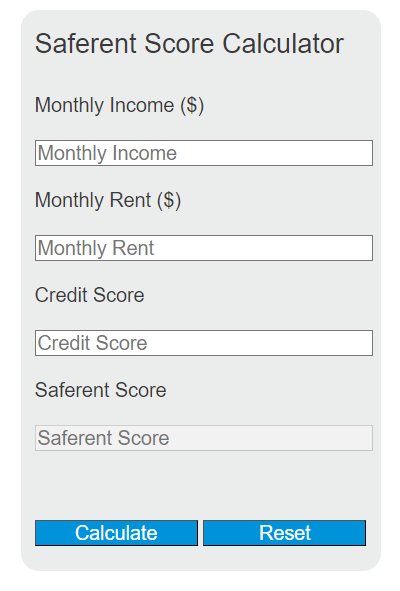
Calculate a Saferent-style score from monthly income, rent, and credit score, or find required income and maximum rent for a target score.
Safe Rent Score Formula
This calculator uses a simplified SafeRent-style estimate to combine two major rental application factors: affordability and credit strength. It is designed for budgeting and pre-screening only, not as an official score from a tenant-screening provider.
| Symbol | Meaning | Typical Unit |
|---|---|---|
| SS | Estimated safe rent score | Score value |
| I | Monthly income | Dollars per month |
| R | Monthly rent | Dollars per month |
| CS | Credit score | Usually on a 300 to 850 scale |
Under this model, the score increases when income rises, decreases when rent rises, and improves as the credit score gets closer to 850. Because the formula is multiplicative, affordability and credit both matter: strong income can be offset by weak credit, and strong credit can still be limited by high rent.
What the Calculator Can Solve
| Calculator Mode | What It Answers |
|---|---|
| Safe Rent Score | Given income, rent, and credit score, estimate the score. |
| Income Needed | Given rent, credit score, and a target score, estimate the monthly income required. |
| Max Rent | Given income, credit score, and a target score, estimate the highest rent that fits the target. |
Rearranged Formulas
The same relationship can be rearranged to solve for the other unknowns used by the calculator.
Required monthly income:
Maximum monthly rent:
How to Use the Calculator
- Enter your gross monthly income from stable, documentable sources.
- Enter the monthly rent for the unit you are evaluating.
- Enter your credit score.
- Select the result you want to estimate: score, income needed, or maximum rent.
- Compare multiple rent scenarios to find a payment level that fits your profile more comfortably.
How to Interpret the Result
This calculator is best used as a comparison tool. A higher result generally means the rent is easier to support relative to income and credit. A lower result usually means one or both of the following are creating pressure on the application profile:
- the rent consumes too much of monthly income, or
- the credit score reduces the strength of the affordability picture.
Since different landlords and property managers apply different approval rules, the most useful approach is to compare several units, several target scores, or several rent levels rather than treating one exact number as a universal pass-or-fail cutoff.
How Each Input Changes the Score
| Change | Effect on Score | Why |
|---|---|---|
| Income increases | Score increases | More income covers the same rent more easily. |
| Rent increases | Score decreases | The income-to-rent ratio becomes smaller. |
| Credit score increases | Score increases | The credit multiplier moves closer to its maximum value. |
| Credit score decreases | Score decreases | The formula applies a smaller credit factor to the same affordability ratio. |
Example Calculation
If monthly income is $4,800, monthly rent is $1,600, and credit score is 720, the estimated score is:
That result reflects a 3 times income-to-rent relationship, adjusted by the credit score factor. If the rent increases while income and credit stay the same, the score falls. If credit improves while income and rent stay the same, the score rises.
For reference, a 3 times rent ratio with a 700 credit score produces:
When This Calculator Is Most Useful
- Comparing two or more apartments before applying
- Estimating how much income is needed for a target rent
- Checking whether a planned rent increase still fits your income profile
- Testing how much a credit-score improvement could change your estimate
- Setting a practical rent ceiling before starting a housing search
Ways to Improve Your Estimated Safe Rent Score
- Lower the target rent. Even a modest reduction can materially improve the income-to-rent ratio.
- Increase verifiable income. Bonuses, side income, commissions, or co-applicant income only help if they can actually be documented and accepted.
- Improve credit. Paying on time, lowering revolving balances, and correcting reporting errors can raise the credit component of the formula.
- Test multiple scenarios. A unit that is only slightly cheaper may fit much better when the score is recalculated.
Important Limitations
- This is a simplified estimate, not an official SafeRent or proprietary tenant-screening score.
- Real screening models may also evaluate payment history, debt, collections, eviction records, identity verification, background checks, occupancy rules, and application documentation.
- Some properties use fixed income multiples, minimum credit thresholds, guarantor rules, or manual review standards that are not captured here.
- A higher estimated score may indicate a stronger application profile, but it does not guarantee approval.
Common Questions
Should I use gross income or net income?
Gross monthly income is usually the best starting point for rental qualification comparisons. If you want a stricter personal budget test, run the calculator again using take-home pay.
Does this score replace a landlord’s approval criteria?
No. It is most useful as a planning shortcut before you submit an application.
What if my credit score model does not use 850 as the maximum?
This calculator normalizes credit against 850, so the result should be treated as an estimate when a different credit scale is used.
Can I use combined household income?
You can if the property will evaluate combined income from all applicants. If only one applicant’s income will be counted, use that amount instead.