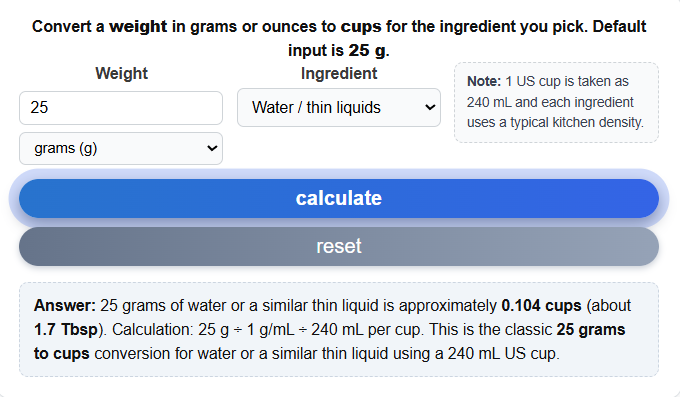
This page focuses on “How many cups is 25 grams?” and shows that the result depends heavily on which ingredient you are measuring. Roughly 25 g of water is about 0.10 cups, 25 g of granulated sugar comes out near 0.12 cups, and 25 g of all-purpose flour is around 0.18 cups. The interactive 25 grams to cups calculator above lets you pick an ingredient and enter any weight so you can line up with recipe instructions, nutrition panels, or food logs.
How the 25 grams to cups calculation works
Turning grams (g) into cups means converting a mass into a volume. To do that correctly you need the ingredient’s density (how many grams fit in 1 mL) together with the size of a cup. On this page we assume a US measuring cup of 240 mL.
The calculator follows this general method:
- mL = grams ÷ density (g/mL)
- cups = mL ÷ 240 (for a 240 mL US cup)
For water-like liquids the density is close to 1 g/mL, so 240 mL is roughly 240 g and 25 g works out to just over a tenth of a cup. Lighter ingredients such as flour and cocoa have lower densities, so 25 g will occupy more cup volume. Very dense ingredients like table salt, honey, and tightly packed brown sugar are heavier for the same volume and therefore use fewer cups per 25 grams.
The values shown are based on common kitchen reference densities and assume level, not heaped, cups. Brand, grind, and how you fill the cup (scooping versus spooning and levelling) can all shift the real-world amounts slightly, so treat them as practical approximations rather than laboratory measurements.
Exact 25 grams to cups values for common ingredients
The table below uses those typical densities and a 240 mL US cup. It shows about how many cups you need for 25 g and 50 g of each ingredient, plus how many grams are in a full 1 cup.
| Ingredient | Approx. density (g/mL) | 25 g (cups) | 50 g (cups) | 1 cup (g) |
|---|---|---|---|---|
| Water | ≈ 1.00 | ≈ 0.10 | ≈ 0.21 | ≈ 240 g |
| Milk (whole) | ≈ 1.04 | ≈ 0.10 | ≈ 0.20 | ≈ 249.6 g |
| Granulated sugar | ≈ 0.85 | ≈ 0.12 | ≈ 0.25 | ≈ 204 g |
| Brown sugar (packed) | ≈ 0.89 | ≈ 0.12 | ≈ 0.23 | ≈ 213.6 g |
| All-purpose flour | ≈ 0.57 | ≈ 0.18 | ≈ 0.37 | ≈ 136.8 g |
| Cocoa powder (unsweetened) | ≈ 0.53 | ≈ 0.20 | ≈ 0.39 | ≈ 127.2 g |
| Butter | ≈ 0.96 | ≈ 0.11 | ≈ 0.22 | ≈ 230.4 g |
| Vegetable oil | ≈ 0.92 | ≈ 0.11 | ≈ 0.23 | ≈ 220.8 g |
| Olive oil | ≈ 0.91 | ≈ 0.11 | ≈ 0.23 | ≈ 218.4 g |
| Table salt | ≈ 1.20 | ≈ 0.09 | ≈ 0.17 | ≈ 288 g |
| Honey | ≈ 1.42 | ≈ 0.07 | ≈ 0.15 | ≈ 340.8 g |
| Peanut butter | ≈ 0.94 | ≈ 0.11 | ≈ 0.22 | ≈ 225.6 g |
For day-to-day cooking and baking, these figures are usually close enough to swap between grams and cups when you do not have a scale handy. For very precise recipes, weighing ingredients is still best, and you can treat these numbers as starting points for refining your own preferred kitchen conversions.
When to convert 25 grams to cups (and when to stay in grams)
Volume units like cups are familiar and quick to use, but they are sensitive to how you fill the cup. Converting 25 grams to cups is especially useful in situations such as:
- You have a recipe written in grams but only have cup measures available in your kitchen.
- You are scaling a recipe that calls for “25 g of X” and want to eyeball that amount using cups.
- You are tracking food where the app expects cups, but the package lists nutrition values per 100 g or per 25 g.
For strict baking or detailed macro tracking, sticking with grams is usually more accurate. Use this page when you need a quick, ingredient-aware estimate of how many cups correspond to 25 grams or any other weight you type into the calculator.
Related conversions:
- 40 grams to cups
- 75 grams to cups
- 160 grams to cups
- 170 grams to cups
- 180 grams to cups
- 350 grams to cups
- 600 grams to cups
- 100 grams to cups
- 200 grams to cups
- 150 grams to cups
- 50 grams to cups
- 250 grams to cups
- 300 grams to cups
- 500 grams to cups
- 400 grams to cups
- 120 grams to cups
- 60 grams to cups
Most popular conversions:
- 100 grams to cups
- 200 grams to cups
- 150 grams to cups
- 50 grams to cups
- 250 grams to cups
- 300 grams to cups
- 500 grams to cups
- 400 grams to cups
- 120 grams to cups
- 60 grams to cups