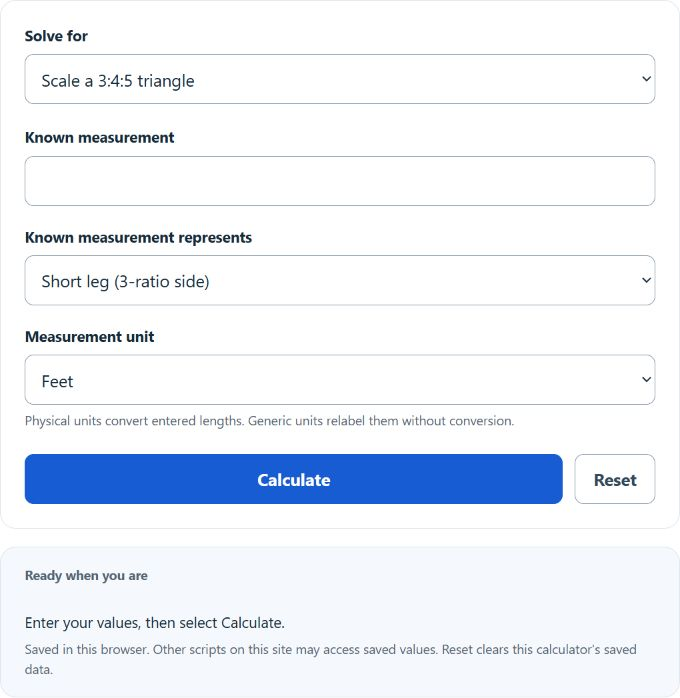
How do I use this calculator?
Choose a task: scale a 3:4:5 triangle, find the diagonal for a right angle, or verify a measured corner.
Calculator Operations:
- For a scaled triangle, enter one known measurement and identify its ratio side.
- For a required diagonal, enter Run A and Run B.
- To verify a corner, enter both runs and their measured diagonal; adjust the optional diagonal-error tolerance if needed.
The verification task reports the angle from all three measured lengths using the law of cosines. Use the same measurement unit for all lengths.
Use the calculate button when all known values have been entered and use the reset button when you want to clear the values from the calculator.
Scale a 3:4:5 triangle, calculate the exact diagonal for two runs, or verify a measured corner with angle, diagonal error, tolerance, and common units.
3 4 5 Rule Formula
The following formula is used to calculate the length of the sides in a right-angled triangle using the 3 4 5 rule.
Variables:
- a is the length of one side (units)
- b is the length of the other side (units)
- c is the length of the hypotenuse (units)
To calculate the length of the sides using the 3 4 5 rule, square the length of one side (a), square the length of the other side (b), and add these two values together. The result should be equal to the square of the length of the hypotenuse (c). If the lengths of the sides are in the ratio 3:4:5, a right angle is formed between sides a and b.
What is a 3 4 5 Rule?
The 3 4 5 rule is a mathematical principle used in construction and carpentry to create right angles. It is based on the Pythagorean theorem, which states that in a right-angled triangle, the square of the hypotenuse (the side opposite the right angle) is equal to the sum of the squares of the other two sides. By measuring 3 units along one side, 4 units along the other, and ensuring the diagonal between these two points measures 5 units, you form a right angle.
How to Calculate 3 4 5 Rule?
The following steps outline how to use the 3 4 5 Rule to calculate the length of the hypotenuse in a right triangle.
- First, determine the lengths of the two sides of the right triangle (a and b) in the given units.
- Next, measure the diagonal between the ends of the two runs. A 3:4 run ratio alone does not establish a right angle.
- A 3:4:5 triangle is right-angled only when all three measured lengths match that ratio.
- Finally, use the formula a² + b² = c² to calculate the length of the hypotenuse (c).
Example Problem:
Use the following variables as an example problem to test your knowledge.
a = 3 units
b = 4 units
For runs of 3 and 4 units, a right angle requires the diagonal between their ends to measure 5 units.
Now, we can use the formula a² + b² = c² to calculate the length of the hypotenuse (c).
Substituting the given values:
3² + 4² = c²
9 + 16 = c²
25 = c²
Taking the square root of both sides:
c = 5 units
Therefore, the length of the hypotenuse (c) in the right triangle is 5 units.