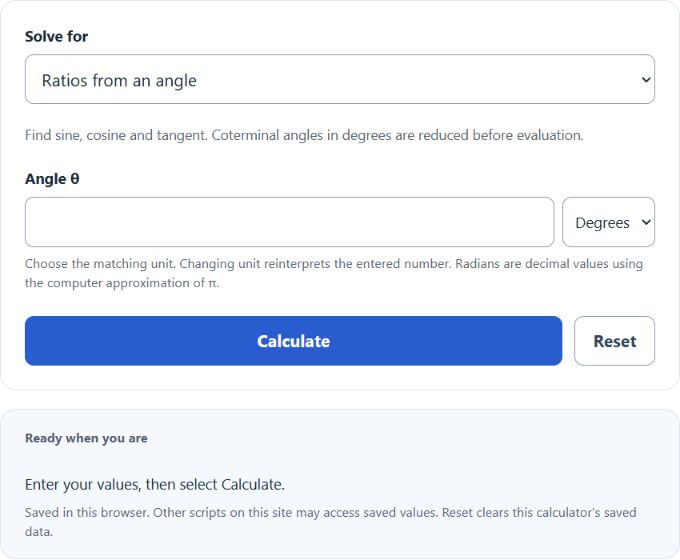
Calculate sin, cos, and tan from an angle in degrees or radians, or from two right-triangle sides and find the missing side of a right triangle.
Trigonometric Ratios for a Right Triangle
For angle a, the side labels are always relative to that angle: the opposite side is across from the angle, the adjacent side touches the angle, and the hypotenuse is the longest side opposite the right angle. Choose the known pair and enter two positive side lengths in the same unit to find the third side, acute angle, sine, cosine, tangent, and secant.
Core Formulas
| Ratio | Mnemonic | What it compares | Best use |
|---|---|---|---|
| Sine | SOH | Opposite to hypotenuse | When you know or need the side across from angle a |
| Cosine | CAH | Adjacent to hypotenuse | When you know or need the side next to angle a |
| Tangent | TOA | Opposite to adjacent | When comparing vertical change to horizontal change |
Finding the Missing Side
| Known sides | Formula | Notes |
|---|---|---|
| Opposite and adjacent | H = √(O² + A²) |
Use this when both legs are known and you need the hypotenuse. |
| Opposite and hypotenuse | A = √(H² - O²) |
Use this when the side across from angle a and the hypotenuse are known. |
| Adjacent and hypotenuse | O = √(H² - A²) |
Use this when the side next to angle a and the hypotenuse are known. |
Finding the Angle from a Ratio
If you already know the side ratio, inverse trig functions return angle a.
Useful Checks
| Check | What it means |
|---|---|
| Hypotenuse is largest | The hypotenuse must be longer than both the opposite and adjacent sides. |
| Same input unit | All side lengths should use the same unit before calculating ratios. |
| Ratios are unitless | Because one length is divided by another, the units cancel out. |
| Side labels depend on angle a | Changing the reference angle changes which side is opposite and adjacent. |
Quick Reference Values
The values below assume the listed opposite and adjacent sides are measured relative to angle a.
| Opposite (O) | Adjacent (A) | Hypotenuse (H) | sin(a) | cos(a) | tan(a) |
|---|---|---|---|---|---|
| 3 | 4 | 5 | 0.6000 | 0.8000 | 0.7500 |
| 5 | 12 | 13 | 0.3846 | 0.9231 | 0.4167 |
| 8 | 15 | 17 | 0.4706 | 0.8824 | 0.5333 |
| 1 | 1 | 1.4142 | 0.7071 | 0.7071 | 1.0000 |
Angle, Secant, and Inverse-Secant Modes
Choose degrees or decimal radians for angle input. Changing the unit reinterprets the entered number. The general angle mode accepts coterminal angles. Secant mode uses 0° through 180°, excluding 90°, and calculates 1/cos(θ). Inverse secant uses arccos(1/x) for real |x| ≥ 1, with principal range [0°,90°) or (90°,180°]. A rounded display near 90° is not an exact pole.
Exact degree quarter-turns are handled explicitly. Nearby finite values are not replaced by undefined results. The side solver uses stable hypotenuse and factored missing-leg calculations. Results display up to ten decimal places or scientific notation; extreme unresolved side scales are rejected. Editing preserves the previous answer with an Inputs changed warning until Calculate runs again. Reset empties this calculator and clears its saved data.
Common Mistakes
- Using side labels from the wrong reference angle.
- Entering side lengths in mixed units without converting first.
- Choosing a value for the hypotenuse that is not the longest side.
- Confusing tangent with sine or cosine; tangent compares only the two legs.