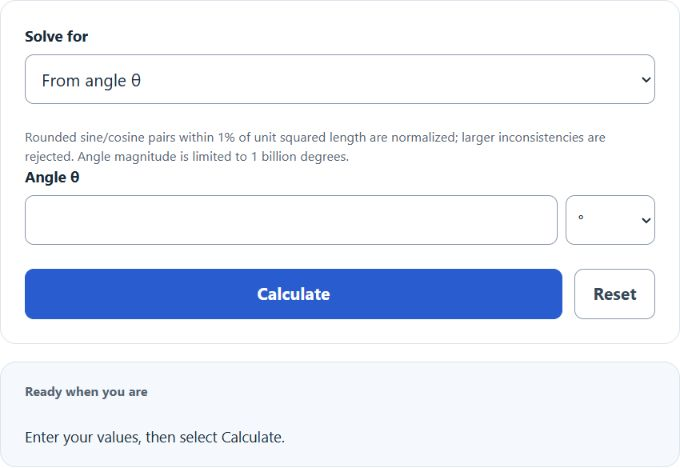
Calculate sin(2θ) from an angle in degrees or radians, or from sin θ and cos θ, including quadrant-based values and step-by-step work.
- Inverse Sine Calculator
- Inverse Tan Calculator
- Arcsin Calculator (Radians or Degrees)
- All Math and Numbers Calculators
Sin 2 Theta Formula
The calculator uses one of two equivalent forms depending on what you enter.
When you enter the angle directly, it computes:
When you enter sin θ with a quadrant, it recovers cos θ from the Pythagorean identity:
- θ — the input angle, in degrees or radians
- sin θ — sine of θ, between −1 and 1
- cos θ — cosine of θ, between −1 and 1
- sin(2θ) — the result, always between −1 and 1
The sign of cos θ is set by the quadrant: positive in Q I and Q IV, negative in Q II and Q III. Rounded sine/cosine pairs are accepted only when sin²θ + cos²θ is within 0.01 of 1. The pair is normalized to unit length before applying the identity, with an approximation notice; larger inconsistencies are rejected.
Common Values and Sign Reference
Exact values of sin(2θ) at standard angles:
| θ | 2θ | sin(2θ) |
|---|---|---|
| 0° | 0° | 0 |
| 15° | 30° | 1/2 |
| 30° | 60° | √3/2 ≈ 0.8660 |
| 45° | 90° | 1 |
| 60° | 120° | √3/2 ≈ 0.8660 |
| 75° | 150° | 1/2 |
| 90° | 180° | 0 |
| 135° | 270° | −1 |
Sign of sin(2θ) by the quadrant of θ:
| Quadrant of θ | sin θ | cos θ | sin(2θ) |
|---|---|---|---|
| I | + | + | + |
| II | + | − | − |
| III | − | − | + |
| IV | − | + | − |
Worked Example
Given sin θ = 3/5 and θ in Quadrant II, find sin(2θ).
- cos θ = ±√(1 − 9/25) = ±4/5. In Q II, cos θ is negative, so cos θ = −4/5.
- sin(2θ) = 2 · (3/5) · (−4/5) = −24/25 = −0.96.
FAQ
Is sin(2θ) the same as 2·sin(θ)? No. sin(2θ) = 2·sin(θ)·cos(θ). They coincide when sin θ = 0, that is, at every integer multiple of π (180°).
What is the maximum value? sin(2θ) reaches 1 when 2θ = 90° + 360°k, so θ = 45°, 225°, and so on.
Does the calculator accept negative angles? Yes. Enter positive or negative angles in degrees or radians, up to a magnitude of 1 billion degrees (about 17.45 million radians). sin(2θ) is an odd function, so sin(−2θ) = −sin(2θ).
Why does it warn when sin²θ + cos²θ ≠ 1? Those two inputs must come from the same angle. Rounded inputs within the stated tolerance are normalized to represent an approximate angle. Pairs outside that tolerance are rejected.