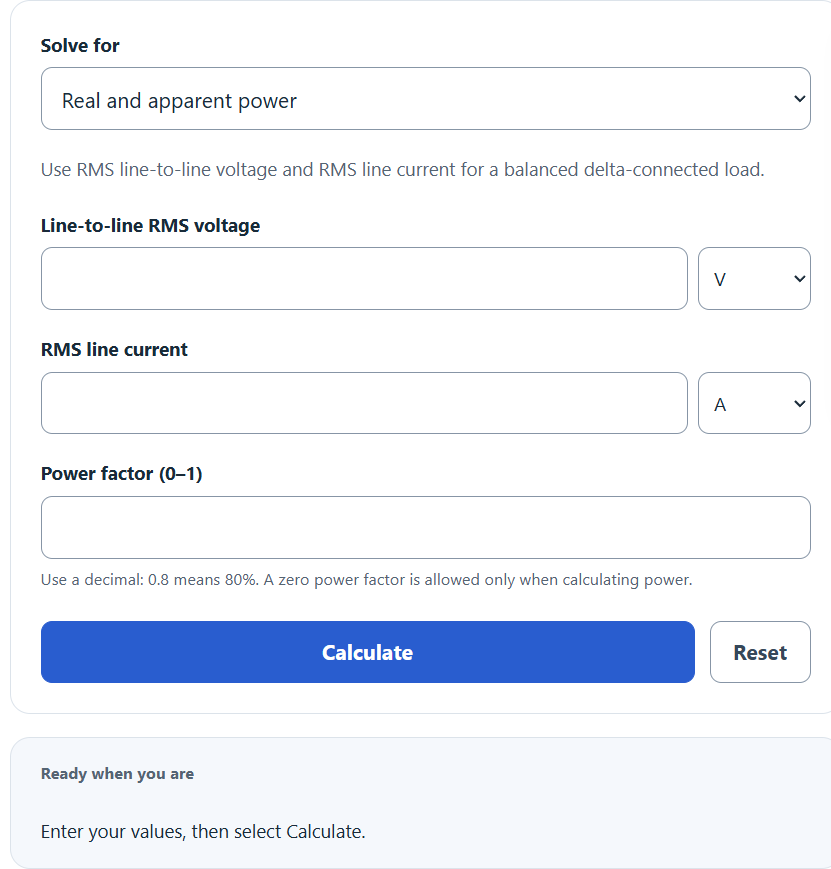
Calculate three-phase delta connection values including line current, phase current, line voltage, real power, and apparent power.
- All Physics Calculators
- 3 Phase Fault Current Calculator
- 3 Phase Horsepower Calculator
- 3 Phase Motor Capacitor Calculator
3 Phase Delta Formula
The following equation is used to calculate the power in a 3-phase delta system.
- Where P is total real power (W), and PF is power factor from 0 to 1
- V is the RMS line-to-line voltage (V)
- I is the RMS line current (A)
Choose what to solve for and enter the shown known values. Apparent power is S = √3 × V × I in VA. In balanced delta, phase voltage equals line voltage and phase current equals line current divided by √3.
What is a 3 Phase Delta Calculator?
Definition:
A 3 Phase Delta Calculator is a tool that computes the missing electrical parameter in a 3-phase delta system by applying the standard formula relating power, voltage, and current.
How to Calculate 3 Phase Delta Values?
Example Problem:
The following example outlines the steps and information needed to calculate the missing electrical parameter using the 3 phase delta formula.
First, choose real and apparent power as the calculation.
Next, use 400 V line-to-line voltage, 10 A line current, and power factor 1 for this balanced example.
Finally, calculate the missing power using the formula above:
P = √3 × 400 × 10
P = √3 × 4000
P ≈ 6928.2032 W
FAQ
What does the 3 Phase Delta Calculator compute?
It calculates the missing electrical parameter (line voltage, line current, or power) in a 3-phase delta system based on the provided values and the formula.
Can this calculator be used for both delta and wye systems?
The balanced line-voltage/line-current power formulas also apply to wye. However, the phase-current relationship shown here is specific to delta; do not use it for wye phase values.
What precautions should I take when using the calculator?
Choose the desired result under Solve for and enter the known values shown. Inverse power calculations require positive power factor and a nonzero denominator. The model assumes balanced sinusoidal values.