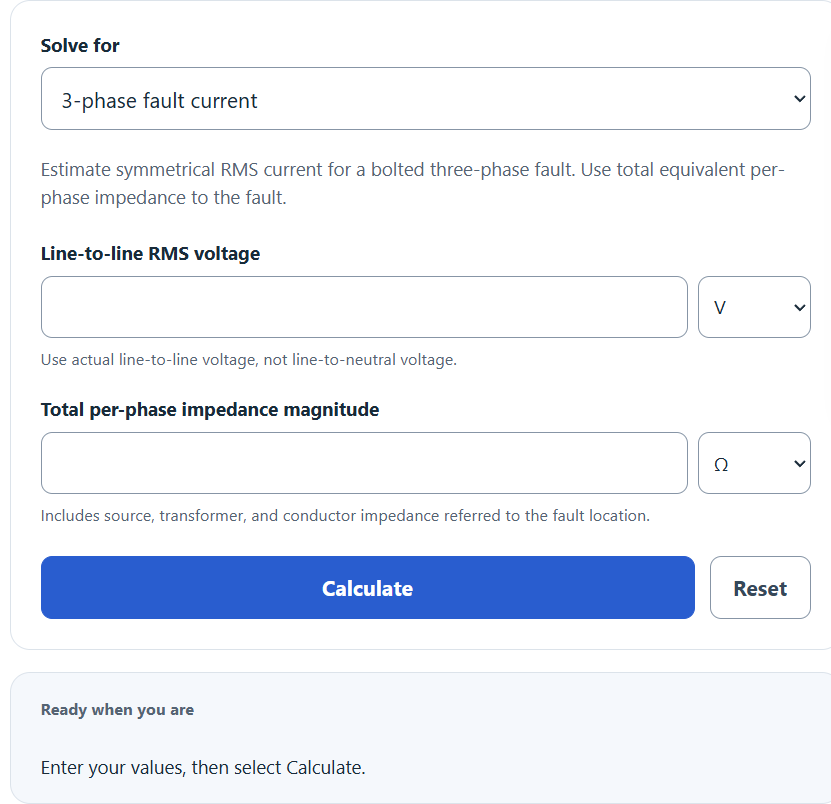
Choose fault current, voltage, total equivalent impedance, or short-circuit MVA for the stated single-phase or balanced three-phase model. Use the voltage and impedance basis shown for that mode.
- All Physics Calculators
- 3 Phase Horsepower Calculator
- 3 Phase Motor Capacitor Calculator
- 3 Phase Ohms Law Calculator
3 Phase Fault Current Formula
The following equation is used to calculate the 3 Phase Fault Current.
- Where I_fault is the fault current (A)
- V_line is the RMS line-to-line voltage (V)
- Z_fault is the total equivalent upstream per-phase impedance magnitude (Ω), including source, transformer, and conductors referred to the fault location
To calculate the 3 Phase Fault Current, divide the line-to-line voltage by √3 times the total equivalent per-phase impedance. The result is symmetrical RMS current for a balanced bolted fault, using voltage factor 1. For a single-phase loop use I = V / Z_loop; for a supplied three-phase short-circuit level use I = MVA × 1,000,000 / (√3 × V_line).
What is a 3 Phase Fault Current?
Definition:
3 Phase Fault Current refers to the current that flows during a fault in a three-phase electrical system and is critical for designing protective schemes and ensuring electrical safety.
How to Calculate 3 Phase Fault Current?
Example Problem:
The following example outlines the steps and information needed to calculate the 3 Phase Fault Current.
First, determine the line voltage. In this example, assume a line voltage of 480 V.
Next, determine the total equivalent per-phase impedance to the fault. This example assumes 2 Ω, including the upstream network rather than just the fault itself.
Finally, calculate the fault current using the formula above:
I_fault = V_line / (√3 * Z_fault)
I_fault = 480 / (√3 * 2)
I_fault ≈ 480 / 3.464
I_fault ≈ 138.6 A
FAQ
What factors can affect the 3 Phase Fault Current?
The 3 Phase Fault Current can be influenced by system impedance, transformer characteristics, network configuration, and the nature of the fault. Conductor sizes, cable lengths, and impedance limiting devices can also affect the current level.
How can I reduce fault current levels in my electrical system?
Reducing fault current levels can be achieved by adding impedance to the circuit, using protective devices that limit current, and ensuring proper sizing of system components. Regular maintenance and network analysis also contribute to managing fault currents effectively.
Why is it important to calculate fault current?
Calculating fault current is crucial for designing safe electrical systems and selecting appropriate protective devices. A complete study informs equipment and protection selection. This simplified calculator alone cannot establish a safe rating: it excludes DC offset, peak duty, protection clearing time, and arc-flash energy.