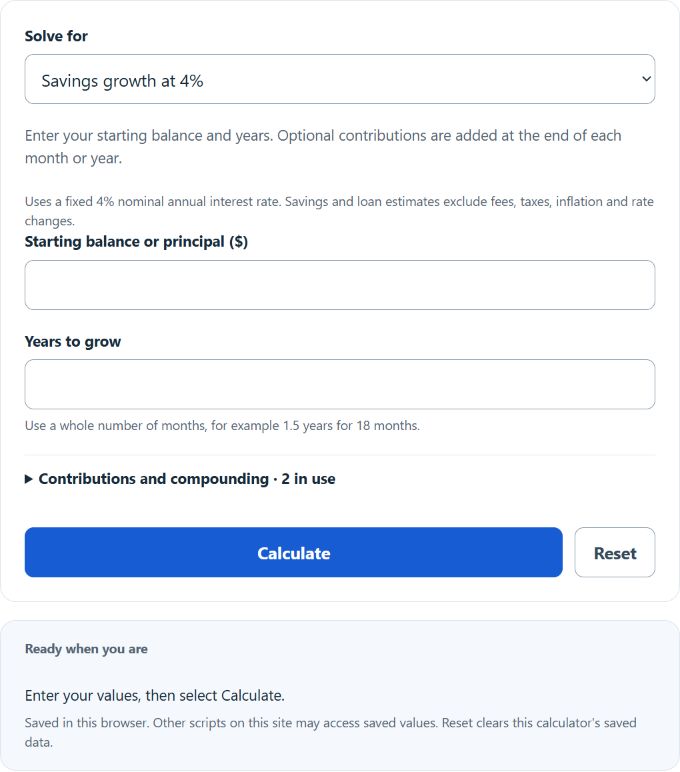
Calculate savings at a 4% interest rate using starting balance, regular contributions, years, and compounding to see balance and interest.
4 Percent Interest Rate Formula
The following compound-growth equation applies to a starting principal with no additional deposits at a fixed 4% nominal annual rate.
- Where A is the final amount ($)
- P is the principal ($)
- 0.04 is the annual interest rate (4%)
- n is the compounding periods per year
- t is the total number of years
To calculate the accumulated amount at a 4 percent interest rate, multiply the principal by (1 + 0.04/n) raised to the power of the product of n and t.
What is a 4 Percent Interest Rate?
Definition:
This calculator assumes a fixed 4% nominal annual interest rate. With annual compounding, a balance grows by 4% over a full year. More frequent compounding produces a higher effective annual yield; monthly compounding gives about 4.0742%. This assumption is not a promised account or investment return.
How to Calculate 4 Percent Interest Rate?
Example Problem:
The following example outlines the steps and information needed to calculate the growth at a 4 percent interest rate.
First, determine the principal. In this example, the initial investment is $1,000.
Next, determine the compounding frequency and time period. In this example, the investment compounds annually (n=1) over 5 years (t=5).
Finally, calculate the final amount using the formula above:
A = P ( 1 + 0.04 / n )^( n * t )
A = 1,000 ( 1 + 0.04 / 1 )^( 1 * 5 )
A = 1,000 ( 1 + 0.04 )^5
A = 1,000 ( 1.04 )^5 ≈ $1,216.65
Contribution, simple-interest and loan models
For savings, an equivalent monthly rate of (1 + 0.04/n)^(n/12) − 1 grows the balance before each scheduled deposit. Monthly deposits occur at each month end; annual deposits occur at months 12, 24 and so on. The calculator uses exact whole months and rejects fractional months rather than silently rounding them. Exponential interpolation between compounding dates is a modeling assumption; actual account crediting rules may differ.
Simple interest is I = P × 0.04 × years; the total is P + I. The daily illustration divides annual interest by 365. For loans, monthly payment M = P × r ÷ [1 − (1+r)^(−N)], where r = 0.04/12 and N is the whole number of monthly payments. Payment totals use unrounded internal payments.
For example, $25,000 over 5 years gives a monthly payment of about $460.41 and total interest of $2,624.78 before lender rounding. See the CFPB explanation of interest rate and APR and Investor.gov compound-interest calculator.
FAQ
How often is interest typically compounded at a 4 percent rate?
Interest can be compounded monthly, quarterly, semi-annually, or annually at a 4 percent rate. The frequency of compounding affects how quickly the principal grows.
Is a 4 percent interest rate good for an investment?
A stated return alone does not establish safety or suitability. Compare risk, fees, taxes, inflation, liquidity and your circumstances. The projection assumes an unchanging rate and does not predict investment performance.
Can I apply a 4 percent interest rate to a loan?
The loan mode estimates equal monthly principal-and-interest payments using a 4% nominal annual interest rate divided by 12. APR can include applicable fees and differs from the interest rate. The estimate excludes fees, taxes, insurance and lender-specific payment rounding.