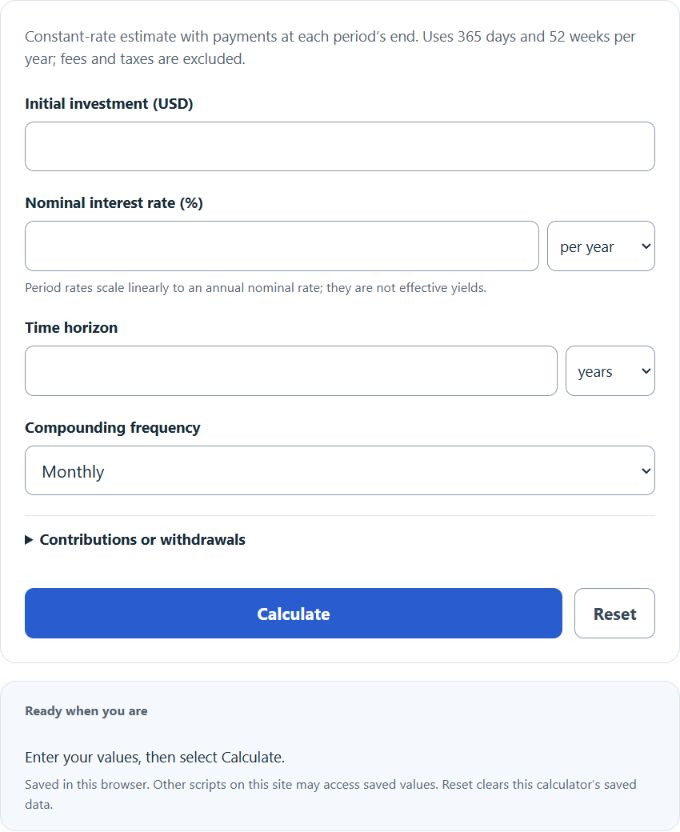
Calculate a constant-rate future balance from an initial investment, nominal interest rate, time horizon and compounding frequency. Optionally include equal contributions or withdrawals at each selected payment period’s end.
Compound Interest Plus Contributions Formula
The following ordinary-annuity equation applies when contributions match compounding and the horizon contains a whole number of periods. For other schedules, the calculator sums growth from the exact payment dates using the same exponential interpolation model.
- Where FV is the future value of the investment ($)
- P is the initial principal ($)
- r is the annual nominal interest rate (decimal), not an effective annual yield
- n is the number of compounding periods per year
- t is the total number of years
- C is the contribution amount each compounding period ($)
Sum the initial principal’s growth and each end-of-period contribution’s growth. With g = n×ln(1+r/n), payment frequency f and N = floor(t×f), FV = P×exp(g×t) + C×Σ exp[g×(t−k/f)] for k = 1,…,N. At zero rate, FV = P + C×N. No payment is added for an unfinished final period. Uses 365 days and 52 weeks per year.
What Is Compound Interest Plus Contributions?
Definition:
Compound Interest Plus Contributions refers to the accumulation of an initial principal that grows with compound interest, along with additional periodic contributions that also earn interest over time.
How to Calculate Compound Interest Plus Contributions?
Example Problem:
The following example outlines the steps and information needed to calculate the Compound Interest Plus Contributions.
First, determine the initial principal. In this example, our initial investment is $5,000.
Next, determine the annual interest rate, compounding periods, and time frame. Let’s assume a 5% annual rate (0.05 in decimal form), compounded monthly (n = 12), over 10 years (t = 10).
Then, decide on the contributions made each compounding period. Let’s say $100 is added monthly (C = $100).
Finally, calculate the future value by plugging these values into the formula above:
FV = 5000 (1 + 0.05/12)^(12×10) + 100 [((1 + 0.05/12)^(12×10) - 1) / (0.05/12)]
This gives approximately $23,763.28 after 10 years, including $17,000 deposited and $6,763.28 of modeled growth, before fees and taxes.
FAQ
Why is compounding so powerful for long-term investments?
Compounding allows your earnings to generate additional earnings over time. As both the initial principal and the reinvested interest grow, the overall balance increases at an accelerating rate, making compounding especially powerful over longer periods.
Can I adjust my contribution amounts over time?
You can select a payment frequency, but each calculation uses one constant payment amount. Negative payments model regular withdrawals; the calculator does not enforce account withdrawal limits. Varying payments requires a separate cash-flow model. Changing payment frequency reinterprets the entered amount per payment.
Does the compounding frequency significantly change the outcome?
For the same positive nominal annual rate and cash-flow dates, more frequent compounding increases modeled growth. Rate-period choices scale the entered nominal rate linearly to annual terms: 0.5% per month means 6% nominal per year. Growth between posting dates is interpolated; actual account timing, rounding, rates and charges can differ.
How long should I keep investing to maximize benefits?
Generally, the longer you keep your money invested, the more you can benefit from compound growth. Even modest contributions, when invested early, can accumulate significantly over extended periods due to compounding. Your individual goals and timeline will determine how long you should continue contributing.