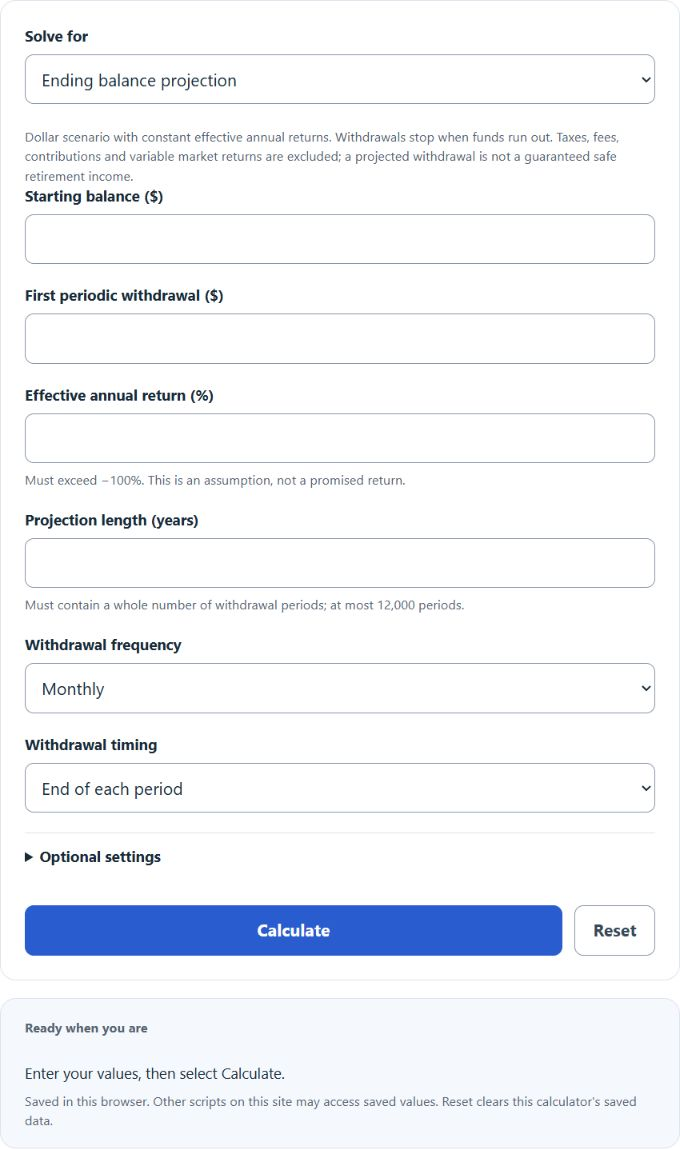
Project an account with compound returns and growing withdrawals, solve for a sustainable withdrawal or starting balance, and compare a stress-return scenario.
Compound Withdrawal Formula
For constant withdrawals at the end of each period, before any account depletion, the following equation gives the ending balance. Here r is the effective return per withdrawal period. When r = 0, use Bf = B0 − W × t. Beginning-of-period withdrawals multiply the withdrawal term by (1 + r). The calculator also supports growing withdrawals using the period-by-period recurrence.
- Where Bf is the final balance
- B0 is the initial balance
- r is the effective return per withdrawal period (decimal): (1 + annual effective return)^(1/frequency) − 1
- W is the withdrawal amount each compounding period
- t is the number of compounding periods
To calculate a compound withdrawal, you first compute the compound growth on the balance, then subtract the sum of withdrawals adjusted for compound growth.
What is a Compound Withdrawal?
Definition:
A compound withdrawal scenario looks at how an account grows through compound interest while also accounting for periodic withdrawals. These withdrawals reduce the principal on which future interest is calculated, but the account may still grow if interest exceeds withdrawals.
How to Calculate Compound Withdrawal?
Example Problem:
The following example outlines the steps and information needed to calculate the Compound Withdrawal.
First, determine the initial balance. In this example, the initial balance is $10,000.
Next, determine the interest rate and number of compounding periods. Here, the interest rate is 5% annually, compounded once per year, for 10 years, so t = 10.
Next, determine the withdrawal amount. In this case, $500 is withdrawn at the end of each year.
Finally, calculate the final balance after 10 years using the formula above:
Bf = 10000 * (1 + 0.05)^10 – 500 * ((1 + 0.05)^10 – 1) / 0.05
Bf = 10000 * (1.05)^10 – 500 * (1.628894626777441 – 1) / 0.05
Bf = 10000 * 1.628894626777441 – 500 * 0.628894626777441 / 0.05
Bf ≈ 16288.946 – 500 * 12.57789253554882
Bf ≈ 16288.946 – 6289
Bf ≈ $10000
FAQ
How often are withdrawals taken in a compound withdrawal scenario?
The frequency of withdrawals can vary (monthly, annually, etc.), and will affect how the balance grows and declines over time. Commonly, withdrawals might be taken annually in retirement accounts, but they can be taken any number of times per year depending on the account.
Can additional contributions be made while withdrawals are occurring?
An account may accept contributions, but this calculator does not include contributions. Use a cash-flow model with both deposits and withdrawals if those apply.
How can I ensure my account balance lasts as long as possible?
Lower withdrawals may extend an account’s life, but actual outcomes depend on returns, their timing, taxes, fees and spending needs. A constant-return projection does not model market uncertainty or guarantee a safe withdrawal amount. See the SEC’s Managing Lifetime Income resource for broader retirement-income considerations.